Hack squat
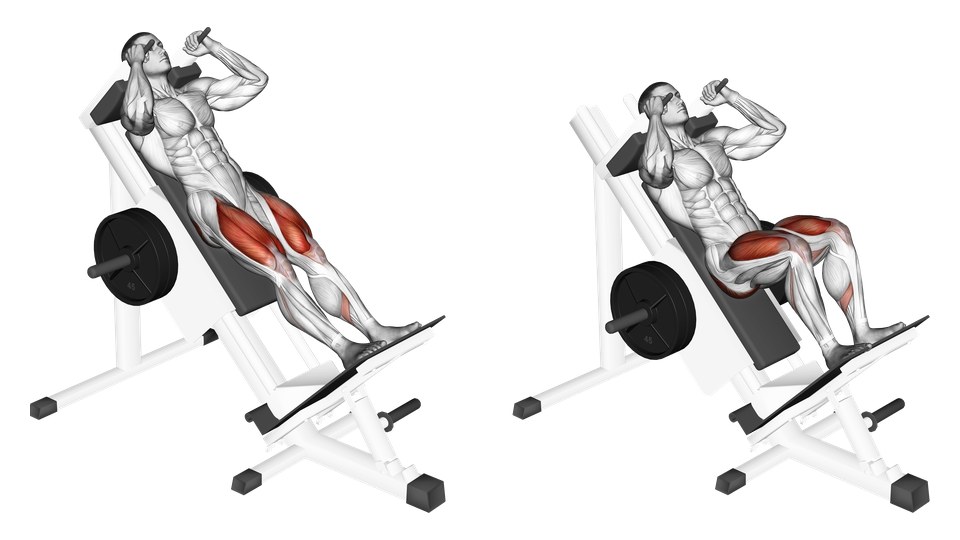
The hack squat is a machine squat performed with the back supported and the shoulders under a moving sled.
- Equipment in the guide
- hack squat machine
Choose the hack squat when you want a squat with back support and a guided sled. Choose the barbell back squat when you want to train the free-weight lift itself. Both involve the knees and hips, but the support and balance demands differ. Neither is a universal winner.
The hack squat is a machine squat performed with the back supported and the shoulders under a moving sled.
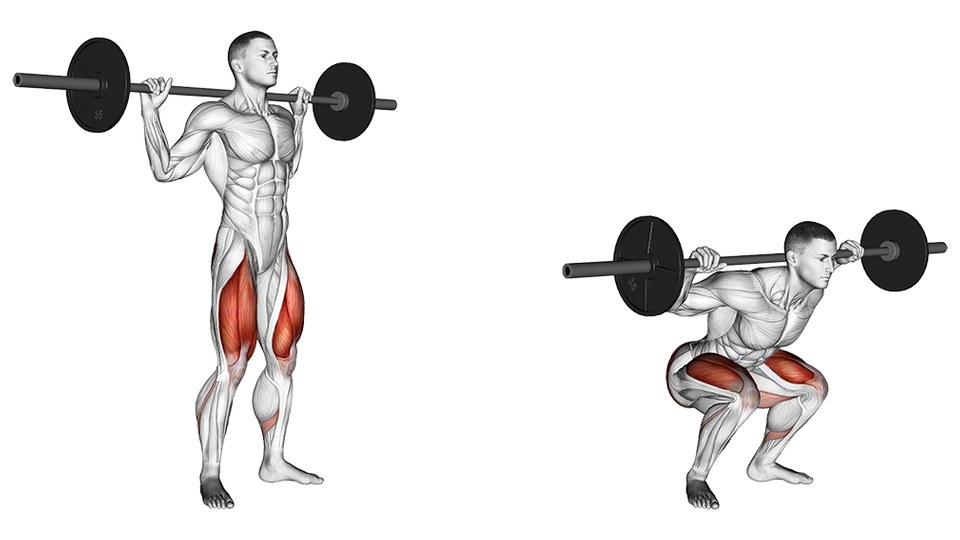
A barbell back squat is a bilateral squat performed with a barbell resting across the upper back.
| The main differences | Hack squat | Barbell back squat |
|---|---|---|
| Support | Your back rests against a pad beneath shoulder pads. | You support the bar across your upper back without a back pad. |
| Load path | A sled follows the machine's rails. | You balance a free bar over your base of support. |
| Range of motion | Use the range the machine allows while your feet and pelvis stay supported. | Depth depends on the squat you can control with your chosen stance and bar position. |
| Setup to repeat | Record the machine, foot position and safety-stop setting. | Keep bar position, stance and depth consistent. |
| Strength goal | Progress the same hack-squat setup. | Practise and progress the barbell squat itself. |
| Weight comparison | Sled mass, angle and machine design affect the resistance. | Barbell load is a separate history; there is no dependable conversion from the sled. |
You want supported leg work and have a machine that fits your movement. It can fill a squat slot or provide additional leg work after a free-weight lift.
You want to improve your barbell squat or prefer a free-weight movement. You support the bar and control its path, using a rack and appropriate safeties.
The highlights locate muscles involved in each exercise. They do not measure effort, muscle growth or how closely the exercises match.
Schematic surface view. Some muscles are partly visible or not shown.
The quadriceps are the main target; the gluteus maximus and adductor magnus assist hip extension on the sled.
Schematic surface view. Some muscles are partly visible or not shown.
Grouped by what the training evidence measured, not ranked: the MRI trial this page leans on tested each muscle group against its own baseline and never compared one against another, so no ordering is claimed here. The hamstrings are under secondary because they were measured and did not grow, but they stay on the list because they do work during the lift, as hip extensors. Rectus femoris is there for a different reason: one trial measured no growth and a second did find it, so that one is unsettled rather than settled either way. The trunk extensors and the calves are absent because neither trial measured them, which is not the same as ruling them out.
Both exercises ask you to bend and straighten the knees and hips. On a sled hack squat, the back pad supports your torso and the rails determine the sled's path. In a back squat, your legs move the load while you brace your torso and keep a free bar balanced over your feet.
That changes what you have to manage during a hard set. The hack squat lets you concentrate on moving against the platform while keeping contact with the pads. The back squat also asks you to keep the bar and your body organised through the descent and ascent. You still need to learn the setup for either version.
In a small acute study of ten men, trunk muscle activation was greater in the back squat for most measured comparisons, even though the hack-squat loads were heavier. This supports the distinction in trunk demands. It does not establish an injury-risk or long-term leg-growth advantage.
The quadriceps straighten the knees in both exercises. The gluteus maximus and adductor magnus help extend the hips. The hack squat provides a supported way to train that knee-and-hip movement; the back squat combines the leg work with supporting and balancing the bar.
The guide for the hack squat lists the quadriceps as its main target. The back-squat guide describes a broader set of muscles producing and supporting the lift. Those lists explain roles, so a longer list or a different highlight on the map should not be read as a muscle-growth score. For a leg-training slot, consider the version you can set up, control and progress consistently.
On the hack squat, place your feet so you can descend while keeping the whole foot on the platform and your pelvis against the back pad. Check the safety stops before loading the sled. The machine fixes the load path, so test how its platform and pads fit your movement rather than copying another person's foot position.
In a barbell back squat, your stance and bar position are part of how you balance the lift. Keep the bar over your base of support and use the depth you can control. Treat the two exercises as separate setups: the same apparent depth in an illustration does not make the machine and free-bar positions identical.
If increasing your barbell back squat is the goal, keep practising that lift. A stronger hack squat does not tell you how much you can back squat. If your goal is supported leg work, the hack squat can fill that role without making bar balance the task you are practising.
A 2023 systematic review found that strength changes were partly specific to the equipment used in training and testing. Its five studies measuring hypertrophy did not show an overall machine-versus-free-weight advantage, but they used varied measurements and exercises. That broader finding does not settle every hack-squat versus back-squat program.
For general leg training, choose around equipment access, a repeatable setup and the movement you want to spend time doing. For a particular strength test, include practice of the lift that will actually be tested.
On a day built around improving your back squat, you could do the barbell lift first and use a hack squat later for additional supported leg work. Another option is to make one lower-body day barbell-focused and use the hack squat on the other. These are ways to organise the lifts, rather than a requirement to perform both.
If you are replacing a squat exercise in an existing plan, start by deciding what that slot is for. General leg work can often be organised around either movement. A slot specifically intended to practise the back squat needs that practice. Count the leg work already in the plan before adding another squat exercise.
When the machine is busy or unavailable, switching to a back squat also introduces a rack setup, an unrack and a free-bar movement. Make that a deliberate exercise choice and warm up for it, rather than carrying your sled load straight across.
Find a working load with warm-up sets for the exercise you are about to do. Do not copy a percentage of your barbell squat onto the hack-squat sled. Two hack-squat machines can also differ, even when you load the same plates.
Log each exercise under its own name. For hack squats, note the machine and foot position; for back squats, keep your bar position and depth consistent. Compare your next session with the same setup, rather than treating the larger number as the better exercise.
They can fill a general squat or leg-training slot when their support suits the session. They do not replace practising a barbell squat when improving that specific lift is your goal.
The sources here do not establish a universal winner. Machine-versus-free-weight research is broader than this exact pair, and an acute muscle-activation result does not measure long-term growth.
There is no dependable conversion. The sled, machine angle, range of motion and support change the task. Establish and track a working load for each exercise separately.
Put the lift you most want to practise or progress first. A back-squat-focused session can start with the barbell and use the hack squat later. A session built around the machine can prioritise that instead.
The glutes still help extend the hips in a hack squat. The back support changes the task, while the knees and hips still bend and straighten. The muscle maps describe roles rather than measuring which exercise will grow a muscle more.
Acute comparison in ten men at four relative loads. The abstract was checked; it measures trunk activation, not long-term leg growth or injury outcomes.
Full text checked. Systematic review and meta-analysis with five studies measuring hypertrophy using varied methods. Its broad equipment comparison does not establish identical outcomes for this exact exercise pair.