
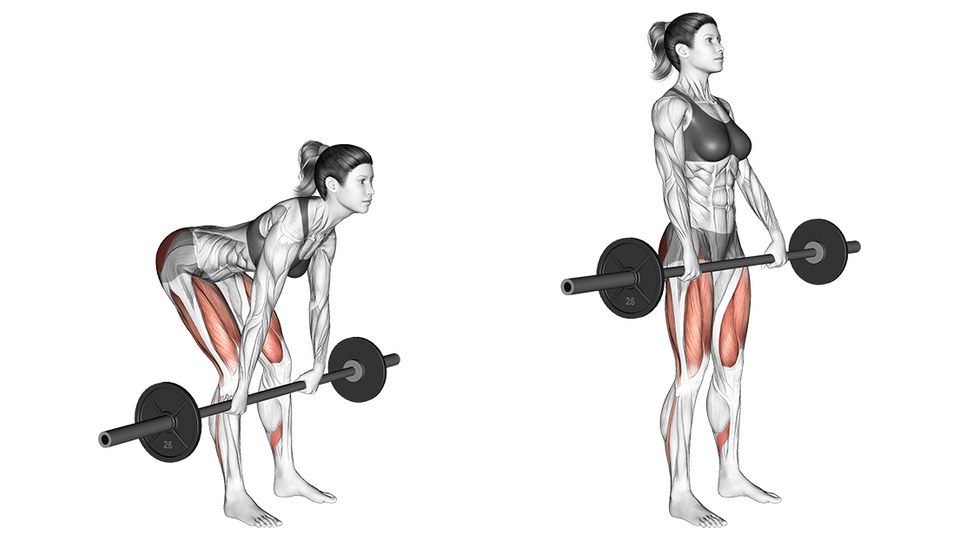
Romanian deadlift
The Romanian deadlift is a hip hinge.
- Equipment in the guide
- barbell
An RDL starts standing and lowers the bar through a hip hinge, with a small knee bend and no floor reset between reps. A conventional deadlift starts on the floor and uses both knee and hip extension to stand. Choose around the movement you want to train, rather than treating the names as interchangeable.
The Romanian deadlift is a hip hinge.
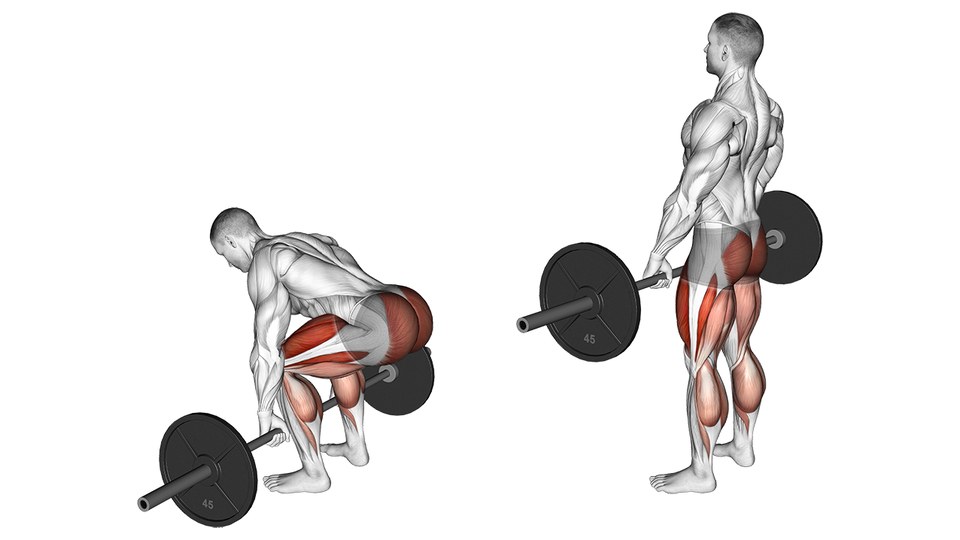
The conventional deadlift is a barbell lift from the floor: you stand with a roughly hip-width stance behind the bar, take it with both hands just outside your legs, and stand up.
| The main differences | Romanian deadlift | Conventional deadlift |
|---|---|---|
| Start of each repetition | Standing, with the bar held near the thighs. | The bar rests on the floor before the pull. |
| Knee movement | A small bend stays fairly consistent through the hinge. | The knees and hips extend together as you stand. |
| Bottom position | Set by your controlled hinge range, without needing to touch the floor. | Set by the bar's position on the floor and your lifting setup. |
| Main task | Lower and raise the held bar through a hip hinge. | Break a stationary load from the floor and stand with it. |
| What to keep consistent | Knee bend, lowering range, grip and whether straps are used. | Bar height, stance, grip and the floor reset. |
| Tracking | Keep a separate RDL history with consistent range. | Keep a separate conventional-deadlift history with consistent setup. |
You want repeated hip-hinge work with a controlled lowering phase. Stop the descent where you can keep the movement controlled; the floor is not the target.
You want to practise lifting a stationary bar from the floor, including improving the conventional deadlift itself. Build each repetition from that starting position.
The highlights locate muscles involved in each exercise. They do not measure effort, muscle growth or how closely the exercises match.
Schematic surface view. Some muscles are partly visible or not shown.
The gluteus maximus and the hamstrings that cross the hip extend it. Neither the anatomy nor the research summarized here establishes a glutes-versus-hamstrings growth ranking. The short head of the biceps femoris crosses the knee but not the hip, so it cannot directly extend the hip. The hamstring portion of the adductor magnus is a hip extensor too.
Schematic surface view. Some muscles are partly visible or not shown.
Split by role, not by size of contribution. The primary list is the muscles whose named actions are the lift: hip extension (gluteus maximus, the hamstrings, and the ischiocondylar part of the adductor magnus, which runs from the ischial tuberosity like a hamstring and extends the thigh like one), knee extension (quadriceps femoris), and holding the spine where you put it (erector spinae and multifidus, which work isometrically here — they are loaded hard while changing length very little). The secondary list is what carries the bar and the trunk without producing the movement. Anatomy establishes actions and attachments; it does not rank how much each muscle contributes to a deadlift, and the limited comparisons in the evidence section do not provide a complete ranking either. Quadratus lumborum is left off deliberately: its own anatomy chapter reports cadaver forces of roughly 200 N against about 1800 N for erector spinae and 2800 N for multifidus in the lumbar spine, and concludes it "does not appear to be a significant lumbar stabilizer".
The conventional deadlift asks you to organise the pull around a stationary bar. An RDL begins with the bar already held at the top. You send the hips back to lower it, then reverse the hinge without trying to reach a standard floor height.
You may lift the bar from the floor to get into position for your first RDL. That does not make every subsequent repetition a conventional deadlift. What matters is the movement you repeat and the range you can control.
The hamstrings and gluteus maximus help extend the hips in both exercises, and the trunk muscles help hold position. The conventional deadlift also includes a substantial knee-extension task as you push the floor away and stand. In the RDL, the small knee bend stays fairly consistent while the hips move back and forward.
That makes the RDL a useful way to organise repeated hip-hinge work with a controlled lowering phase. The conventional lift adds the task of building the pull from the floor. Seeing the hamstrings in both maps tells you they are involved; it does not make the two movements identical.
An acute study of 21 experienced men found different muscle activity and joint torques between the lifts. Both conditions used the same load based on RDL strength, and both required floor contact. That differs from the standing RDL taught here, so the study cannot establish which version produces more muscle growth over months.
In the RDL, unlock the knees slightly, keep the bar close and send the hips back. Reverse the movement at the end of the hinge you can control. Lowering the bar farther by bending the knees more or rounding the back changes how you reach that position; touching the floor is not the goal.
The conventional deadlift starts from the bar's height on the floor. You arrange your hips and knees around that start, take the slack out of the bar, then stand with the load. Letting the plates settle and resetting makes the next repetition another pull from a stationary bar. A raised starting position or a bouncing reset is a different standard to track.
Choose an RDL when the session calls for direct hip-hinge work and you want to repeat the lowering and lifting movement without resetting on the floor. Keep the knee bend and lower position consistent so the load is progressing through the same exercise.
Choose the conventional deadlift when the task is to lift a stationary bar from the floor, particularly when improving that lift is the goal. Practise the start, the coordinated knee-and-hip extension and the reset. Extra RDL practice can sit alongside that work, but it does not practise breaking a bar from the floor.
Look at what the exercise slot is meant to achieve. If a plan calls for a general hip hinge, either lift may be an option once you account for the different setup and movement. If it calls for conventional-deadlift practice, switching to RDLs changes that purpose. If it specifically calls for a controlled standing hinge, switching to floor pulls changes it too.
Warm up for the movement you choose and find its own working load for the planned repetitions. Keep the rest of the session in view: swapping the exercise and then adding the original lift back in as an extra can leave you with more hinge work than you intended.
One option is to prioritise conventional deadlifts in one session and use RDLs as the hinge in another. In a session containing both, put the lift you most want to practise first and account for the work already done before adding the second. These are programming examples, rather than a trial-tested ideal schedule.
Use each lift's movement standard to judge the set. An RDL that gets progressively shallower is changing as the load rises. A conventional deadlift whose starting position or reset changes is also harder to compare with the previous session. Keeping those standards steady makes it easier to decide whether both exercises are contributing useful work.
There is no reliable rule that your RDL should be a fixed percentage of your conventional deadlift. Start with warm-up sets and choose a load you can control for the intended repetitions. Keep the RDL range consistent rather than lifting more by shortening each repetition.
Record the exercises separately. Notes about grip, straps, range and the floor reset make the numbers easier to interpret next time. If your exercise list combines RDLs with another deadlift variation, create a distinct exercise name rather than mixing two movements into one history.
They can provide hip-hinge work, but they change the starting position and knee movement. Keep conventional deadlift practice if improving that specific lift is the goal.
It does not need to. For the standing RDL described here, reverse the descent at the end of your controlled hinge range. Floor contact is not the target.
You can, but you do not have to. Put the priority lift first and consider how much hinge work the session already includes. Separate days are another option.
No. It describes electrical activity under the study's particular conditions. Long-term muscle growth is a different outcome, and differences in load, technique and range limit how far a laboratory result applies.
Both involve the hamstrings in hip extension. The RDL repeats a standing hip hinge with a fairly constant knee bend; the conventional lift starts on the floor with more knee movement. That mechanical distinction does not establish a universal hamstring-growth winner.
Full text checked. Twenty-one experienced men used 70% of RDL 1RM for both lifts, with floor contact requested in both conditions. This acute protocol does not measure long-term growth.