
Romanian deadlift
Also called RDL, barbell Romanian deadlift.
What is a Romanian deadlift?
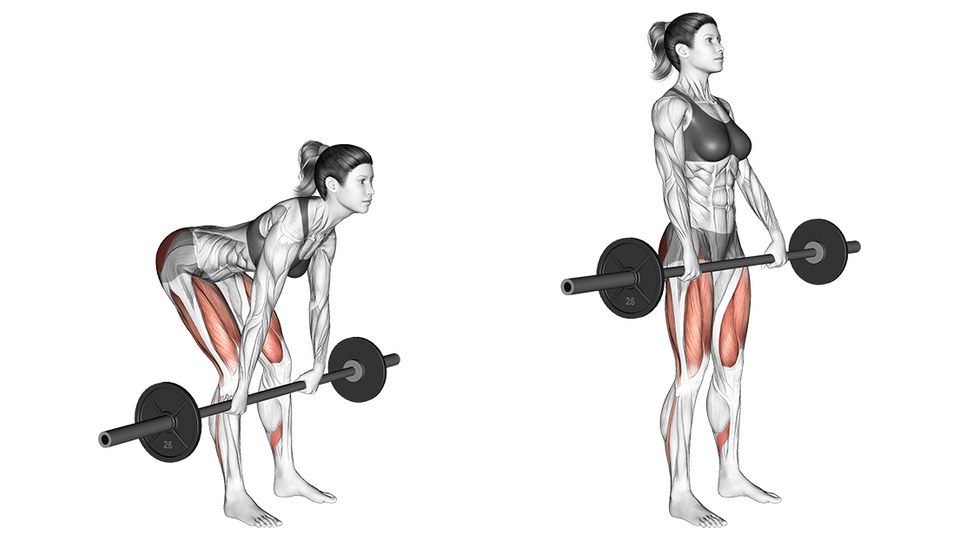
The Romanian deadlift is a hip hinge. You start standing with a barbell against your thighs, push your hips back until your hamstrings stop you somewhere around knee height, and drive the hips forward to stand up again. The knees stay softly bent at the angle you set at the start, and the bar does not return to the floor between reps. The hamstrings and gluteus maximus extend the hip; the muscles along the spine hold your back flat while your trunk tips forward. It is a relative of the stiff-legged deadlift rather than another name for it: that one starts from the floor, with a straighter knee, and resets there every rep.
How do you perform a Romanian deadlift?
Set up
- Set the bar in a rack around mid-thigh, or deadlift it safely from the floor, and stand with it against your thighs.
- Grip the bar just outside your hips and stand with your feet about hip-width apart.
- Unlock your knees slightly, brace your torso, and keep your spine neutral.
Execution
- Push your hips back and hinge forward, keeping your torso braced and your soft knee bend unchanged.
- Keep the bar close to your legs as it moves down.
- Stop when your hamstrings limit the hinge, usually between knee and mid-shin height, before your back starts to round.
- Reverse under control and drive your hips forward to stand tall without leaning back; keep the bar off the floor between reps.
Common mistakes
Bending the knees on the way down, so it turns into a squat
As the knees travel forward, the hips travel less far back and the movement becomes more squat-like. The bar still goes down, but you lose the consistent knee angle that makes this a Romanian deadlift.
Letting the bar drift away from the legs
Every inch the bar moves forward lengthens the lever between it and your hips, so the demand on your lower back climbs while the hip gets no extra work. It also pulls your weight onto your toes, which is where people lose the position at the bottom.
Chasing depth by rounding the lower back
When the hamstrings run out of length, more range can only come from the spine. The bar keeps going and it feels like a deeper rep, but the extra range is bought entirely from the lower back rather than added to the hamstrings.
Leaning back at the top
Hip extension is finished once you are standing upright. Going past that arches the lower back under load and adds nothing at the hip. If you feel the top of a rep in your lower back, this is usually why.
Loading it off your conventional deadlift
A pull from the floor is limited by what you can break off the ground; a Romanian deadlift is limited by what your hamstrings tolerate at length, and that is a lower number. A deadlift-sized weight tends to reappear as bent knees and a rounded back within a couple of reps.
Where it fits in a session
Lower-body work, after the main squat or pull and before machine leg work.
It is a compound movement trained at long muscle lengths, so it earns its keep with a load you can control at the bottom rather than a heavy one. Sets of six to twelve are the usual home for it. Grip often gives out before the hamstrings do on the higher rep sets, which is a reason to use straps rather than a reason to cut the set short.
Muscles worked
- hamstrings (biceps femoris long head, semitendinosus, semimembranosus)
- gluteus maximus
- erector spinae
- adductor magnus
- forearm flexors (grip)
The gluteus maximus and the hamstrings that cross the hip extend it, and the anatomy does not rank them against each other for this movement. Ranking would need EMG or a training comparison, which this page does not report. Two details are worth knowing: the short head of the biceps femoris attaches to the femur rather than the pelvis, so it crosses the knee but not the hip and contributes nothing to the hinge, and the hamstring portion of the adductor magnus is a hip extensor too.
What lifters actually do
About a quarter of regular RepCount users have logged a Romanian deadlift, and it turns up in roughly one workout in forty. What it sits beside says what lifters use it for: the five exercises that most often share a session with it are all lower body, led by squats in 43.5% of them, then leg extensions, leg curls, calf raises and leg presses. It is leg-day work rather than part of a deadlift session — a little over three sets, in a session of about six exercises.
Most often trained alongside
Share of Romanian deadlift sessions that also include each exercise.
- Squat43.5%
- Leg extension42.8%
- Leg curl35.4%
- Calf raise29.7%
- Leg press26.9%
Figures come from workouts tracked in RepCount.
Variations
- Dumbbell Romanian deadlift — A dumbbell in each hand, passing either side of the legs rather than in front of them.
- Single-leg Romanian deadlift — One leg at a time with the free leg trailing behind. Usually limited by balance long before the hamstrings.
- Stiff-legged deadlift — The close relative, not a second name for this one: it starts from the floor with a straighter knee and returns the bar there every rep.
- B-stance Romanian deadlift — Back foot on its toes a few inches behind, taking most of the load on the front leg without the balance demand of a true single-leg version.
- Snatch-grip Romanian deadlift — A wide grip starts the bar lower, so the hinge begins from further down.
- Deficit Romanian deadlift — Standing on a plate or platform, which extends the range past where the plates would normally stop you.
Frequently asked questions
What muscles does the Romanian deadlift work?
The hamstrings that cross the hip and the gluteus maximus, all of which extend the hip. These hamstrings are the long head of the biceps femoris, semitendinosus and semimembranosus; anatomy references list hip extension and knee flexion as their two jobs, and a Romanian deadlift asks for the first while holding the knee still. The gluteus maximus extends the thigh, and straightening up from a bent-over position is one of the standard examples of it doing so. Behind them, the hamstring portion of the adductor magnus also extends the thigh, the erector spinae controls forward flexion of the trunk against gravity, and the forearm flexors hold the bar.
What is the difference between a Romanian deadlift and a stiff-legged deadlift?
They are two movements, not two names for one. The Romanian deadlift starts at the top, keeps a soft bend in the knee for the whole set, and never puts the bar back on the floor — the bottom is wherever your hamstrings stop your hips travelling. The stiff-legged version starts from the floor with a straighter leg and returns the bar to the floor each rep. Confusingly, plenty of apps and gyms use either name for either lift, so it is worth checking which one a program means.
How far down should the bar go?
As far as your hips will keep travelling backwards with your back still flat, and no further. For most lifters that is somewhere between the knee and mid-shin, but it depends on your hamstring length rather than on any particular height. The bar reaching the floor is not the goal, and for most lifters it only gets there once the back has started to round — but if yours is still flat and your hips are still travelling, the plates touching down does no harm.
Should my knees be bent or straight?
Softly bent, and at the same angle from the first rep to the last. This is not a preference — it is what separates this movement from the stiff-legged deadlift. Locking the knees out shifts the movement toward that variation, and bending them progressively through the descent turns it into a squat with a barbell held awkwardly low.
Does the Romanian deadlift build hamstrings or glutes?
Both, and the honest answer is that we cannot rank them for you. The anatomy says the hamstrings and the gluteus maximus are both hip extensors and does not tell you which contributes more in this movement. Answering that would take EMG or a training comparison, which this page does not have. Anyone giving you a confident split is guessing.
Barbell or dumbbells?
A preference rather than a technique point. A barbell is easier to load heavy and to add small amounts to; dumbbells pass either side of the legs, which some lifters find lets them hinge further before the weight gets in the way. Any single illustration has to show one of the two, so read it as an example rather than a recommendation.
Why does my grip give out before my hamstrings do?
Because the bar hangs from your fingers for the whole set with no rest at either end of the rep, and Romanian deadlifts are usually done for longer sets than a pull from the floor. That is normal, and it is what straps are for. Training the grip separately works too, but there is no reason to end a hamstring set early to prove a point about your hands.
Where does the Romanian deadlift fit in a week?
In RepCount, lifters log it on leg day rather than as part of a deadlift session. Squats appear alongside it in about 43% of the sessions that contain one, and leg extensions, leg curls, calf raises and leg presses fill out the rest of the list. It is usually a little over three sets, inside a session of about six exercises, which is the profile of a main accessory rather than the day's heaviest lift.
Sources
- Hu Y, Raja A. Anatomy, Bony Pelvis and Lower Limb, Hamstring Muscle. StatPearls. https://www.ncbi.nlm.nih.gov/books/NBK546688/
- Elzanie A, Borger J. Anatomy, Bony Pelvis and Lower Limb, Gluteus Maximus Muscle. StatPearls. https://www.ncbi.nlm.nih.gov/books/NBK538193/
- Jeno SH, Launico MV, Schindler GS. Anatomy, Bony Pelvis and Lower Limb: Thigh Adductor Magnus Muscle. StatPearls. https://www.ncbi.nlm.nih.gov/books/NBK534842/
- Henson B, Kadiyala B, Edens MA. Anatomy, Back, Muscles. StatPearls. https://www.ncbi.nlm.nih.gov/books/NBK537074/
- Mitchell B, Whited L. Anatomy, Shoulder and Upper Limb, Forearm Muscles. StatPearls. https://www.ncbi.nlm.nih.gov/books/NBK536975/