Conventional deadlift
Also called deadlift, barbell deadlift, conventional barbell deadlift.
What is a conventional deadlift?
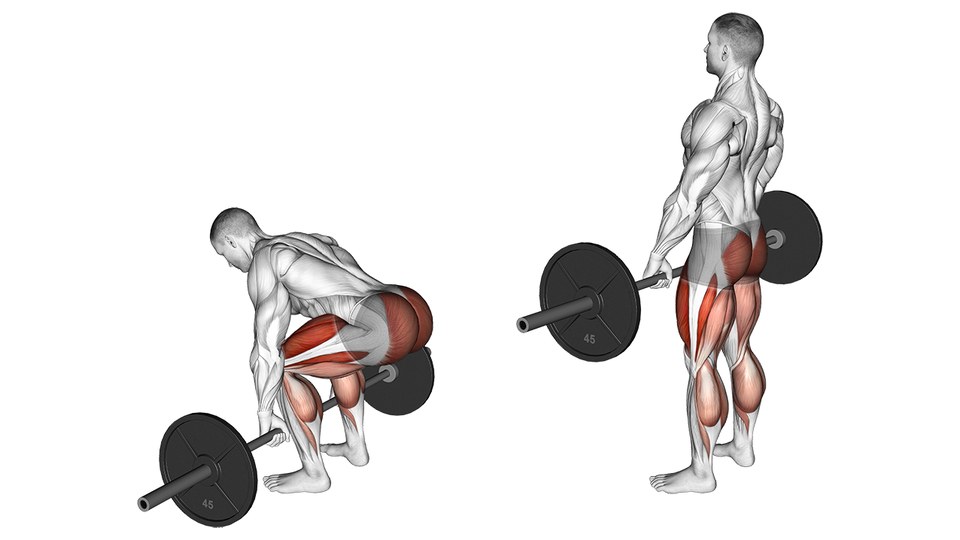
The conventional deadlift is a barbell lift from the floor: you stand with a roughly hip-width stance behind the bar, take it with both hands just outside your legs, and stand up. "Conventional" names the narrow stance with the arms outside the knees, as opposed to sumo, where the feet are wide and the hands go inside the legs. It is a hip hinge with real knee extension in it, so the muscles that produce the movement are the hip extensors (gluteus maximus, the hamstrings, and the ischiocondylar part of adductor magnus) and the knee extensors (quadriceps femoris), while the spinal extensors are loaded heavily but hold a position instead of changing one. Nothing in the lift can help the fingers hold the bar, which is why grip is often the part that runs out first.
How do you perform a conventional deadlift?
Set up
- Stand with your feet about hip-width apart and the bar over your mid-foot, close to your shins.
- Hinge at your hips and grip the bar just outside your legs, with your arms straight and your thumbs wrapped around it.
- Bend your knees until your shins touch the bar without rolling it forward. Keep your shoulders over the bar, lift your chest, brace your core, tighten your lats and pull the slack out of the bar.
Execution
- Push the floor away, letting your hips and shoulders rise together while the bar stays close to your legs.
- Once the bar passes your knees, drive your hips forward and stand tall with your hips and knees straight. Pull your shoulders back if they have rounded, but do not lean back.
- Lower the bar by pushing your hips back, then bend your knees after the bar passes them.
- Let the bar settle on the floor, reset your brace, pull the slack out and repeat. Do not bounce it between reps.
Common mistakes
Setting up with the bar out over your toes
The bar has to come back over the middle of your foot before it can go up, so it swings toward you as it breaks the floor and you pay for the extra distance in hip torque. Everything else in the setup is downstream of where the bar sits.
Hips shooting up before the bar moves
Your knees finish extending while the bar is still on the floor, so by the time it moves you are doing a stiff-legged deadlift at a weight you picked for a conventional one. The quadriceps did their work before the bar could feel any of it, and the hip extensors are left with the lift.
Yanking the bar off the floor from a loose start
With slack in the bar and in your arms, the first thing you accelerate is yourself. The load then arrives all at once against a back that has not finished bracing, which is both the least efficient way to start and the one that leaves you no chance to correct position.
Letting the bar drift away from your legs
Every centimetre the bar sits in front of mid-foot is more hip torque at the same weight. If a pull stalls just below the knee, that is worth checking before you conclude the back is weak: the lever may be longer than the one you set up with.
Leaning back at the top
Hips and knees locked with the shoulders back is the finish. Leaning past that adds lumbar extension to a rep that was already over, which is work the lift never asked for.
Bouncing reps off the floor
The rebound does the hardest part of the rep for you and it starts the next one from wherever the bounce left you, rather than from a position you set.
Where it fits in a session
Early in the session, first or second, while you are fresh. It is likely the heaviest thing you will lift that day and the least forgiving of a position that has already drifted.
Run it as a small number of hard sets rather than as volume, and not in every session. Rep quality is the limit: the set is over when you can no longer hold your back where you set it, not when the weight stops moving.
Muscles worked
Primary
Secondary
Schematic surface view. Some muscles are partly visible or not shown.
Split by role, not by size of contribution. The primary list is the muscles whose named actions are the lift: hip extension (gluteus maximus, the hamstrings, and the ischiocondylar part of the adductor magnus, which runs from the ischial tuberosity like a hamstring and extends the thigh like one), knee extension (quadriceps femoris), and holding the spine where you put it (erector spinae and multifidus, which work isometrically here — they are loaded hard while changing length very little). The secondary list is what carries the bar and the trunk without producing the movement. Anatomy establishes actions and attachments; it does not rank how much each muscle contributes to a deadlift, and the limited comparisons in the evidence section do not provide a complete ranking either. Quadratus lumborum is left off deliberately: its own anatomy chapter reports cadaver forces of roughly 200 N against about 1800 N for erector spinae and 2800 N for multifidus in the lumbar spine, and concludes it "does not appear to be a significant lumbar stabilizer".
What lifters actually do
Fewer than two in five regular RepCount lifters have ever logged a deadlift, and it turns up in roughly one workout in twenty — rarer than most of the accessory work that fills a session. What it gets when it does turn up is volume: a little over four sets, inside a session of about six exercises. The company it keeps is the more useful number. The movements most often logged in the same session are pulldowns, the squat, pull-ups, cable rows and barbell rows — four back movements and one squat — and fewer than one deadlift session in five also contains a squat. That leans toward a pull or back day rather than leg day, and it only leans: no one of those movements shows up in even a fifth of deadlift sessions.
Most often trained alongside
Share of conventional deadlift sessions that also include each exercise.
- Pulldowns19.9%
- Squat18.5%
- Pull up14.2%
- Cable row14.2%
- Barbell row14%
Figures come from workouts tracked in RepCount.
Scientific studies on the conventional deadlift
Changing the stance, bar or amount of knee bend changes the demands of a deadlift. The studies below measured those differences during the lift; they did not establish which variation produces the most muscle growth.
Conventional, sumo, Romanian and trap-bar deadlifts distribute the work differently. A higher muscle-activity reading or a larger weight lifted in one variation does not, by itself, establish better growth, safer lifting or greater long-term strength gains.
How does conventional compare with sumo?
Sumo’s wider stance changes more than the distance the bar travels. In 13 collegiate football players, sumo deadlifts produced higher average electrical activity in two quadriceps muscles than conventional deadlifts.
A newer study of 30 men experienced with both styles found a greater knee-extension demand early in the sumo pull and a greater hip-extension demand during much of the conventional pull. Those are differences in joint mechanics, not a ranking of how hard each entire exercise is. Neither study followed muscle growth or injuries over a training program.
What did the newer study compare?
Participants performed three dead-stop repetitions of each style with the same load. It was set from an estimated maximum derived using one of the two styles, so equal weight did not necessarily mean equal relative difficulty. Joint moments describe rotational demand at a joint; they are not direct measurements of individual muscle force or injury risk.
Is the conventional deadlift more demanding on the quads than the Romanian version?
One comparison supports greater involvement of rectus femoris, one of the quadriceps muscles, in the conventional version. Twenty-one trained men performed both exercises with the same weight. Conventional repetitions produced higher rectus femoris and gluteus maximus electrical activity; biceps femoris activity did not clearly differ.
The setup matters. Repetitions began from standing, and participants were asked to lower the bar to the floor in both versions, although some could not do that in the Romanian deadlift. That differs from the usual Romanian version that stops above the floor. The study also matched weight rather than relative effort, so it cannot establish superior glute or hamstring growth.
Sources
What changes when you use a trap bar?
In a study of 19 male powerlifters, the hexagonal bar allowed a heavier maximum lift than a straight bar. During faster submaximal repetitions, the hexagonal bar also shifted the measured joint demands: peak moments were lower at the lumbar spine and hip, and higher at the knee.
This helps explain why a trap-bar deadlift can feel different even when both lifts start on the floor. It does not show that one is safer, and it is not a universal rule for every handle height or trap-bar design. The experiment measured immediate mechanics, not injury rates or the results of training with each bar.
Sources
Variations
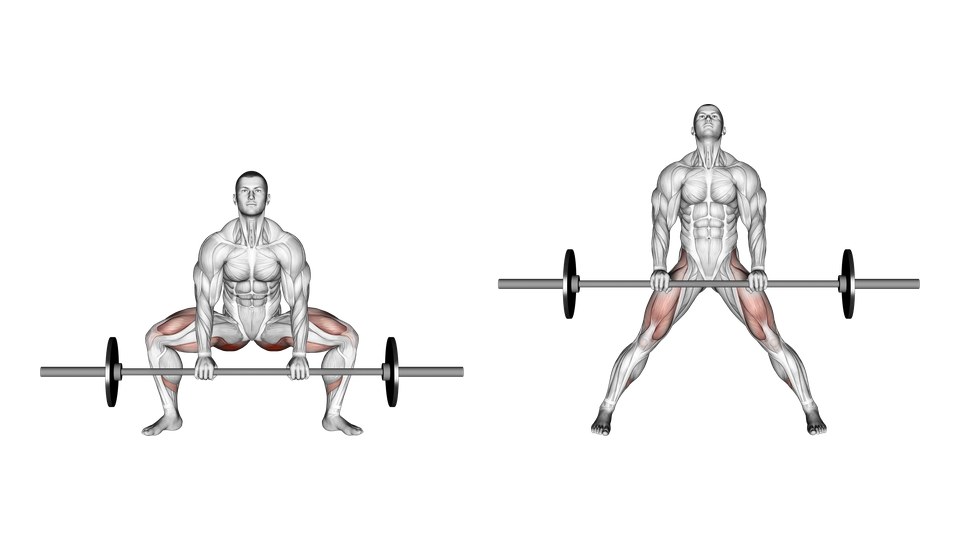
- Sumo deadliftWide stance with the hands inside the legs. Shorter bar path, and different angles at the hip and knee.
- Romanian deadliftStarts from standing and lowers to about mid-shin with the knees only slightly bent. The bar does not return to the floor.
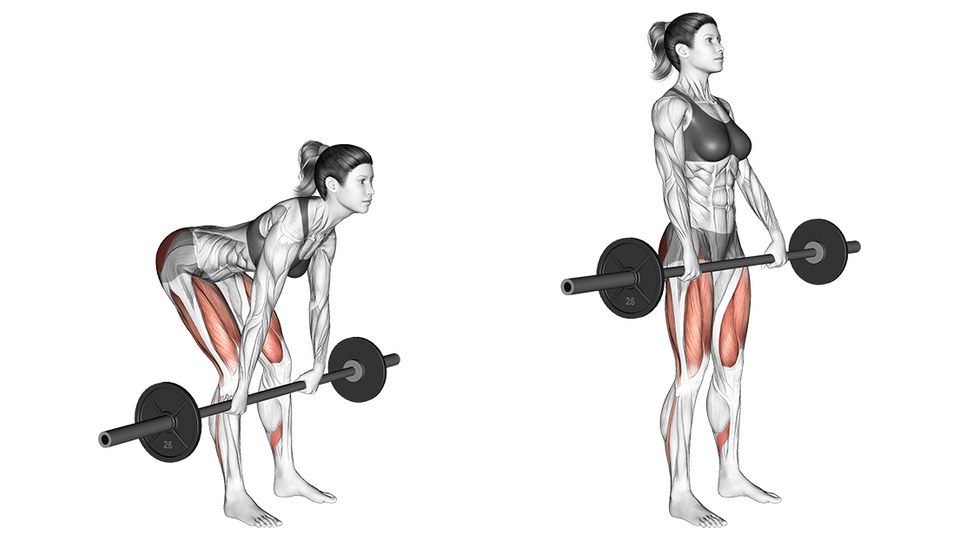
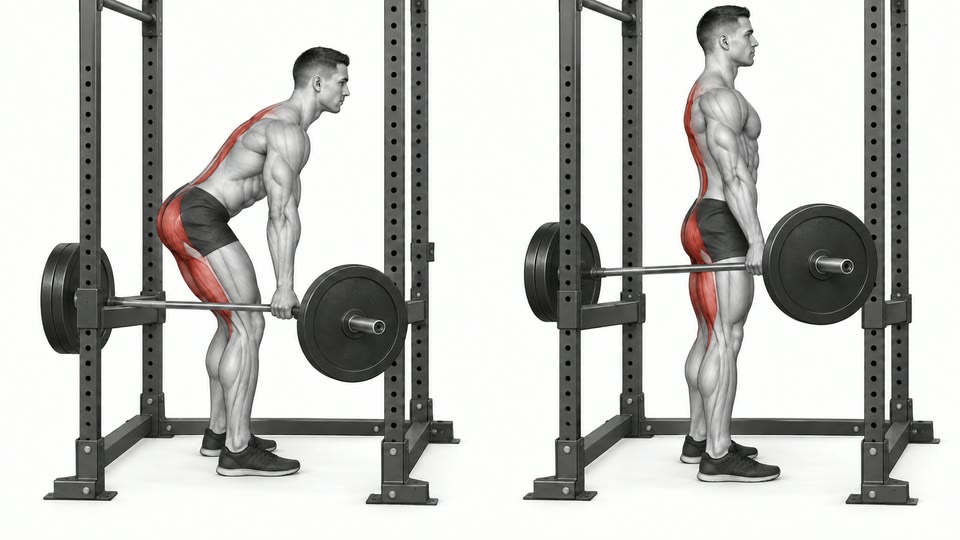
- Stiff-legged deadlift — From the floor with the knees close to straight, so the hips do almost all of the work.
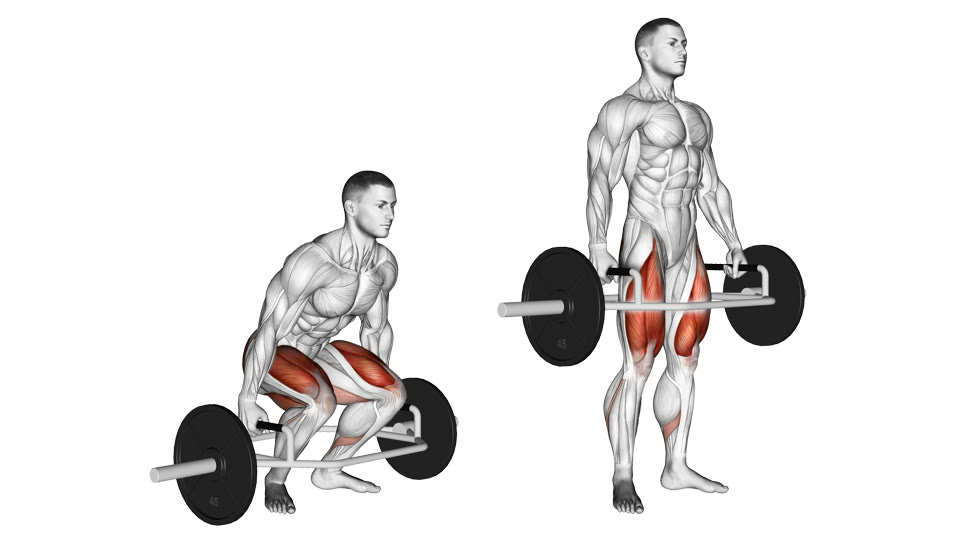
- Trap bar deadliftHands at your sides in a hexagonal bar, which puts the load closer to the hips and lets the knees bend more.
- Snatch-grip deadlift — Very wide grip, which lowers the start position and lengthens the range.
Articles
Related tools
Frequently asked questions
What muscles does the conventional deadlift work?
The movement itself is hip extension plus knee extension, so it is produced by the gluteus maximus, the hamstrings, the hamstring-like part of the adductor magnus, and the quadriceps femoris. The erector spinae and multifidus are loaded heavily but work isometrically — they hold the spine where you set it rather than moving it. Holding on adds the forearm flexors; the latissimus dorsi and trapezius keep the arm and the shoulder blade where they are; and the abdominal wall tenses against the trunk. Anatomy tells you which muscles act and where they attach; it does not tell you how the work is divided between them, so treat any ranked list of deadlift muscles with suspicion, including a ranked one from us.
Is the deadlift a back exercise or a leg exercise?
Both descriptions point at something real, which is why the argument never ends. The joints that move are the hips and the knees, so the muscles doing the moving are leg muscles. The back muscles are under heavy load for the whole rep but they are holding a position rather than changing one, and holding a position under load is still work. If you want one sentence: the legs move the bar and the back holds the shape you set while they do it.
What is the difference between a conventional and a sumo deadlift?
Stance width and where your hands go. Conventional is roughly hip-width with the arms hanging outside the knees; sumo is a wide stance with the hands inside the legs. Both start from the floor and finish standing. The wide stance shortens the distance the bar travels and changes the angles at the hip and knee, so the two feel different and suit different builds — that is a matter of which one fits you, not of one being the real version.
Should I deadlift with a double overhand, mixed or hook grip?
It is a preference, and this page does not pick one for you. Double overhand is symmetrical and usually what limits you first. A mixed grip, one palm forward and one back, stops the bar rolling out of your fingers but leaves the two arms doing different things. A hook grip traps the thumb under the fingers, holds like a mixed grip and stays symmetrical, and hurts until it stops hurting. Straps are a fourth answer when the point of the set is the legs and back rather than the grip. Any single illustration can only show one of these, so read the one you see as an example rather than an instruction.
Do deadlifts work your quads?
Yes, in the conventional version from the floor. Your knees are bent at the start and straighten as the bar comes up, and the quadriceps femoris is the knee extensor. How much they contribute depends on how much knee bend your start position actually has, which varies with limb lengths and with how you set up. Variations that start with the knees nearly straight, like the stiff-legged and Romanian deadlift, remove most of that.
Do deadlifts work the lower back?
Heavily, but as a holding job. The spinal extensors — erector spinae and multifidus — resist the trunk being folded forward by the bar rather than extending it. One muscle from the same region is missing from that pair on purpose: the anatomy reference cited on this page reports cadaver forces of roughly 200 N for the quadratus lumborum in the lumbar spine against about 1800 N for erector spinae and 2800 N for multifidus, and concludes it is not a significant lumbar stabiliser.
How often do people actually deadlift?
Less often than you might guess from how much is written about it. Across workouts tracked in RepCount, fewer than two in five regular lifters have ever logged a deadlift, and it appears in roughly one workout in twenty. When it does appear it gets a little over four sets, in a session of about six exercises. The movements logged alongside it most often are pulldowns, the squat, pull-ups, cable rows and barbell rows. A logged deadlift does not record which stance it was pulled from, so those figures describe the lift rather than the conventional version of it specifically.
Should I reset every rep or use touch-and-go?
Reset. Let the bar settle on the floor, take the slack out again, then pull, so every rep starts from a dead bar in a position you chose. Touch-and-go keeps tension on and gets through a set faster, but it skips the hardest part of the rep, breaking a still bar off the floor, and starts the next one from wherever the bar happened to touch down. Set the bar down under control, and never use the floor as a spring.
Sources
- Henson B, Kadiyala B, Edens MA. Anatomy, Back, Muscles. StatPearls. https://www.ncbi.nlm.nih.gov/books/NBK537074/
- Elzanie A, Borger J. Anatomy, Bony Pelvis and Lower Limb, Gluteus Maximus Muscle. StatPearls. https://www.ncbi.nlm.nih.gov/books/NBK538193/
- Hu Y, Raja A. Anatomy, Bony Pelvis and Lower Limb, Hamstring Muscle. StatPearls. https://www.ncbi.nlm.nih.gov/books/NBK546688/
- Jeno SH, Launico MV, Schindler GS. Anatomy, Bony Pelvis and Lower Limb: Thigh Adductor Magnus Muscle. StatPearls. https://www.ncbi.nlm.nih.gov/books/NBK534842/
- Bordoni B, Varacallo MA. Anatomy, Bony Pelvis and Lower Limb: Thigh Quadriceps Muscle. StatPearls. https://www.ncbi.nlm.nih.gov/books/NBK513334/
- Bordoni B, Sina RE, Varacallo MA. Anatomy, Abdomen and Pelvis, Quadratus Lumborum. StatPearls. https://www.ncbi.nlm.nih.gov/books/NBK535407/
- Jeno SH, Varacallo MA. Anatomy, Back, Latissimus Dorsi. StatPearls. https://www.ncbi.nlm.nih.gov/books/NBK448120/
- Ourieff J, Scheckel B, Agarwal A. Anatomy, Back, Trapezius. StatPearls. https://www.ncbi.nlm.nih.gov/books/NBK518994/
- Mitchell B, Whited L. Anatomy, Shoulder and Upper Limb, Forearm Muscles. StatPearls. https://www.ncbi.nlm.nih.gov/books/NBK536975/
- Seeras K, Qasawa RN, Ju R, Prakash S. Anatomy, Abdomen and Pelvis: Anterolateral Abdominal Wall. StatPearls. https://www.ncbi.nlm.nih.gov/books/NBK525975/
- Escamilla RF, Francisco AC, Kayes AV, Speer KP, Moorman CT III. An electromyographic analysis of sumo and conventional style deadlifts. 2002. https://pubmed.ncbi.nlm.nih.gov/11932579/
- Hanen NC, Ben Mansour K, Ertel GN, Duchene Y, Gauchard GC. Biomechanical analysis of conventional and sumo deadlift. 2025. https://pmc.ncbi.nlm.nih.gov/articles/PMC12148905/
- Lee S, Schultz J, Timgren J, Staelgraeve K, Miller M, Liu Y. An electromyographic and kinetic comparison of conventional and Romanian deadlifts. 2018. https://pmc.ncbi.nlm.nih.gov/articles/PMC6323186/
- Swinton PA, Stewart A, Agouris I, Keogh JW, Lloyd R. A biomechanical analysis of straight and hexagonal barbell deadlifts using submaximal loads. 2011. https://pubmed.ncbi.nlm.nih.gov/21659894/