
Band lateral raise
Also called resistance band lateral raise, band side raise, banded lateral raise.
What is a band lateral raise?
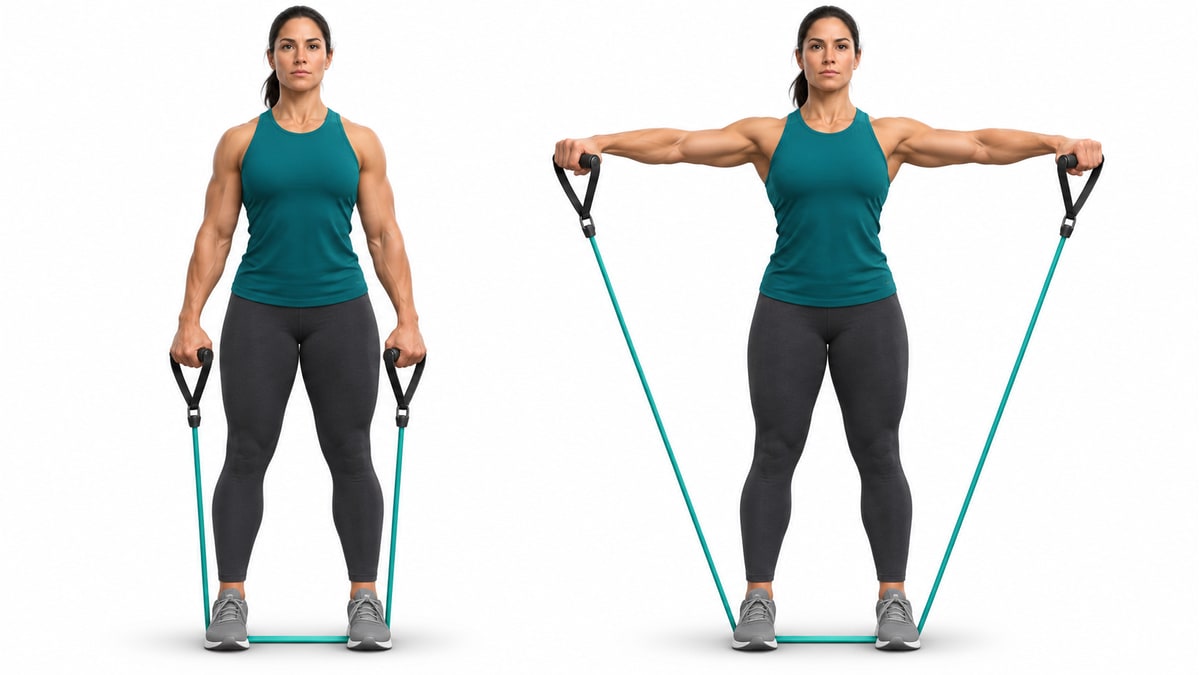
A band lateral raise lifts your arms sideways against an elastic band to train the side of your shoulders. In this version, both feet hold the band against the floor and both hands raise its handles to about shoulder height. The band stays under your feet throughout the set; no wall or door anchor is used.
How do you perform a band lateral raise?
Set up
- Check the band, handles and attachments for wear or damage. Use a handle-equipped band intended for underfoot exercises, and secure its handles as the maker directs.
- Put on athletic shoes and stand on the middle of the band, with it held securely beneath both arches. Set your feet about hip-width apart and leave equal lengths on either side.
- Hold a handle beside each thigh with your palms facing inward. Stand upright with soft knees, your torso braced and a small bend in both elbows.
Execution
- Sweep both arms out to the sides without rocking your body. Keep the bend in your elbows steady, and finish when your upper arms are roughly level with your shoulders.
- Bring the handles back beside your thighs slowly, resisting the band's pull. Repeat while your feet and torso stay in place.
- After the last rep, lower your hands fully and let the band relax before stepping off it.
Common mistakes
Rocking back to finish the lift
Choose a lighter band if you have to lean or bounce to reach the same endpoint. Keep the body position you started with instead of adding a different movement as the set gets hard.
Turning the raise into an upright row
Bending your elbows more and drawing the handles up the front of your body changes the movement. Let the arms travel outward with the same small elbow bend throughout.
Moving your feet while the band is stretched
Your feet are the anchor. Keep the band securely beneath your shoes, and unload it before changing your stance or correcting its position.
Where it fits in a session
Use it as shoulder accessory work in the session you have planned.
Choose resistance that lets you repeat the same arm path and endpoint. Compare sets with the same band, stance and starting length; change one of those deliberately rather than midway through the set.
Muscles worked
Primary
Secondary
Schematic surface view. Some muscles are partly visible or not shown.
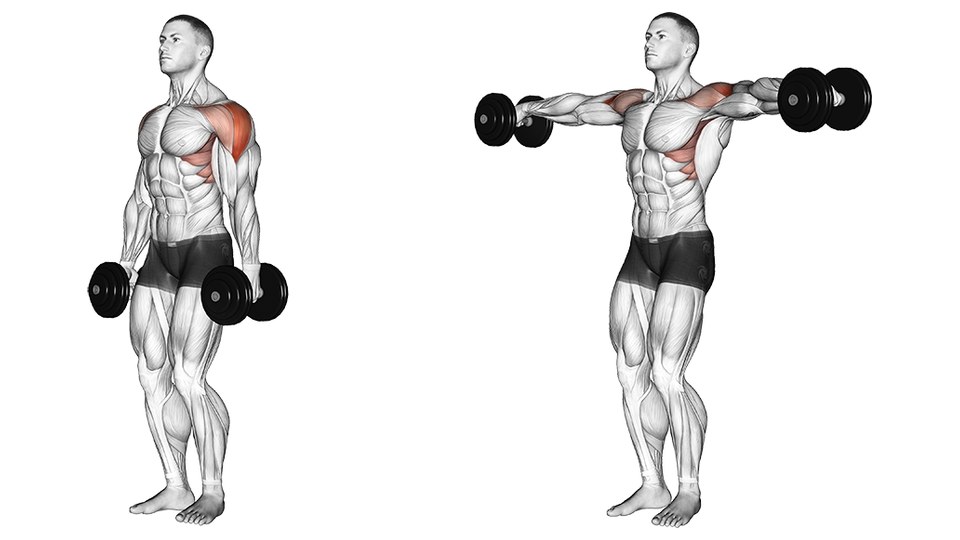
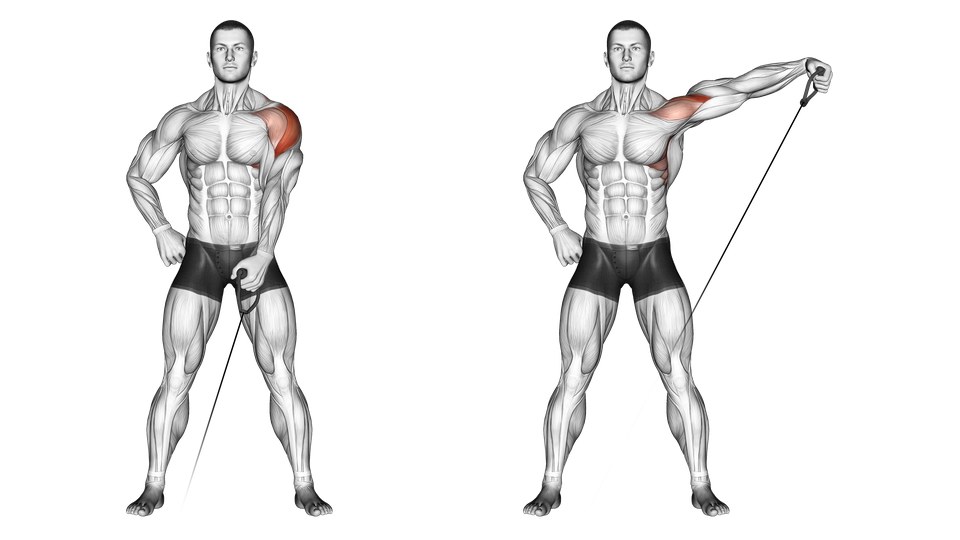
The lateral deltoid raises the upper arm out to the side. The supraspinatus assists that movement, while the trapezius and serratus anterior help move and control the shoulder blade. The list describes their roles, not a ranking of measured muscle activity.
Variations
Frequently asked questions
What muscles do band lateral raises work?
The main target is the lateral deltoid, the side portion of the shoulder muscle. The supraspinatus also helps raise the upper arm. The trapezius and serratus anterior help control the shoulder blade as you lift.
Where should I stand on the band?
For the two-handle version shown in these instructions, place the middle beneath both arches while wearing athletic shoes. Keep it secure and use roughly equal lengths on each side. Check your own band's underfoot instructions and stretch limit before using this setup.
How high should I raise my arms?
Use about shoulder height as a repeatable endpoint for this version. You do not need to turn the rep into an overhead raise. If you cannot reach that height without rocking, use a lighter band.
How can I make the exercise easier?
Switch to a lighter band that still lets you use the intended underfoot setup. Put your hands down and release the tension before making any adjustment. Do not bounce or bend your elbows further to finish a difficult rep.
Is a band's weight rating the same as a dumbbell weight?
Do not treat the two as interchangeable loads. A band's rating depends on how it is stretched and how the maker defines the rating. Record which band and setup you used, rather than converting its label into a dumbbell weight.
Sources
- Elzanie A, Varacallo MA. Anatomy, Shoulder and Upper Limb, Deltoid Muscle. StatPearls. Updated 2024. https://www.ncbi.nlm.nih.gov/books/NBK537056/
- Lam JH, Bordoni B. Anatomy, Shoulder and Upper Limb, Arm Abductor Muscles. StatPearls. Updated 2023. https://www.ncbi.nlm.nih.gov/books/NBK537148/