
Barbell front raise
Also called barbell front raises, straight-bar front raise.
What is a barbell front raise?
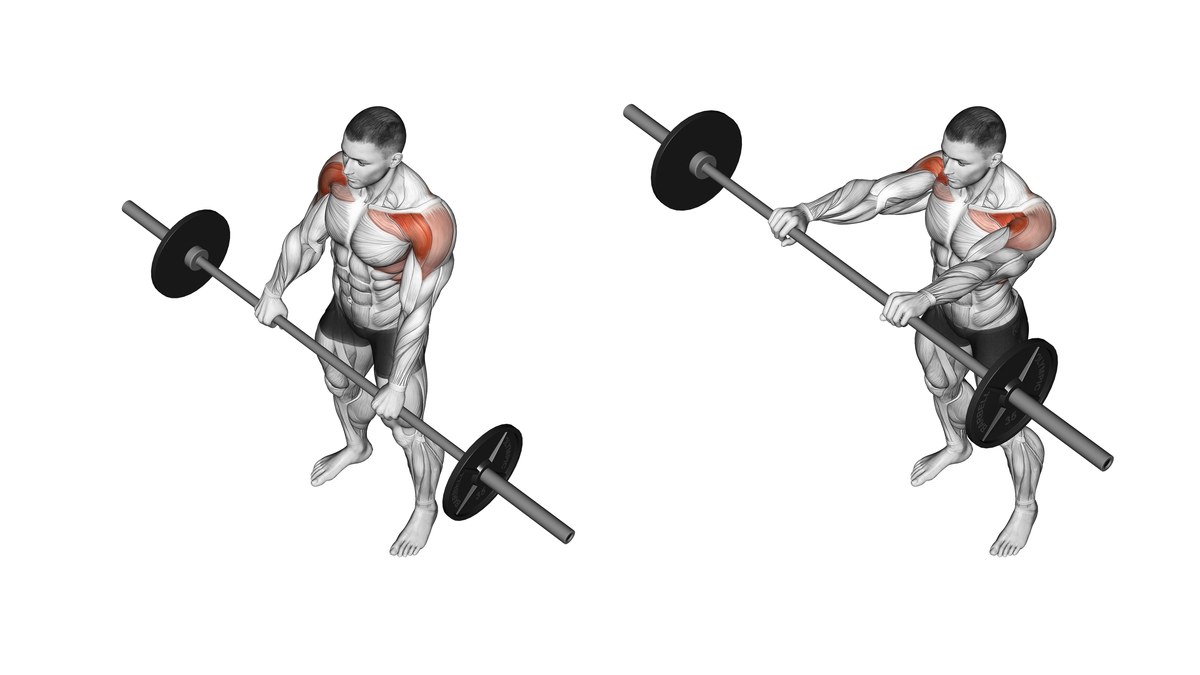
A barbell front raise moves a bar from in front of your thighs to about shoulder height with both hands in an overhand grip. Your elbows stay nearly straight as the arms lift forward. The bar fixes the distance between your hands throughout the repetition.
How do you perform a barbell front raise?
Set up
- Choose a light training bar or fixed bar that you can raise without swinging. If you use added plates, secure them with collars.
- Stand with the bar in front of your thighs, hands about shoulder-width apart in an overhand grip. Keep your wrists aligned with your forearms and a small bend in your elbows.
Execution
- Raise the bar forward and upward while keeping your torso upright and your elbow angle steady.
- Stop when your arms are around shoulder height. Keep both ends of the bar level.
- Guide the bar back toward your thighs without letting it bounce off your legs. Set it down securely after the set.
Common mistakes
Using a full-size bar that is already too heavy
Begin with a lighter training bar or fixed bar. An empty Olympic bar can still be too much for controlled front raises.
Driving the bar forward with the hips
Choose a load that lets you start each repetition without a backward lean or a hip thrust.
Bending the elbows into a row
Keep the small bend constant instead of pulling the bar toward your chest as it rises.
Where it fits in a session
Use it for front-shoulder accessory work when a suitably light bar is available.
Keep the same bar, grip width and endpoint when comparing sets. Load increases should preserve the level bar and still torso.
Muscles worked
Primary
Secondary
- None listed in this guide
Schematic surface view. Some muscles are partly visible or not shown.
The front deltoids raise the arms forward.
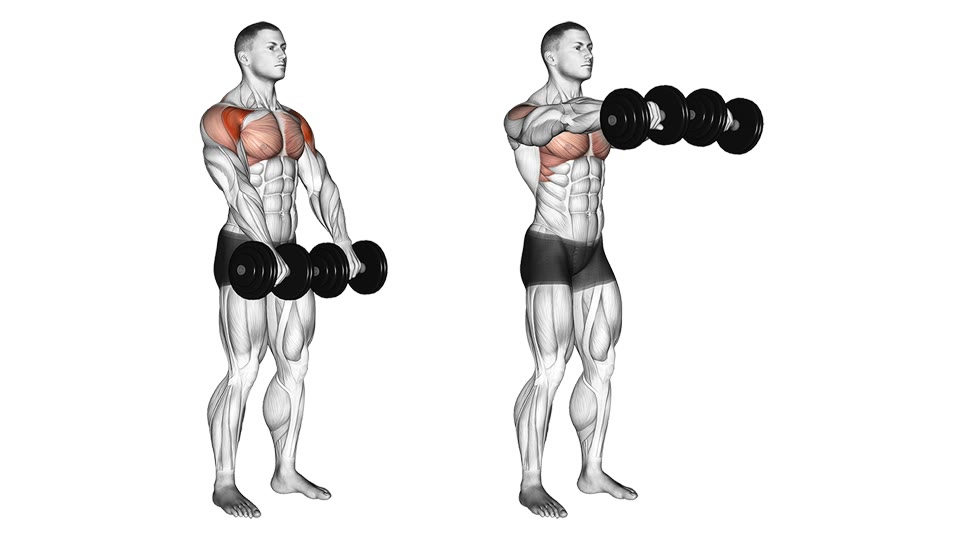
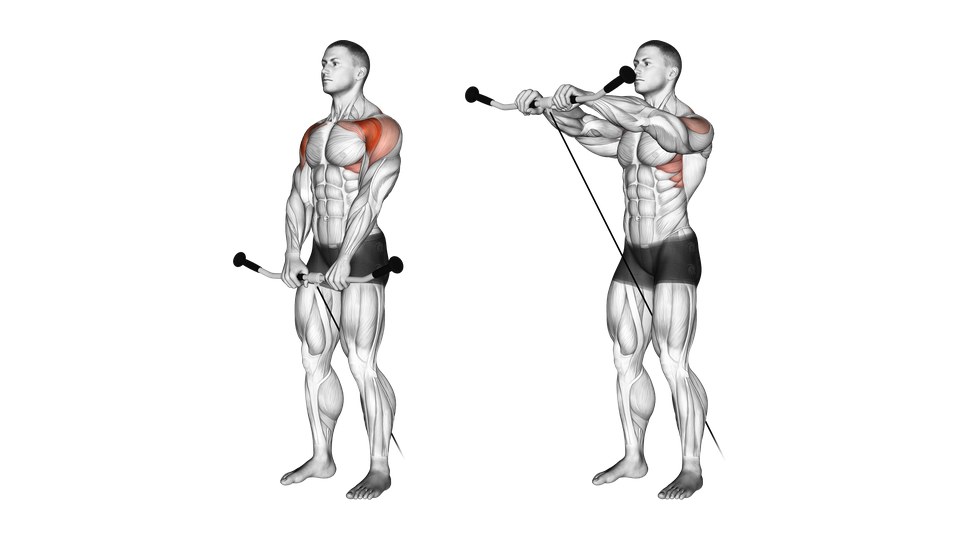
Variations
Frequently asked questions
Can you start with an empty Olympic bar?
Only if you can control it through the whole repetition. A lighter training bar or fixed bar is a better starting choice when the empty Olympic bar requires swinging.
How wide should your grip be?
Start around shoulder-width with an overhand grip. Adjust slightly for a comfortable wrist position, then keep the grip consistent.
Should you lift the bar overhead?
This version stops around shoulder height. A front raise continued overhead uses a different range.
Is it an upright row?
No. In a front raise, the elbows stay nearly straight while the bar travels forward. An upright row bends the elbows and keeps the bar closer to the body.
Sources
- Elzanie A; Varacallo MA. Anatomy, Shoulder and Upper Limb, Deltoid Muscle. StatPearls. https://www.ncbi.nlm.nih.gov/sites/books/NBK537056/