
Belt squat
Also called belt squats, hip belt squat.
What is a belt squat?
A belt squat is a squat loaded through a belt around the hips. On a belt squat machine, the belt connects to resistance below you while your hands can hold the support handles. The movement trains the quadriceps and glutes.
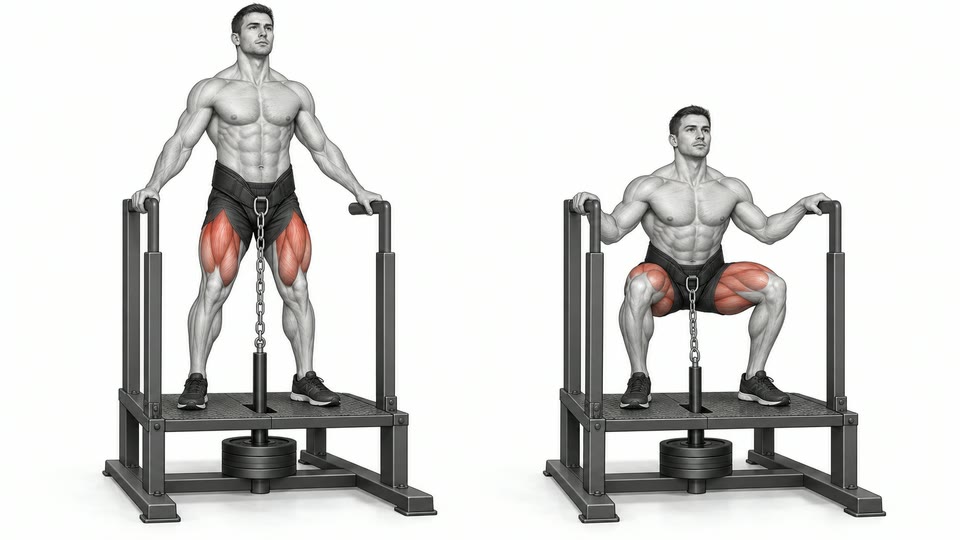
How do you perform a belt squat?
Set up
- Check the machine instructions for its start latch and return position. Fit the loading belt securely around your hips and connect it with the machine parked and the load supported.
- Stand on the platform with your feet about shoulder width, making sure the chain or cable clears your legs. Take the handles, then release the start latch as the machine requires.
Execution
- Bend your hips and knees to squat, keeping your feet planted and your knees following the direction of your toes.
- Stop at a depth where you can hold your position and the resistance remains clear of the floor or stops.
- Stand through both feet without hauling yourself up by the handles. After the final repetition, park the load securely before disconnecting the belt.
Common mistakes
Disconnecting while the belt is loaded
Return the machine to its parked position and check that the weight is supported before opening the attachment.
Using a chain length that stops the squat early
Adjust the connection while the machine is parked so you can squat without the load hitting its stop.
Pulling hard on the handles
Use a lighter load if you need your arms to finish the ascent.
Where it fits in a session
Use it as a main squat or as leg work after other compound lifts.
Keep the same machine, belt connection and depth when comparing sets. Learn its latch and parking sequence with a light load first.
Muscles worked
Primary
Secondary
- None listed in this guide
Schematic surface view. Some muscles are partly visible or not shown.
Variations
- Belt squat between platforms — Suspends plates from a belt between raised platforms and requires a different setup from a machine.
Frequently asked questions
Is a belt squat the same as wearing a lifting belt for squats?
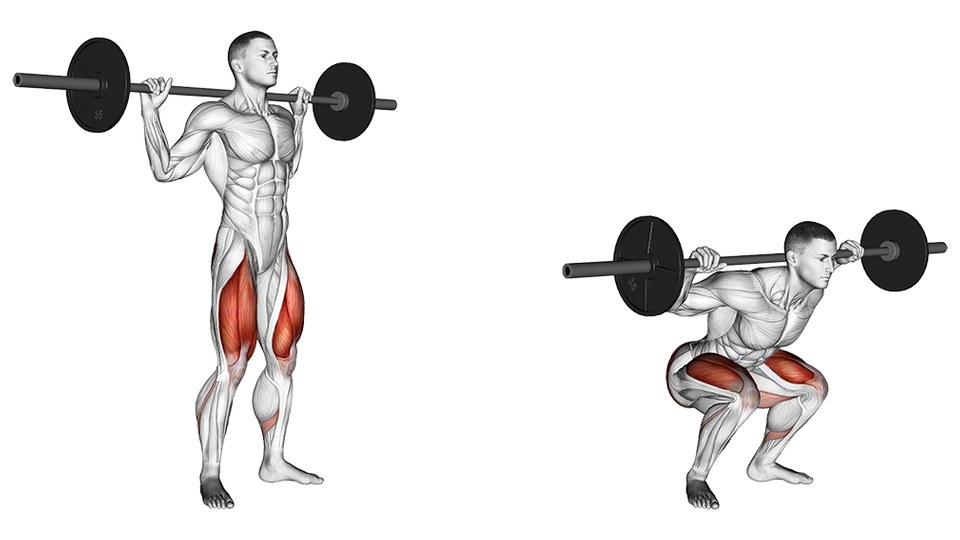
No. In a belt squat, the resistance attaches to a belt at your hips. Wearing a support belt during a barbell squat does not change where the bar is loaded.
Should you hold the handles?
Use them for balance and to operate the machine as instructed. Avoid pulling yourself upward to complete repetitions.
Can you compare the weight with a barbell squat?
Log them separately. Machine designs and attachments differ, so keep the same setup when using the load to judge progress.
Sources
- Evans TW, McLester CN, Howard JS, McLester JR, Calloway JP. Comparison of Muscle Activation Between Back Squats and Belt Squats. 2019. https://pubmed.ncbi.nlm.nih.gov/28595237/