Cable reverse curl
Also called reverse-grip cable curl.
What is Cable reverse curl?
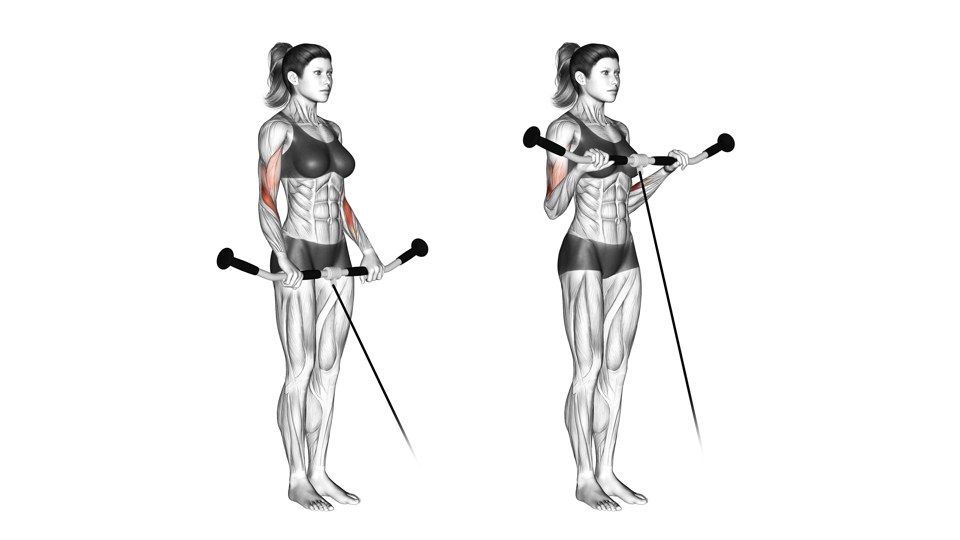
The cable reverse curl is a standing curl with an overhand bar attached to a low pulley. It trains the elbow flexors, including the brachioradialis, while the palms remain facing down.
How to do Cable reverse curl
Set up
- Attach an angled curl bar to the low pulley and take an overhand grip around shoulder width.
- Stand facing the pulley with your arms down, elbows near your sides and wrists straight.
Execution
- Bend the elbows to raise the bar without leaning backward.
- Finish before your elbows need to travel far forward or your wrists bend.
- Lower the bar under control until your arms return to the starting position.
Common mistakes
Letting the wrists fold forward
A bent wrist makes the bar harder to control and changes where the load is supported. Keep the knuckles and forearms in one line.
Swinging a load that is too heavy
Hip drive moves the bar without the elbow flexors controlling the hard middle of the curl. Reduce the load and keep the torso still.
Lifting the elbows to finish
Moving the upper arms forward shortens the curl at the elbow and turns the top into a shoulder movement. End the rep before that happens.
Where it fits in a session
Use it after larger pulling movements or alongside another curl when you want direct elbow-flexor and forearm work.
Log this separately from palms-up curls. The grip changes the movement demands, so select the load with warm-up sets rather than transferring your curl weight.
Muscles worked
Primary
Secondary
Schematic surface view. Some muscles are partly visible or not shown.
Variations
Frequently asked questions
What muscles do cable reverse curls work?
They train the brachioradialis, brachialis and biceps brachii as elbow flexors, while the forearm muscles hold the overhand grip and wrist position.
Should you use an EZ-bar or a straight bar for cable reverse curls?
Either works. An EZ-bar changes the wrist angle and is often more comfortable; use the bar that lets you keep the wrists straight.
Are cable reverse curls a forearm exercise?
They train elbow flexion, not just the forearms. The overhand grip makes the brachioradialis and grip demand prominent, but the brachialis and biceps still contribute.
Sources
- Betts JG et al. Anatomy and Physiology 2e, 11.5 Muscles of the pectoral girdle and upper limbs. OpenStax, 2022. https://openstax.org/books/anatomy-and-physiology-2e/pages/11-5-muscles-of-the-pectoral-girdle-and-upper-limbs