Cable Y raise
Also called cable Y-raise, standing cable Y raise, two-arm cable Y raise.
What is a cable Y raise?
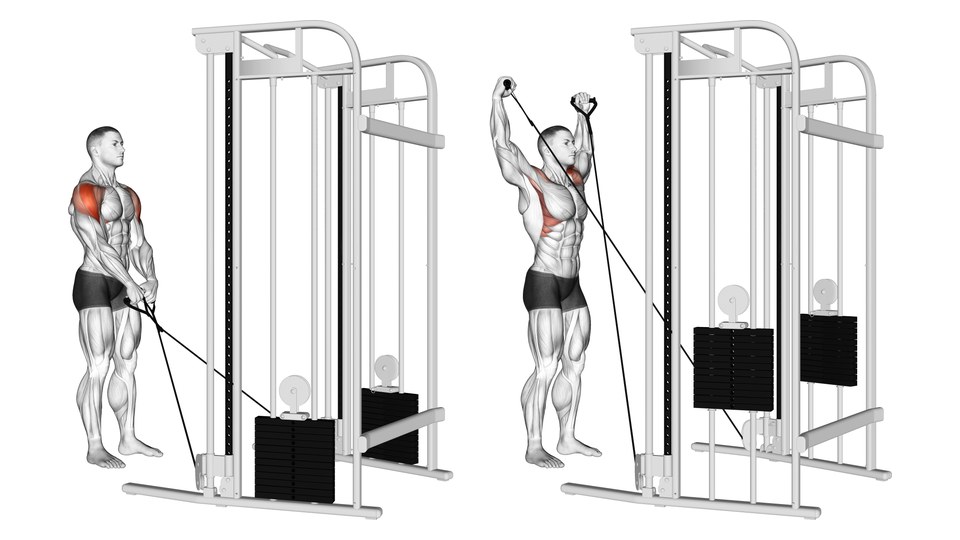
The cable Y raise is a shoulder isolation exercise performed standing between two low pulleys. You cross the handles in front of your hips, then raise both arms upward and outward into a Y. It trains the deltoids through that diagonal raise.
How do you perform a cable Y raise?
Set up
- Set both pulleys to their lowest positions and take the left handle in your right hand and the right handle in your left hand.
- Stand centered just in front of the pulleys so the cables cross in front of your hips and stay taut.
- Brace your torso, let your arms hang with a small elbow bend and keep that bend for the set.
Execution
- Raise both arms upward and outward on diagonal paths while keeping your torso still.
- Finish when your arms form a clear Y overhead without leaning back to reach higher.
- Lower the handles along the same paths until they meet in front of your hips, then repeat from a still position.
Common mistakes
Raising the arms too narrowly
A straight-forward path turns the repetition toward a front raise. Send the hands both upward and outward so the finish forms a Y.
Bending the elbows as the handles rise
Changing the elbow angle shortens the lever and makes the path inconsistent. Keep the same small bend from start to finish.
Leaning back for the overhead finish
Torso extension creates extra height without reproducing the same shoulder movement. Reduce the load or stop slightly lower.
Where it fits in a session
As shoulder isolation work after compound pressing or alongside other raise variations.
Use a load that preserves the diagonal path, steady elbows and upright torso. Keep pulley height and stance consistent when comparing sessions.
Muscles worked
Primary
Secondary
- None listed in this guide
Schematic surface view. Some muscles are partly visible or not shown.
The deltoid raises and steadies the arms as they travel upward and outward. The compact list does not rank its three portions or promote every shoulder-blade stabilizer into a target.
Variations
- Seated cable Y raise — Uses two low pulleys from a seated station while keeping the same upward-and-outward arm path.
- Incline dumbbell Y raise — Lies face down on an incline bench and uses dumbbells, shifting the setup toward upper-back and shoulder-blade work.
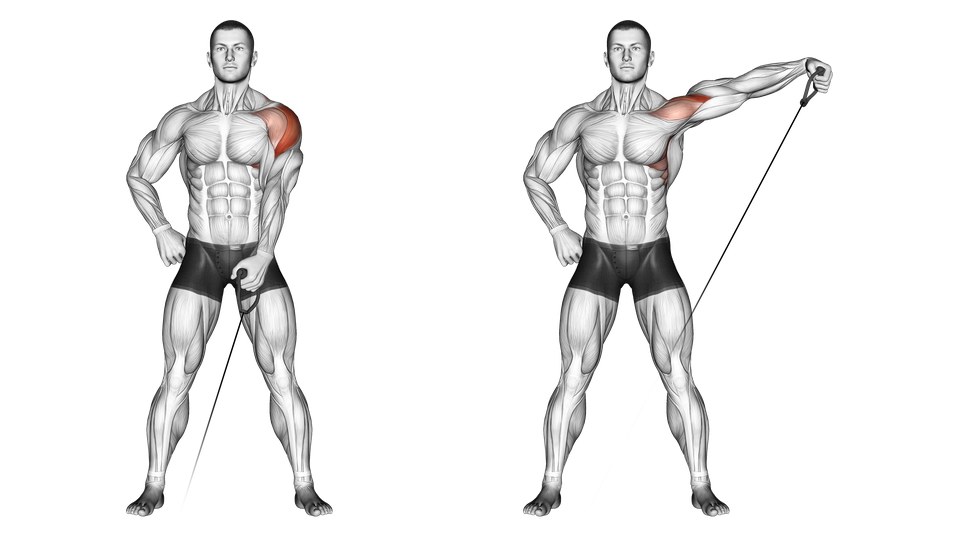
- Cable lateral raiseRaises one arm mainly out to the side and usually stops around shoulder height instead of continuing into an overhead Y.
Frequently asked questions
What muscles do cable Y raises work?
They train the deltoids as the arms travel upward and outward. Shoulder-blade muscles also help control the overhead path, but this guide does not rank them or the three portions of the deltoid.
Why do the cables cross?
Taking each handle in the opposite hand gives both arms room to begin near the centre and travel outward on separate diagonal paths.
How high should you raise the handles?
Raise them until your arms form a controlled Y overhead. Stop lower if reaching that position requires a backward lean or causes discomfort.
Is a cable Y raise the same as a cable lateral raise?
No. Both move the arms outward, but this bilateral version continues on diagonal paths into an overhead Y. A standard cable lateral raise usually trains one side and stops around shoulder height.
Can you do cable Y raises one arm at a time?
Yes, but this guide and illustration cover the bilateral crossed-cable version. Treat a single-arm setup consistently if its stance or cable path differs.
Sources
- Elzanie A, Varacallo MA. Anatomy, Shoulder and Upper Limb, Deltoid Muscle. StatPearls. https://www.ncbi.nlm.nih.gov/books/NBK537056/