Calf press
Also called leg press calf raise, calf raise on leg press, 45-degree calf press, leg press calf raises.
What is a calf press?
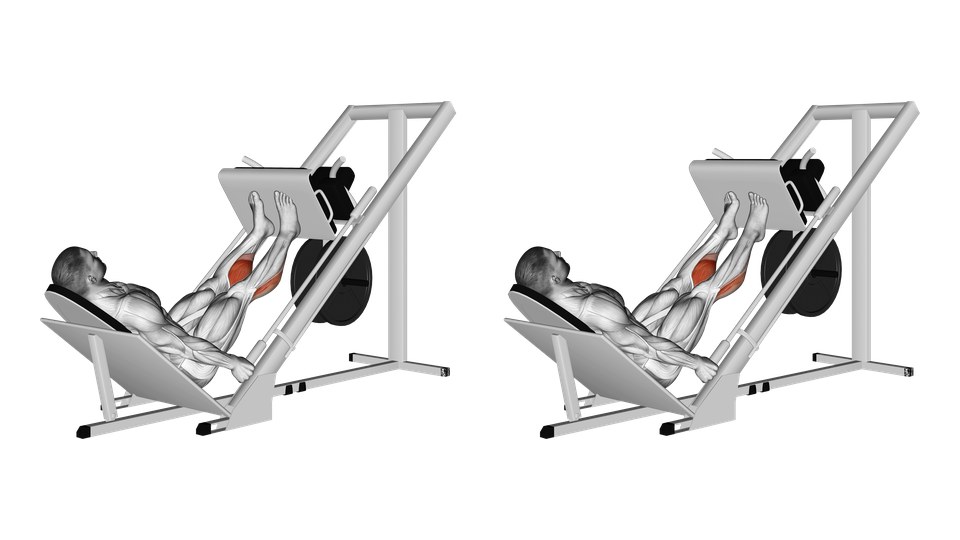
The calf press is a calf raise performed on a leg press machine with the balls of the feet on the platform edge. Keeping the knees nearly straight while the heels move through a controlled range trains the gastrocnemius and soleus.
How do you perform a calf press?
Set up
- Set the leg press and sit with your hips and back fully supported, then place the balls of both feet securely on the lower platform edge with your heels free.
- Press the platform to a stable starting position with your legs nearly straight but not forced into knee lockout.
Execution
- Keep the knees still and let your heels travel toward you under control until you reach a comfortable calf stretch.
- Press through the balls of your feet and lift your heels as far as you can without the feet rolling inward or outward.
- Lower slowly to the same comfortable bottom position, then repeat before returning the platform to the machine's safe resting position.
Common mistakes
Bending the knees on every rep
Repeated knee movement turns the exercise into a small leg press. Keep one nearly straight knee angle while the ankles move.
Using only the toes on the edge
Too little foot contact makes the position insecure. Support the balls of the feet across the platform edge before starting.
Bouncing out of the bottom
A fast reversal gives up control in the stretched position. Use a range you can slow down and repeat.
Where it fits in a session
Use it as direct calf work after the main lower-body exercises in a session.
Keep the seat, foot placement and bottom range consistent when comparing loads.
Muscles worked
Primary
Secondary
- None listed in this guide
Schematic surface view. Some muscles are partly visible or not shown.
The gastrocnemius and soleus plantarflex the ankle, lifting the heels away from the body while the knees remain nearly straight.
Variations
- Single-leg calf press — Uses one foot at a time with a lighter sled load.
Frequently asked questions
What muscles does the calf press work?
It trains the gastrocnemius and soleus, the two main muscles of the calf.
Where should your feet go?
Place the balls of the feet securely on the lower edge of the platform so the heels can move freely. Do not balance on the tips of the toes.
Should your knees be locked?
Keep the legs nearly straight while avoiding a forced knee lockout. The ankle should create the repetition, not repeated bending at the knee.
Is a calf press the same as a seated calf raise?
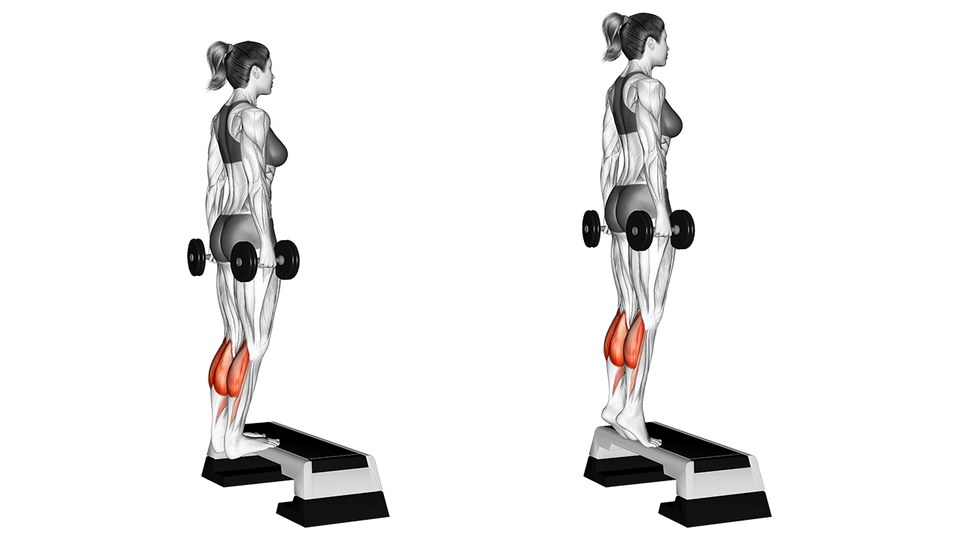
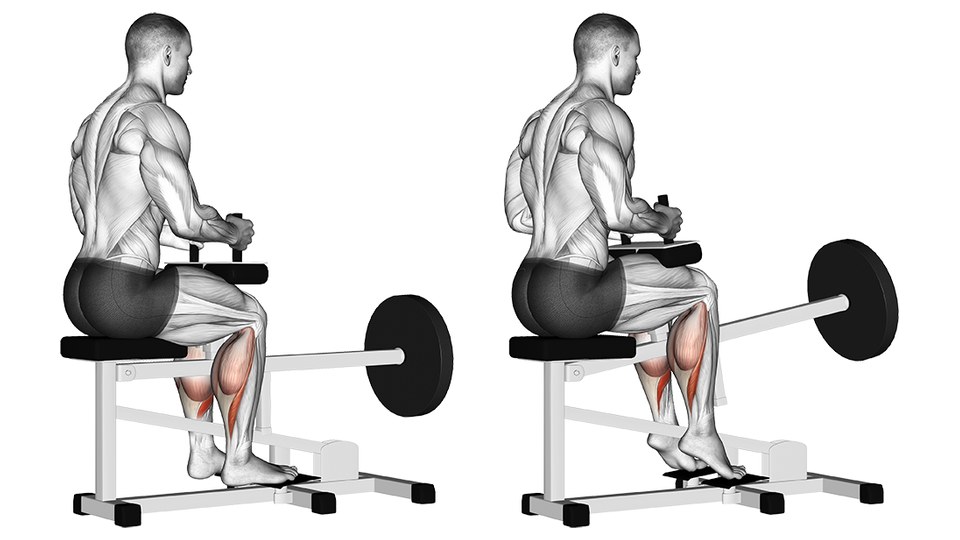
No. A calf press keeps the knees nearly straight on a leg press, while a seated calf raise bends the knees under a pad.
Sources
- Bordoni B, Varacallo MA. Anatomy, Bony Pelvis and Lower Limb: Gastrocnemius Muscle. StatPearls. https://www.ncbi.nlm.nih.gov/books/NBK532946/
- Binstead JT, Varacallo MA. Anatomy, Bony Pelvis and Lower Limb: Calf. StatPearls. https://www.ncbi.nlm.nih.gov/books/NBK459362/