Seated calf raise
Also called seated calf raises, seated heel raise, bent-knee calf raise, machine seated calf raise.
What is a seated calf raise?
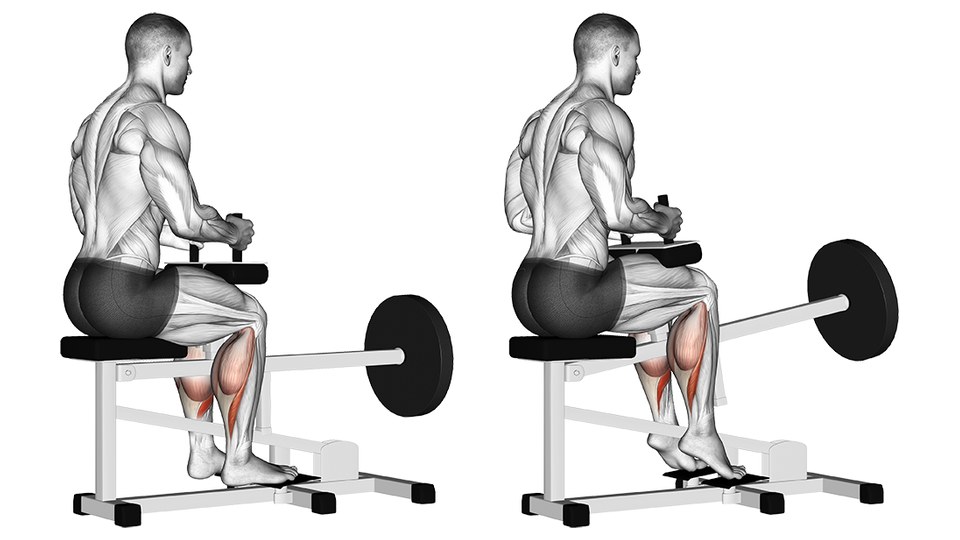
A seated calf raise is performed with the knees bent, usually with a machine pad across the lower thighs and the balls of the feet on a platform. It trains the soleus beneath the visible calf bulge. Bending the knee shortens the gastrocnemius, which crosses both the knee and ankle, but does not switch it off. Seated raises can grow the soleus; straight-knee calf work has stronger evidence for growing the gastrocnemius.
How do you perform a seated calf raise?
Set up
- Load the machine and raise the thigh pad high enough to sit down.
- Sit with the balls of your feet hip-width apart on the platform, toes forward and heels hanging off, then lower the pad onto your thighs just behind your kneecaps.
- Press through the balls of your feet to lift the pad, then swing the safety lever clear.
Execution
- Keeping your knees steady under the pad, lower your heels below the platform until your calves stretch.
- Pause without bouncing, then press through the balls of your feet and lift your heels as high as you can.
- Pause at the top, then lower slowly through the full range.
- After your last rep, lift the pad, swing the safety lever into place, and make sure it catches before you stand.
Common mistakes
Bouncing out of the bottom
The Achilles tendon stores and returns elastic energy, so a bounced rep is partly the tendon throwing the weight back up. The calf does less than the load on the machine suggests, and the tendon takes the peak instead of the muscle.
Loading it heavy and cutting the top short
Ankle plantarflexion has a small range to begin with. Trimming a couple of centimetres off the top removes a real fraction of the only range you have, which is how people end up doing a lot of hard sets and feeling nothing the next day.
Putting the pad on the kneecap
The load then presses on the patella rather than on muscle. It hurts enough that you cut the set short, and the set ends for a reason that has nothing to do with your calves.
Standing the midfoot on the platform
With the arch supported the heel has nowhere to drop, so the bottom half of the movement disappears. Only the ball of the foot belongs on the platform.
Relying only on seated raises for gastrocnemius growth
Seated raises train the calves, but direct comparisons favor straight-knee work for gastrocnemius growth. Include a standing raise or straight-leg calf press if that muscle is a priority. This does not mean everyone doing standing raises also needs seated work.
Where it fits in a session
End of a lower-body session, after the squats, presses and hamstring work.
Calves handle frequency well and recover quickly, so two or three lighter exposures a week tend to beat one heroic set. Sets of eight to fifteen with a genuine pause at the bottom, and progress the load only once the heel still travels its full distance on the last rep. If gastrocnemius growth is a priority, include a straight-knee variation across the week.
Muscles worked
Primary
Secondary
Schematic surface view. Some muscles are partly visible or not shown.
The soleus raises the heel without crossing the knee. The gastrocnemius crosses both the knee and ankle and is shortened at the knee in a seated raise. Both remain involved, but direct training studies favor straight-knee work for gastrocnemius growth and have not shown a clear seated advantage for soleus growth. The smaller plantarflexors are listed for their anatomical actions, not because these trials measured their growth.
What lifters actually do
The logs read like accessory work, and specifically like leg-day accessory work. About a third of regular RepCount users have logged a seated calf raise, and it appears in roughly one workout in thirty. When it does, it is almost never alone: leg extensions are in more than half of those workouts, leg curls in about four in ten, leg press in a third and squats in three in ten, in sessions running to about seven exercises. What is mostly absent is the other calf raise. Only about one workout in eight that contains a seated calf raise also contains a standing one, so for most lifters the seated version is not an addition to standing calf work on the day, it is instead of it.
Most often trained alongside
Share of seated calf raise sessions that also include each exercise.
- Leg extensions56.7%
- Leg curls39.7%
- Leg press35.5%
- Squat29.9%
- Calf raises12.3%
Figures come from workouts tracked in RepCount.
Scientific studies on the seated calf raise
Bending the knee changes the position of the gastrocnemius, the muscle forming the visible calf bulge. It does not switch off the whole calf. Two training studies help separate that anatomical explanation from what actually grows.
Seated raises can grow the soleus, but have not shown a clear advantage over straight-knee calf work for that muscle. Straight-knee work has stronger support for gastrocnemius growth. Doing both is an option, not a requirement established by these studies.
Is the seated calf raise better for soleus growth?
The soleus sits beneath the gastrocnemius and does not cross the knee. It can raise the heel with the knee bent or straight. That explains why seated raises train it, but does not establish that sitting produces more growth.
In a 12-week study of 14 untrained adults, one leg performed standing raises and the other seated raises. MRI measured soleus volume gains of 2.1% standing and 2.9% seated, without a statistically clear difference. An eight-week trial in 30 trained participants also found no clear soleus advantage when comparing straight-leg toe presses with seated raises.
Those small, short studies do not prove the exercises are equivalent. They do challenge the idea that seated work is necessary to make the soleus grow.
Study details: what was measured
Kinoshita and colleagues used standing and seated machines, with the seated knee bent to 90 degrees. Each leg trained twice weekly, building up to five sets of ten with progressive loads. MRI assessed whole-muscle volume. There was no non-training control group.
Burke and colleagues measured muscle thickness over eight weeks. Its straight-knee comparison was a toe press, so it was not an exact repeat of the standing-machine trial. We read its complete publisher abstract; the full methods and tables were not accessible.
How much gastrocnemius growth does seated work miss?
In the MRI study, standing raises produced more growth in both gastrocnemius heads: 12.4% versus 1.7% in the outer head, and 9.2% versus 0.6% in the inner head. The seated changes were not statistically clear. That does not mean the gastrocnemius is inactive when you sit.
The trial in trained participants favored straight-knee work for the inner head, but its outer-head result was inconclusive. The findings support including straight-knee work when gastrocnemius growth matters, without promising the same percentage gains to every lifter. Neither trial establishes which exercise is best for running, jumping or preventing injury.
Do you need both seated and standing raises?
The studies compared the exercises separately; they did not test whether combining them beats an equal amount of straight-knee work. Standing raises trained the soleus as well as the gastrocnemius in the MRI study.
If you want one exercise for overall calf growth, straight-knee work is a reasonable starting point. Seated raises remain an option for additional calf work or for training with a load on the thighs. That is a practical choice, not evidence that everyone needs a seated-and-standing pair.
Sources
Variations
- Dumbbell seated calf raise — Dumbbell stood on end on the lower thigh, balls of the feet on a block or a step. The usual way to do this at home.
- Barbell seated calf raise — Barbell across the lower thighs with a pad. Loads heavier than a dumbbell, but it takes help or a rack to get the bar into place.
- Smith machine seated calf raise — Bench and a block under a Smith bar. The rails hold the bar in line, so nothing has to be balanced on the thigh.
- Single leg seated calf raise — One foot on the platform at a time, so the stronger side cannot carry the set.
- Toes-in and toes-out seated calf raise — The same movement with the feet turned in or out instead of straight ahead.
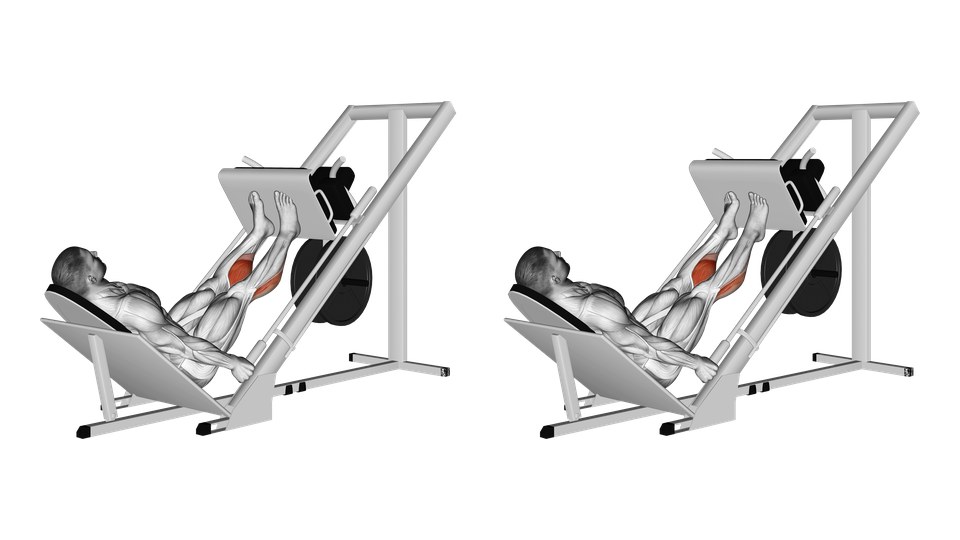
- Leg press calf pressCalf raises on a leg press with the knees close to straight. This keeps the gastrocnemius longer at the knee than a bent-knee seated raise; it is a different exercise despite the seated body position.
Articles
Related tools
Frequently asked questions
What muscles does the seated calf raise work?
The main target is the soleus, the broad muscle beneath the gastrocnemius. The gastrocnemius also contributes with the knee bent, although straight-knee calf work has produced more growth in direct comparisons. Other muscles that assist ankle plantarflexion include plantaris, tibialis posterior, the long toe flexors and the fibularis muscles. The studies here did not measure their growth.
What is the difference between a seated and a standing calf raise?
The main difference is knee position. A bent knee shortens the gastrocnemius at the knee; a straight knee keeps it longer there. The soleus does not cross the knee and works in both positions. Training studies favor straight-knee work for gastrocnemius growth, without showing a clear difference in soleus growth.
Do I need to do both seated and standing calf raises?
Not necessarily. Standing raises can train both the gastrocnemius and soleus, and the studies have not established that adding seated raises gives better growth than the same amount of straight-knee work. If you mainly do seated raises and want more gastrocnemius growth, including a straight-knee variation is a reasonable choice.
Should my toes point straight ahead, in, or out?
Straight ahead is what most people do and what most machines are built around, so it is the sensible default. Turning the feet in or out is a preference rather than a technique point, and this page makes no claim about what it changes. Worth saying because an illustration can only ever show one foot position: read the one you see here as an example, not as the instruction.
Can I do seated calf raises without a machine?
Yes. Sit on a bench with the balls of your feet on a block or a step and stand a dumbbell on end on your lower thigh. A barbell across both thighs with a pad loads heavier, and a Smith machine bar does the same without anything to balance. The knee angle is what matters, not the equipment holding the weight.
How often do lifters actually do seated calf raises?
About a third of regular RepCount users have logged one, and they show up in roughly one workout in thirty. Almost always inside a full lower-body session: leg extensions are in more than half of those workouts, leg curls in about four in ten, leg press in a third and squats in three in ten. The thing usually missing is the other calf raise, which appears alongside in only about one workout in eight.
How many sets and reps should I do?
Around three sets is what most RepCount users log when they do this, in a session of about seven exercises, which is the shape of accessory work rather than a main lift. Calves tolerate being trained often, so spreading the work across the week is easier to recover from than one very hard set. What the weight should be is a question the range of motion answers: if the heel stops travelling, the weight is too heavy.
Sources
- Anatomy, Bony Pelvis and Lower Limb: Leg Posterior Compartment. StatPearls, NCBI Bookshelf. https://www.ncbi.nlm.nih.gov/books/NBK537340/
- Bordoni B, Varacallo MA. Anatomy, Bony Pelvis and Lower Limb: Gastrocnemius Muscle. StatPearls, NCBI Bookshelf. https://www.ncbi.nlm.nih.gov/books/NBK532946/
- Anatomy, Bony Pelvis and Lower Limb: Calf. StatPearls, NCBI Bookshelf. https://www.ncbi.nlm.nih.gov/books/NBK459362/
- Anatomy, Bony Pelvis and Lower Limb: Leg Lateral Compartment. StatPearls, NCBI Bookshelf. https://www.ncbi.nlm.nih.gov/books/NBK519526/
- Kinoshita M et al. Triceps surae muscle hypertrophy is greater after standing versus seated calf-raise training. Frontiers in Physiology, 2023. https://pmc.ncbi.nlm.nih.gov/articles/PMC10753835/
- Burke R et al. Exercise Selection Differentially Influences Lower Body Regional Muscle Development. Published online 2024; volume 7, 2025. https://link.springer.com/article/10.1007/s42978-024-00299-4