Cross-body hammer curl
Also called pinwheel curl, cross body hammer curl.
What is a cross-body hammer curl?
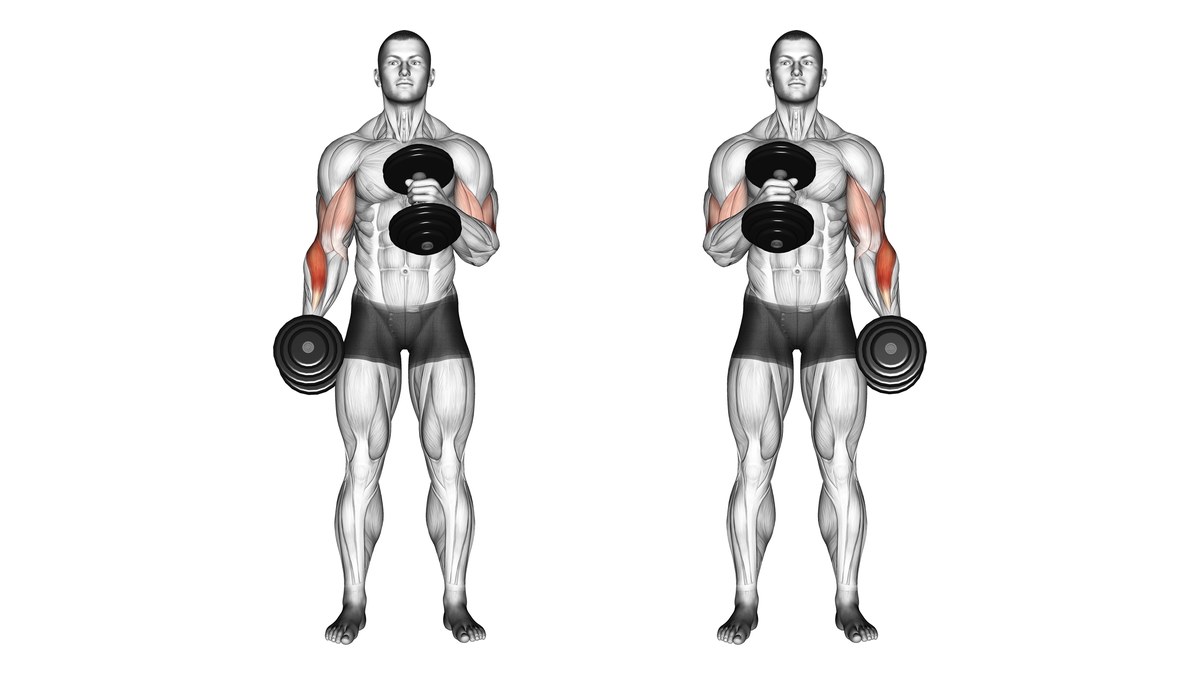
A cross-body hammer curl brings a dumbbell diagonally across your torso toward the opposite shoulder while keeping a neutral, thumb-up grip. Also called a pinwheel curl, it changes the hand path of a standing hammer curl without turning the palm upward.
How do you perform a cross-body hammer curl?
Set up
- Stand with a dumbbell beside each thigh, feet comfortably apart and palms facing inward. Choose weights you can lift without turning your torso.
- Settle your elbows near your sides and keep your wrists in line with your forearms. Leave space for each dumbbell to pass in front of your body.
Execution
- Bend one elbow and bring that dumbbell across your chest toward the opposite shoulder, keeping the thumb uppermost.
- Stop before you need to lift the elbow or twist your body to bring the weight higher.
- Guide the dumbbell back down beside its starting thigh until the arm is straight without forcing the elbow.
- Repeat on the other side and continue alternating, keeping the unused arm down.
Common mistakes
Turning the palm up during the lift
Keep the same hammer grip as the dumbbell crosses your body. If the wrist keeps turning, try a lighter weight and a shorter, controlled path.
Reaching across by rotating the torso
Keep both shoulders facing forward rather than turning your chest toward the working hand.
Bouncing the dumbbell off your chest
Reverse before contact and lower the weight under control rather than using your body as a stop.
Where it fits in a session
Use it where your session calls for curl accessory work.
Choose the load for controlled repetitions from setup through the last return. Keep the same movement as the set becomes harder; reduce the weight if you have to change the path.
Muscles worked
Primary
Secondary
- None listed in this guide
Schematic surface view. Some muscles are partly visible or not shown.
These elbow flexors are listed together without an activity or growth ranking.
Variations
Frequently asked questions
Is a pinwheel curl the same exercise?
Yes. Pinwheel curl is another name for this cross-body dumbbell hammer curl. Keep both names on the same exercise rather than treating them as different movements.
How is it different from a regular hammer curl?
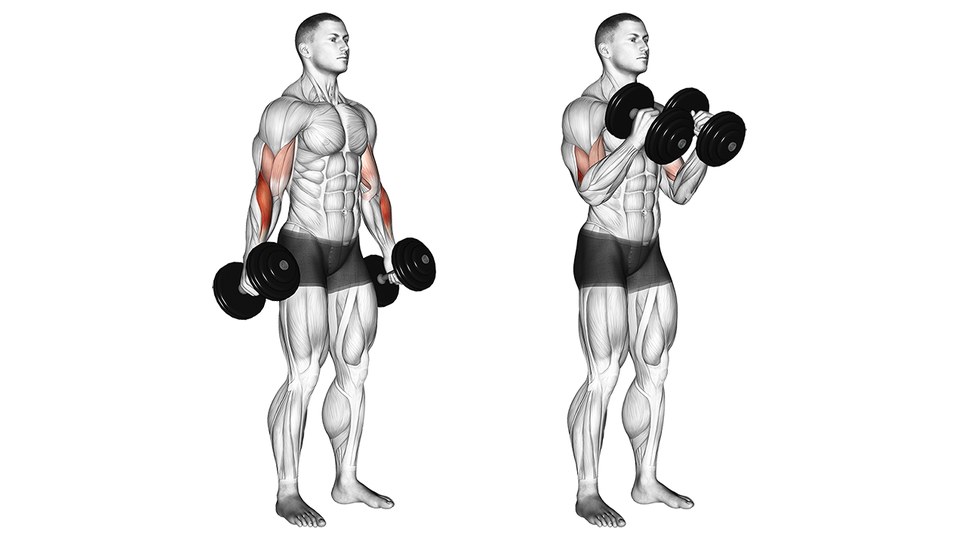
The neutral grip stays the same. The working hand travels diagonally toward the opposite shoulder rather than forward toward its own shoulder.
Should the dumbbell touch the shoulder?
There is no need to touch it. End the lift where you can keep the wrist aligned and the torso still, with space between the dumbbell and your body.
Can you finish one arm before switching?
Yes. Alternating arms is the version described here and shown in the video; completing one side first is another way to organize the set.
Which muscles does it train?
The biceps brachii, brachialis and brachioradialis contribute to bending the elbow. The target list does not rank their activity or claim that the cross-body path isolates one of them.
Sources
- Tiwana MS; Charlick M; Varacallo MA. Anatomy, Shoulder and Upper Limb, Biceps Muscle. StatPearls. https://www.ncbi.nlm.nih.gov/sites/books/NBK519538/
- Plantz MA; Bordoni B. Anatomy, Shoulder and Upper Limb, Brachialis Muscle. StatPearls. https://www.ncbi.nlm.nih.gov/sites/books/NBK551630/
- Lung BE; Ekblad J; Bisogno M. Anatomy, Shoulder and Upper Limb, Forearm Brachioradialis Muscle. StatPearls. https://www.ncbi.nlm.nih.gov/sites/books/NBK526110/