
Cable hammer curl
Also called cable hammer curls, cable hammer, rope cable hammer curl, rope hammer curl.
What is a cable hammer curl?
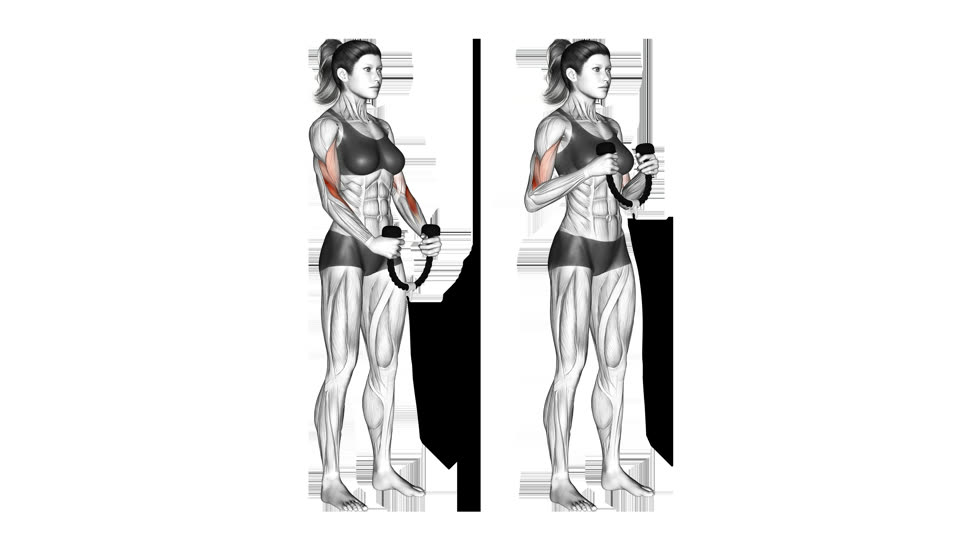
The cable hammer curl is a standing neutral-grip curl performed with a rope on a low pulley. Bend the elbows while keeping the upper arms quiet; the brachialis, brachioradialis and biceps brachii share the work.
How do you perform a cable hammer curl?
Set up
- Attach a rope to the lowest pulley, face the machine and take one end in each hand with the palms facing one another.
- Step back just enough to tension the cable, stand tall and let your arms hang with the elbows close to your sides.
Execution
- Curl the rope upward by bending your elbows while keeping the upper arms beside your torso.
- Finish before the elbows drift forward or the rope ends turn into a palms-up grip.
- Lower under control until the elbows are nearly straight, keeping tension on the cable before the next rep.
Common mistakes
Turning the palms upward
That changes the neutral grip that defines the hammer-curl variation. Keep the rope ends upright.
Leaning back to start the curl
Torso movement gives the cable momentum before the elbow flexors do the work. Use a load you can start while standing still.
Pulling the elbows behind the body at the bottom
Stepping too far back changes the shoulder position and makes the first part of the curl inconsistent. Stand only far enough to keep tension.
Where it fits in a session
Use it after compound pulling or alongside another curl when a neutral grip and cable resistance fit the session.
Keep the pulley height, step-back distance and rope attachment consistent when progressing the logged load.
Muscles worked
Primary
Secondary
Schematic surface view. Some muscles are partly visible or not shown.
A neutral grip changes wrist and forearm position but does not isolate one elbow flexor; the brachialis, brachioradialis and biceps all contribute.
Variations
Frequently asked questions
What muscles do cable hammer curls work?
The brachialis, brachioradialis and biceps brachii all help bend the elbow. The forearm flexors help hold the rope.
Should you separate the rope at the top?
Only as far as you can without changing the neutral grip or moving the upper arms. Pulling the ends wide is not required to complete the curl.
Are cable hammer curls the same as dumbbell hammer curls?
They use the same neutral grip and elbow action, but a cable pulls from the low pulley while dumbbells are resisted mainly by gravity.
How far should you stand from the cable machine?
Stand far enough that the cable remains taut at the bottom, but not so far that your elbows are pulled behind your torso.
Sources
- Anatomy, Shoulder and Upper Limb, Biceps Muscle. StatPearls, NCBI Bookshelf. https://www.ncbi.nlm.nih.gov/books/NBK519538/
- Plantz MA, Bordoni B. Anatomy, Shoulder and Upper Limb, Brachialis Muscle. StatPearls, NCBI Bookshelf. https://www.ncbi.nlm.nih.gov/books/NBK551630/