
Decline crunch
Also called decline bench crunch.
What is a decline crunch?
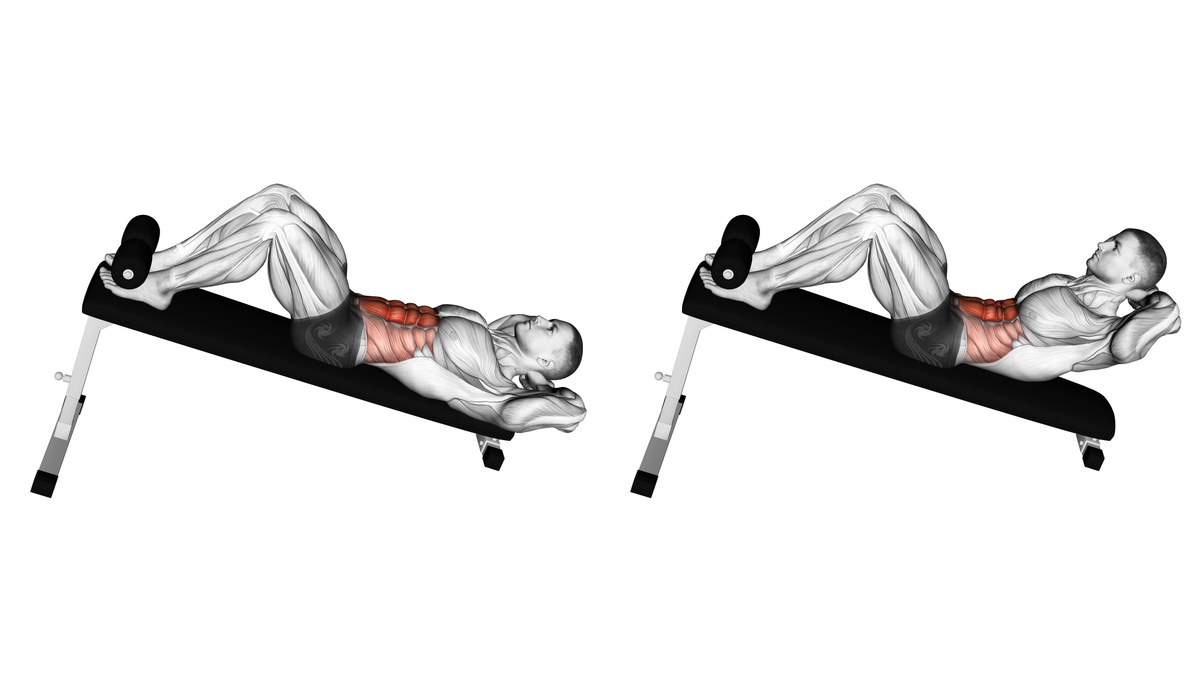
A decline crunch is a short abdominal curl on a bench with your head lower than your hips and your feet secured. You lift your shoulder blades by curling the trunk, then lower back to the pad. Unlike a decline sit-up, you stop before raising the whole torso toward upright.
How do you perform a decline crunch?
Set up
- Use a stable decline bench with a shallow slope. Lock any angle adjustment and check that the foot supports are secure.
- Sit at the raised end, secure your feet under the padded supports and lower your back onto the pad with your knees bent.
- Rest your fingers lightly behind your head, keep your elbows open and leave space between your chin and chest.
Execution
- Breathe out as you curl your ribs toward your pelvis and lift your head and shoulder blades together.
- End the curl while your pelvis and lower back remain supported. Do not continue into a full sit-up.
- Lower your shoulders gently to the pad as you breathe in. Keep your hands light and repeat the same short curl.
Common mistakes
Sitting all the way up
A full torso rise changes this into a decline sit-up. Keep the repetition to the shoulder-blade lift described here.
Pulling the head toward the knees
Keep your hands light and move the head with the trunk. Try folding your arms across your chest if you keep tugging on your head.
Bouncing off the bench
Settle your shoulders onto the pad under control. End the set when you cannot repeat the same short curl without a rebound.
Where it fits in a session
Include it with your other abdominal exercises, for example after your main lifts.
Choose a repetition target you can finish with the same short curl and controlled return. Build repetitions at a repeatable bench setting before changing the setup. A floor crunch is a useful regression; a cable crunch is an option when you want adjustable external resistance.
Muscles worked
Primary
Secondary
Schematic surface view. Some muscles are partly visible or not shown.
The rectus abdominis bends the spine forward, with the obliques assisting the curl. Keeping the movement short does not mean the hip flexors are completely inactive, especially with the feet secured.
Variations
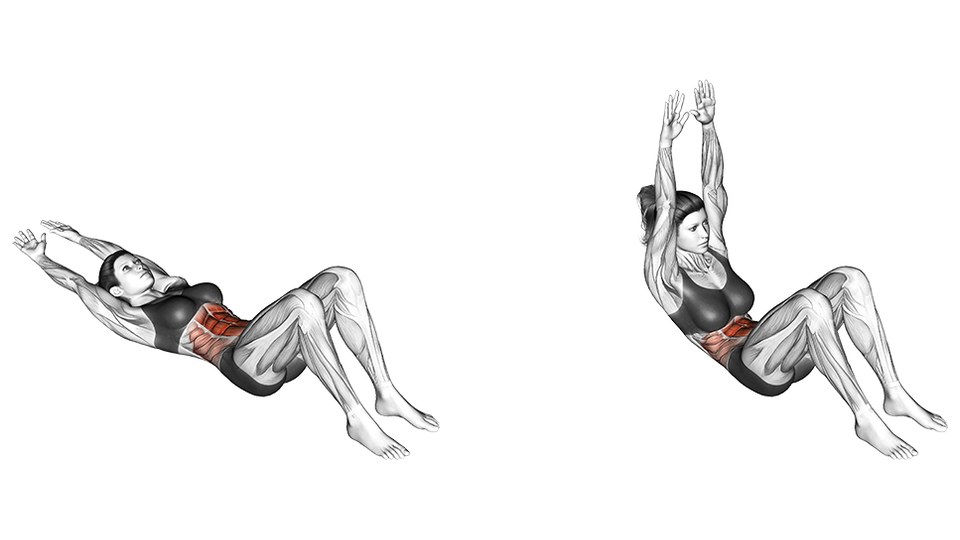
- CrunchPractice the short curl on the floor if controlling the decline setup is difficult or no suitable bench is available.
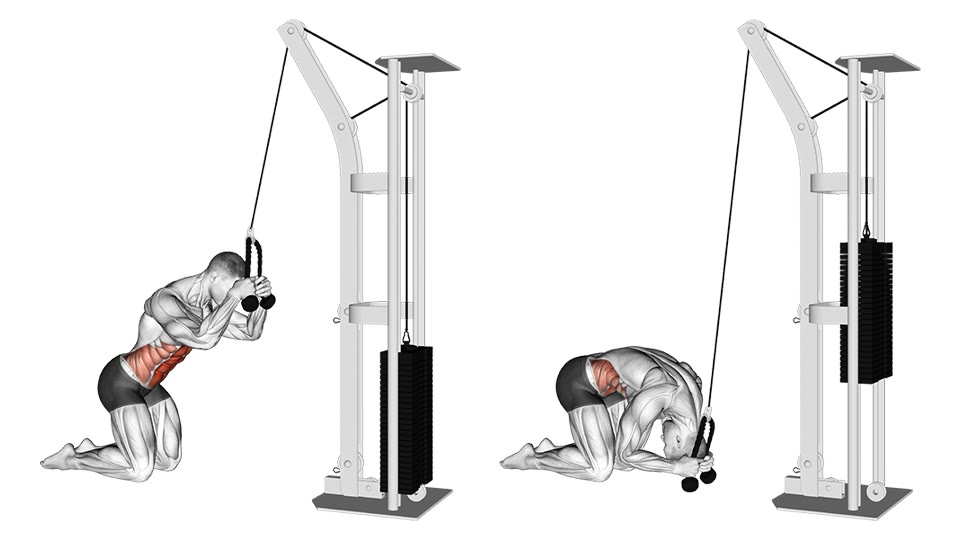
- Cable crunchUses a cable stack for adjustable resistance instead of a bodyweight curl on a decline bench.
Frequently asked questions
Is a decline crunch the same as a decline sit-up?
No. This crunch stops after the shoulder blades lift, with the pelvis and lower back supported. A decline sit-up continues into a much larger torso rise that includes hip flexion. Securing the feet does not turn every short curl into a sit-up, or remove all hip-flexor involvement.
What muscles do decline crunches work?
The main target is the rectus abdominis, with the internal and external obliques assisting trunk flexion. This is an abdominal exercise, but keeping the feet secured does not isolate the abs from every hip flexor.
Where should I put my hands?
The illustration shows hands behind the head. Keep them light, without pulling. Folding your arms across your chest is another option. Use the position that lets you repeat the curl without leading with your chin.
What if I cannot control the decline crunch yet?
Practice a floor crunch first. If you use a decline bench, choose a shallow setting with secure foot supports and keep the curl short. Do not improvise a slope by balancing a flat bench on loose plates or boxes.
How should I progress decline crunches?
Start by repeating the same controlled range, then add repetitions while keeping the bench setting and hand position consistent. Avoid counting a larger sit-up as progress in this exercise. For adjustable external resistance, consider a cable crunch.
Sources
- Flynn W, Vickerton P. Anatomy, Abdomen and Pelvis: Abdominal Wall. StatPearls, updated 2023. https://www.ncbi.nlm.nih.gov/books/NBK551649/
- Varacallo MA, Scharbach S, Al-Dhahir MA. Anatomy, Anterolateral Abdominal Wall Muscles. StatPearls, updated 2023. https://www.ncbi.nlm.nih.gov/books/NBK470334/
- Burden AM, Redmond CG. Abdominal and hip flexor muscle activity during 2 minutes of sit-ups and curl-ups. J Strength Cond Res. 2013;27(8):2119-2128. https://pubmed.ncbi.nlm.nih.gov/23207881/