
Donkey calf raise
Also called donkey calf raises, machine donkey calf raise, lever donkey calf raise.
What is a donkey calf raise?
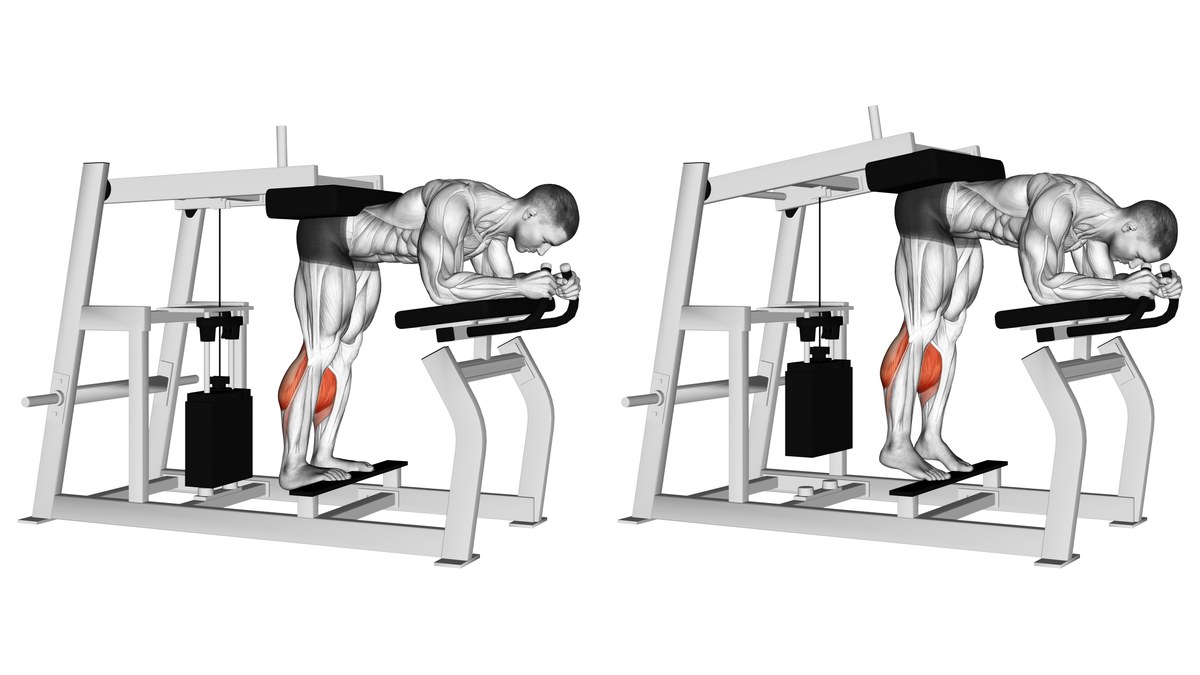
A donkey calf raise is a heel raise performed with your torso bent forward and your knees straight. This guide uses a dedicated machine: your forearms rest on supports while a padded lever loads the back of your hips. You lift and lower your heels to train the gastrocnemius and soleus in your calves.
How do you perform a donkey calf raise?
Set up
- Set the machine's pad height so it rests across the back of your pelvis when you bend forward. Choose a light starting load and check how to enter and leave the machine.
- Step onto the platform with the front of each foot supported and both heels clear of the rear edge. Bend at your hips and settle under the pad.
- Rest your forearms on the arm pads, hold the handles and straighten your knees without forcing them backward. Keep your back steady.
Execution
- Press down through your forefeet to lift both heels as far as you comfortably can. Your hips rise with your heels while your torso stays hinged.
- Lower slowly, letting your heels move below the platform to a comfortable stretch without rounding your back.
- Change direction smoothly and repeat without bending your knees to help the weight up.
- At the end of the set, lower the machine to its resting position before stepping out from under the pad.
Common mistakes
Rocking forward and back under the pad
Repositioning your hips on each rep can shift the pad and change your starting position. Reset the support height if you cannot stay settled.
Using a knee dip to start the lift
Bending and straightening the knees adds a leg push to the heel raise. Reduce the load until you can keep the knees in the same position.
Letting the platform sit under only your toe tips
You need room for the heels to move, but the front of each foot should have a secure contact with the platform. Reposition your feet before starting.
Where it fits in a session
Start with a load that lets you settle into the machine and control both ends of each rep. If the pad shifts or the heels barely move, reduce the weight before adding repetitions.
Muscles worked
Primary
Secondary
- None listed in this guide
Schematic surface view. Some muscles are partly visible or not shown.
The gastrocnemius lies over the soleus. Both contribute to raising the heel.
Variations
- Standing calf raiseAn upright calf raise with the torso held tall.
Frequently asked questions
What muscles does a donkey calf raise work?
It works the gastrocnemius and soleus. Both help point the foot downward at the ankle, which raises your heel when the front of your foot is supported. The gastrocnemius is the superficial calf muscle, with the soleus beneath it.
Where should the machine's pad sit?
Position it across the back of your pelvis at the hips. Adjust the machine before the set so you can keep your forearms supported, your knees straight and your heels free to move. If you cannot reach that position, ask gym staff to help you adjust the machine.
Why do you lean forward?
The forward lean places your hips under the padded lever while your forearms rest on the front supports. Hold that position as your heels move. You do not need to repeatedly bend and straighten your torso to lift the pad.
Do donkey calf raises require a partner?
No. This guide uses a dedicated machine whose padded lever supplies the resistance over your hips.
How is this different from a seated calf raise?
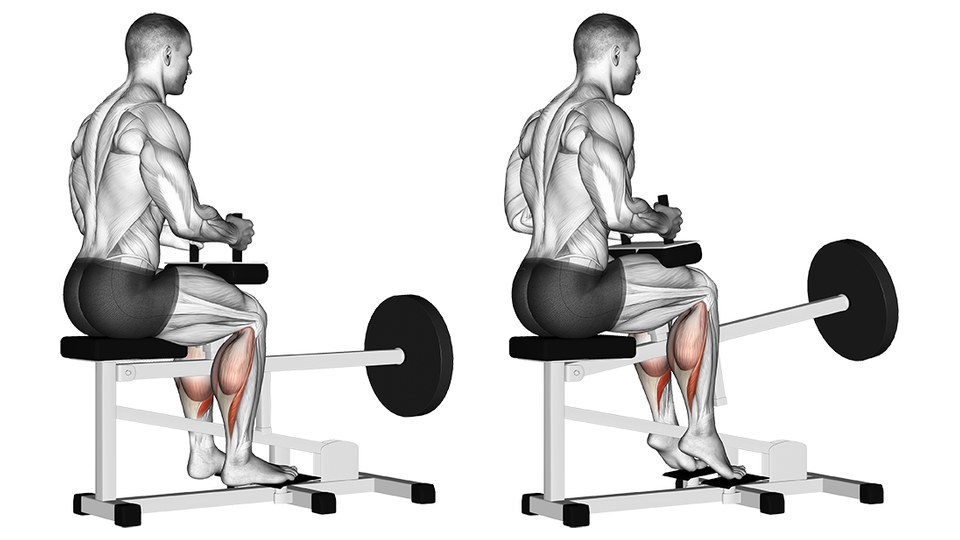
Here you stand with straight knees and bend forward at the hips. In a seated calf raise, you sit with bent knees and the load rests over your thighs. They are different setups, so keep track of their loads separately.
Sources
- Abuqubo R, Graefe SB, La Rose J. Anatomy, Bony Pelvis and Lower Limb: Leg Posterior Compartment. StatPearls. Updated May 13, 2026. https://www.ncbi.nlm.nih.gov/sites/books/NBK537340/