Dumbbell deadlift
What is a dumbbell deadlift?
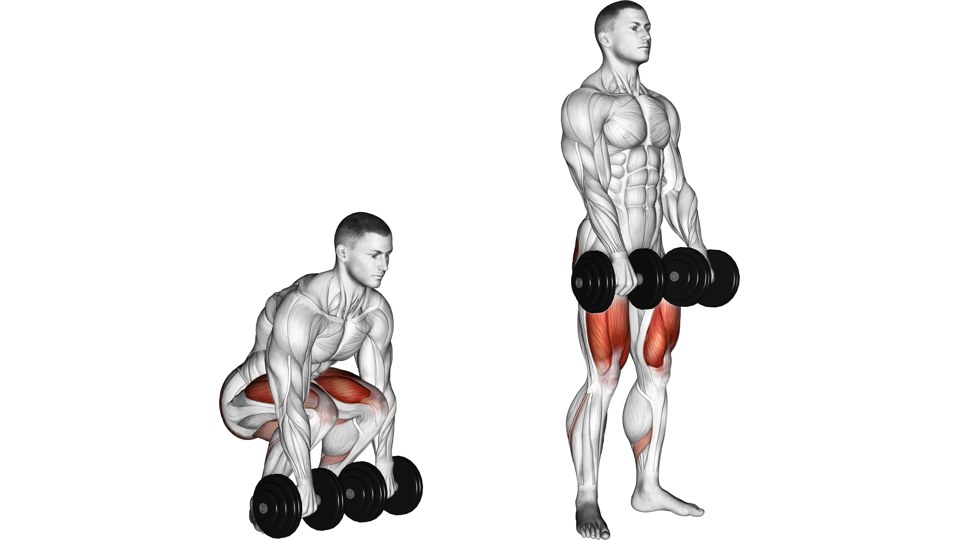
A dumbbell deadlift lifts two dumbbells from the floor to a standing position by straightening the hips and knees. This guide covers the bent-knee version with the weights in front of the legs, rather than a dumbbell Romanian deadlift.
How do you perform a dumbbell deadlift?
Set up
- Place two dumbbells side by side on the floor just in front of your feet. Stand about hip width apart, with room for your knees between your arms.
- Move your hips back and bend your knees to grasp both handles with your palms facing you. Keep your feet flat and your arms long.
- Brace your trunk and settle your back into a steady position before the weights leave the floor.
Execution
- Press into the floor and stand up, bringing your hips and shoulders upward together. Keep the dumbbells close to your legs.
- Finish upright with the weights in front of your thighs. Keep your arms straight and avoid leaning backward.
- Move the hips back and bend the knees to return both dumbbells to the floor. Let them settle, then reset your brace for the next repetition.
Common mistakes
Hips shooting up first
This leaves the chest behind as the weights start moving. Reset and choose a load that lets your hips and shoulders rise together.
Reaching the weights forward
Keep the dumbbells near the legs throughout the lift instead of letting them drift away.
Turning each rep into a Romanian deadlift
This version includes a deliberate knee bend and a floor reset. Keep those features rather than stopping with nearly straight knees.
Where it fits in a session
Place it where your session calls for a deadlift or another loaded lower-body movement.
Choose a weight that lets you repeat the floor setup and standing finish without changing the movement. When starting a new log, enter the weight of one dumbbell and count one lift to standing as one rep. If your existing history uses the combined weight, keep that convention consistent.
Muscles worked
Primary
Secondary
- None listed in this guide
Schematic surface view. Some muscles are partly visible or not shown.
The glutes help straighten the hips and the quadriceps straighten the knees. Both are listed for their roles in the movement, without ranking their relative workload.
Variations
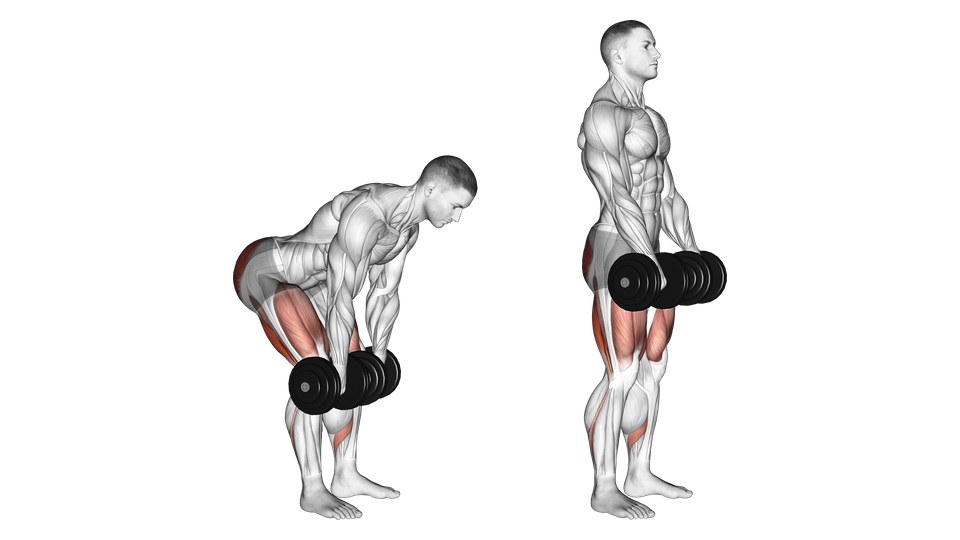
- Dumbbell Romanian deadliftStarts from standing and uses less knee bend, without requiring a floor reset.
Frequently asked questions
Is this the same as a Romanian deadlift?
No. This version starts on the floor and includes enough knee bend to reach the handles. A Romanian deadlift begins from standing and is lowered mainly by moving the hips back.
Should the dumbbells be in front or at the sides?
This guide and illustration use two dumbbells in front of the legs. Keep that placement consistent when following these steps.
Sources
- Adel Elzanie; Judith Borger. Anatomy, Bony Pelvis and Lower Limb, Gluteus Maximus Muscle. StatPearls, NCBI Bookshelf. https://www.ncbi.nlm.nih.gov/sites/books/NBK538193/
- Bruno Bordoni; Matthew A. Varacallo. Anatomy, Bony Pelvis and Lower Limb: Thigh Quadriceps Muscle. StatPearls, NCBI Bookshelf. https://www.ncbi.nlm.nih.gov/sites/books/NBK513334/