
Dumbbell Romanian deadlift
Also called dumbbell RDL, DB Romanian deadlift, dumbbell stiff-leg deadlift.
What is a dumbbell Romanian deadlift?
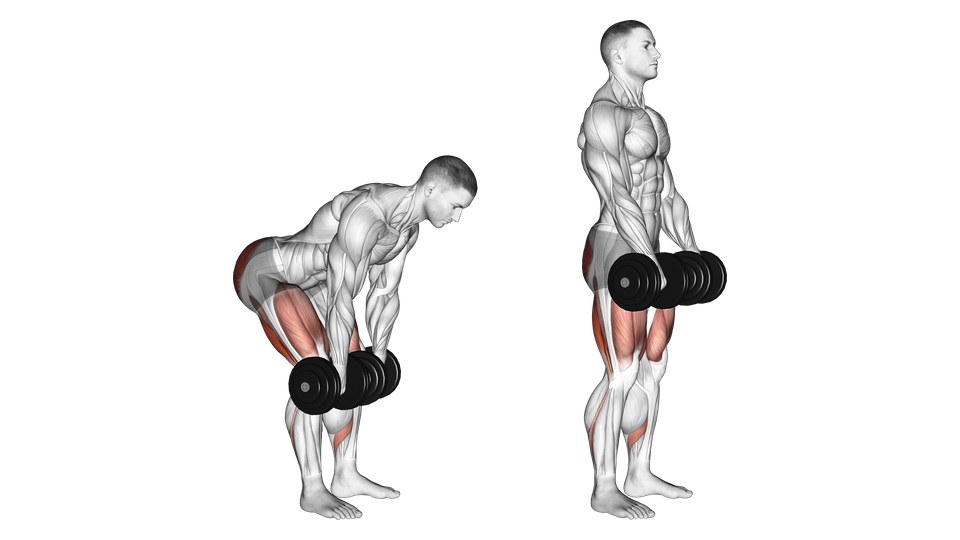
A dumbbell Romanian deadlift is a hip hinge performed with a dumbbell in each hand. You push the hips back with softly bent knees, lower the weights close to the legs until the hamstrings limit the range, then stand by extending the hips.
How do you perform a dumbbell Romanian deadlift?
Set up
- Stand with a dumbbell in each hand, feet around hip width and the weights resting in front of your thighs.
- Soften your knees, brace your trunk and draw your shoulders gently back and down.
Execution
- Push your hips behind you while keeping the dumbbells close to your legs and your shins nearly vertical.
- Stop when you feel a strong hamstring stretch or before your back position changes; the dumbbells do not need to reach the floor.
- Drive your feet into the floor and bring your hips forward to stand tall without leaning back.
Common mistakes
Turning the hinge into a squat
Excessive knee bend sends the hips down instead of back and changes the movement. Keep a soft, mostly fixed knee angle while the hips travel behind you.
Reaching the dumbbells toward the floor
Floor contact is not the target. Stop at the deepest range you can reach through the hips without rounding the back or losing balance.
Letting the weights drift forward
A larger gap increases the demand on the back and makes the hinge harder to control. Let the dumbbells skim close to the thighs and shins.
Where it fits in a session
Use it as the main hinge in a dumbbell session or as hamstring-focused work after squats or heavier deadlifts.
Choose a load that lets the hips set the depth on every rep. Straps can help when grip fails before the hamstrings, but they do not change the movement.
Muscles worked
Primary
Secondary
Schematic surface view. Some muscles are partly visible or not shown.
The hamstrings and gluteus maximus extend the hips, while the spinal erectors help hold the trunk steady during the hinge.
Variations
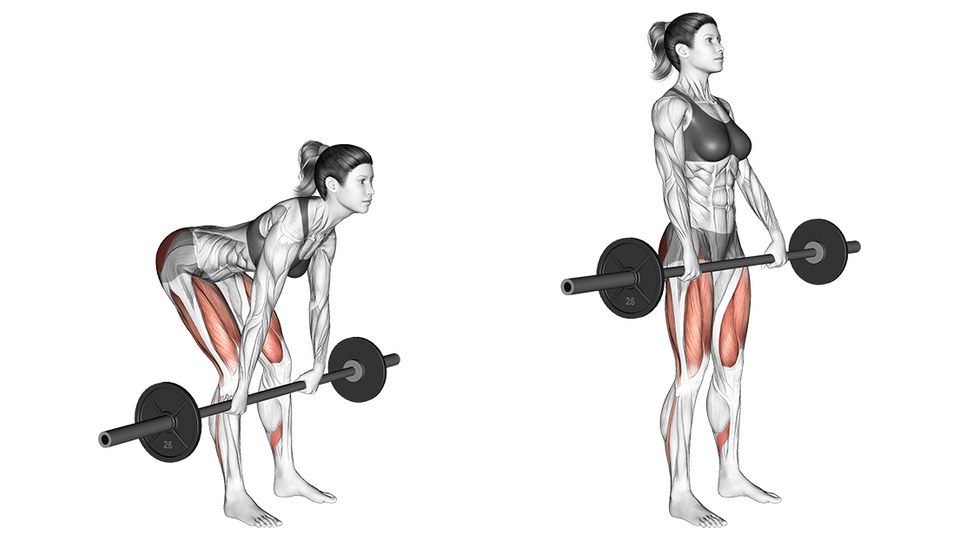
- Barbell Romanian deadliftUses one bar in front of the thighs, allowing both hands to share a single load.
- Single-leg Romanian deadlift — Performs the hinge mainly on one leg and adds a larger balance demand.
- Kettlebell Romanian deadlift — Holds one or two kettlebells while keeping the same hip-hinge pattern.
Related tools
Frequently asked questions
What muscles do dumbbell Romanian deadlifts work?
The hamstrings and gluteus maximus are the main targets. The spinal erectors help keep the trunk steady while you hinge.
How low should the dumbbells go?
Lower until the hamstrings limit the hinge or your back position would change. The right depth depends on your proportions and mobility, not on touching the floor.
Should the knees bend during a dumbbell Romanian deadlift?
Yes, but only slightly. Set a soft knee bend and keep it fairly steady as the hips move back.
Sources
- Hu Y, Raja A. Anatomy, Bony Pelvis and Lower Limb, Hamstring Muscle. StatPearls. https://www.ncbi.nlm.nih.gov/books/NBK546688/
- Elzanie A, Borger J. Anatomy, Bony Pelvis and Lower Limb, Gluteus Maximus Muscle. StatPearls. https://www.ncbi.nlm.nih.gov/books/NBK538193/
- Henson B, Kadiyala B, Edens MA. Anatomy, Back, Muscles. StatPearls. https://www.ncbi.nlm.nih.gov/books/NBK537074/