
Dumbbell front squat
What is a dumbbell front squat?
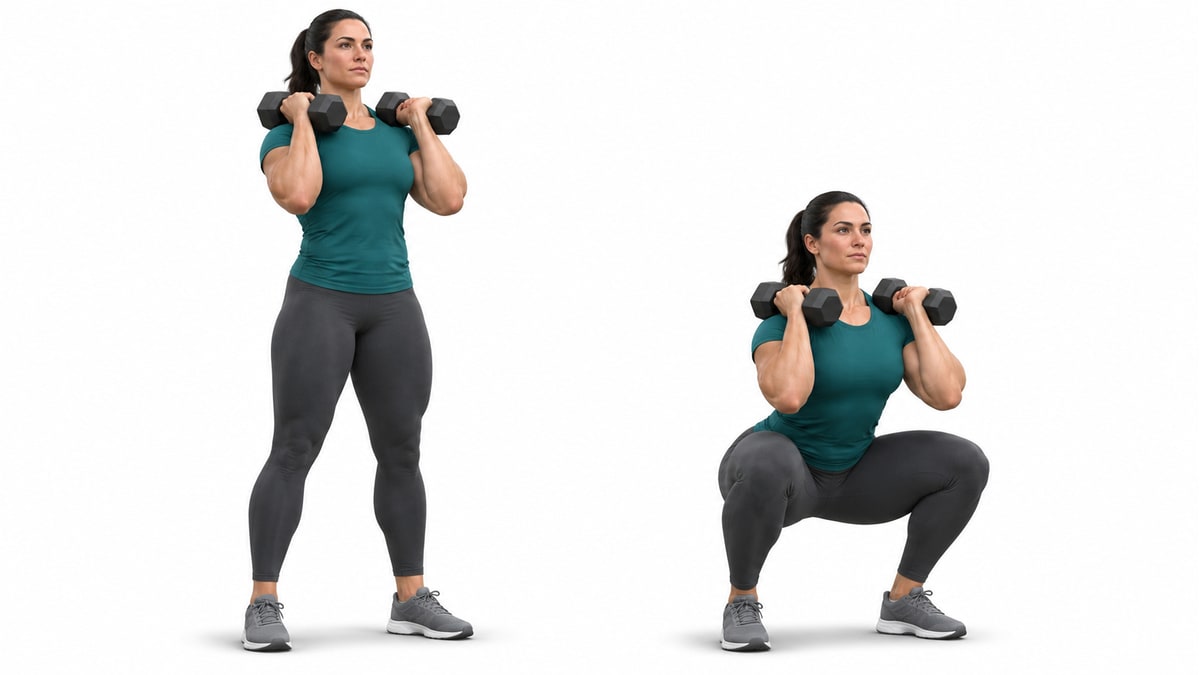
A dumbbell front squat is a squat with two dumbbells held at the fronts of your shoulders, one in each hand. Keep them there as you bend your knees and hips, then stand again. It trains the quadriceps and gluteus maximus. A goblet squat uses one weight held in both hands at the chest instead.
How do you perform a dumbbell front squat?
Set up
- Choose two equal dumbbells you can bring to your shoulders and lower safely. Stand around shoulder width with a dumbbell in each hand and your toes turned slightly out.
- Bring the dumbbells to your shoulders with your palms facing each other. Rest one end of each weight against its shoulder, keep a full grip and point your elbows forward.
Execution
- Brace your midsection and bend your hips and knees to lower into the squat. Keep both feet planted and let your knees follow the direction of your toes.
- Lower only as far as you can keep the dumbbells steady, your chest from collapsing and your heels on the floor.
- Press into the floor to stand, straightening your hips and knees together while the weights stay at your shoulders.
- After the last rep, settle into a steady standing position before lowering the dumbbells to your sides and setting them down under control.
Common mistakes
Letting a dumbbell roll away from the shoulder
Stop the set and lower the weights before adjusting your grip. Use a lighter pair if you cannot keep both weights close throughout the squat.
Chasing depth after the hold starts to fail
Finish the descent while your feet and weights are still steady. Repeat that range instead of dropping farther and trying to recover on the way up.
Turning the finish into a press
Finish standing with the dumbbells at your shoulders. An overhead press adds another movement and should be a deliberate exercise choice.
Where it fits in a session
Use it as the squat in a dumbbell workout, or as additional squat work after your main lift.
Choose the load around the whole set: bringing the dumbbells up, squatting with a steady hold and putting them down. Build repeatable reps before adding weight, and keep a separate training history from goblet and barbell front squats.
Muscles worked
Primary
Secondary
- None listed in this guide
Schematic surface view. Some muscles are partly visible or not shown.
The quadriceps straighten the knees, and the gluteus maximus extends the hips as you stand. These are the main leg muscles listed here; holding the weights at your shoulders is part of the setup, rather than a shoulder press.
Variations

Related tools
Frequently asked questions
What muscles does a dumbbell front squat work?
The quadriceps and gluteus maximus are the main leg muscles listed for this guide. The quadriceps straighten your knees; the gluteus maximus helps bring your hips back to standing. Keep the dumbbells at your shoulders rather than adding a press at the top.
Is a dumbbell front squat the same as a goblet squat?
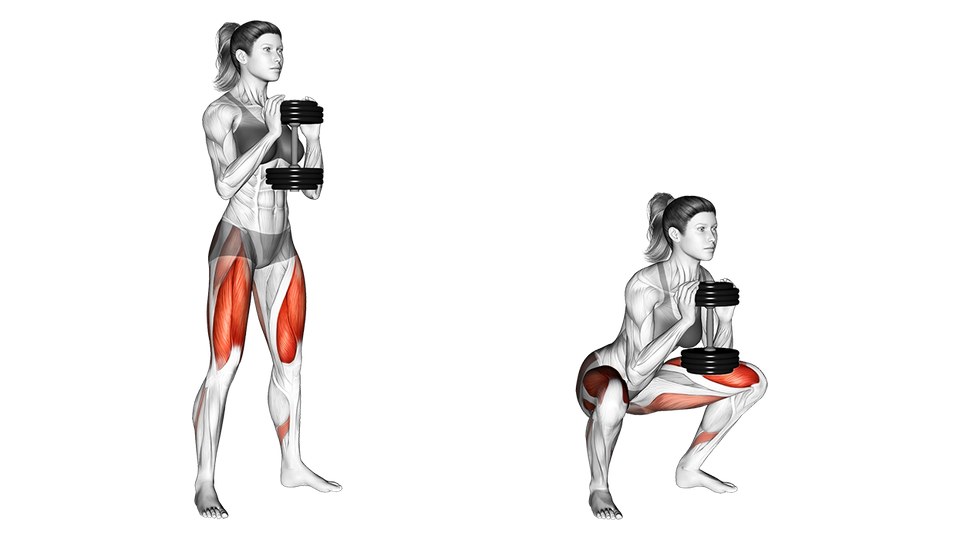
They use different holds. This guide uses two dumbbells, with one at each shoulder. A goblet squat uses one dumbbell or kettlebell held in both hands in front of the chest. Log them as separate exercises so the weights and reps remain comparable.
How should I hold the dumbbells?
Hold a handle in each hand with your palms facing inward and one end of each dumbbell resting against the front of its shoulder. Keep your grip closed. Adjust the elbow angle enough to find a steady, comfortable hold; you do not need to force your upper arms horizontal.
How deep should I squat?
Choose a depth you can reach and leave under control, with your heels down and both dumbbells secure. Start with a shorter range if your chest folds forward or the weights roll away. Keep the same stance and depth from rep to rep before adding load.
What weight should I start with?
Start with a light pair that you can bring to your shoulders and lower without a struggle. You should be able to complete your planned reps without losing the hold or changing your squat depth. The weight you can get into position is part of the choice, even when your legs could squat more.
Sources
- Bordoni B, Varacallo MA. Anatomy, Bony Pelvis and Lower Limb: Thigh Quadriceps Muscle. StatPearls; updated 2023 May 8. https://www.ncbi.nlm.nih.gov/books/NBK513334/
- Elzanie A, Borger J. Anatomy, Bony Pelvis and Lower Limb, Gluteus Maximus Muscle. StatPearls; updated 2023 April 1. https://www.ncbi.nlm.nih.gov/books/NBK538193/