Goblet squat
Also called goblet squats, dumbbell goblet squat, DB goblet squat, kettlebell goblet squat.
What is a goblet squat?
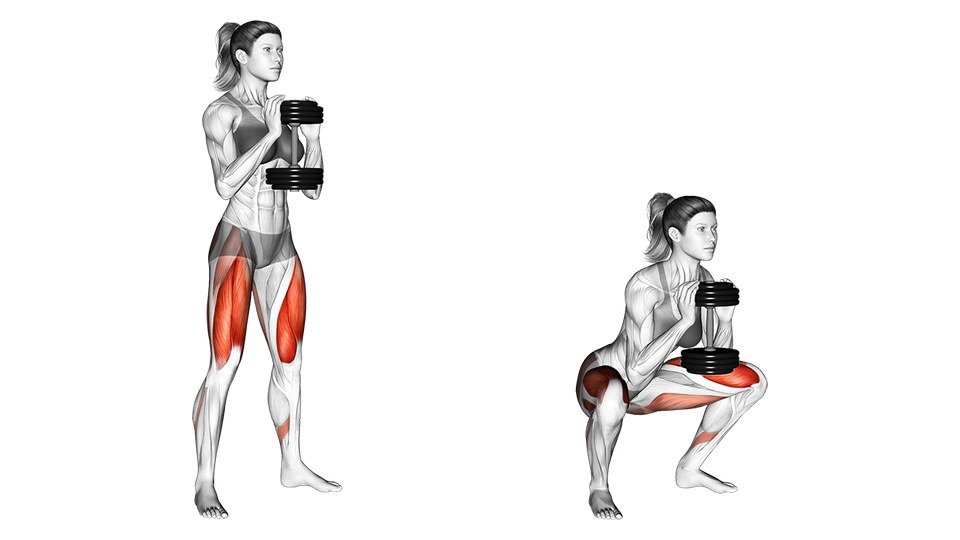
A goblet squat is a squat performed while holding one dumbbell vertically against the chest. The front-held load trains the quadriceps, gluteus maximus and adductor magnus while giving the arms a simple way to keep the weight close.
How do you perform a goblet squat?
Set up
- Hold one dumbbell vertically against your chest, with both palms supporting the upper end and your elbows pointing down.
- Stand around shoulder width with your whole feet planted and your toes turned out only as much as feels natural.
Execution
- Brace, then bend your knees and hips together as you sit down between your feet.
- Keep the dumbbell close, your whole foot down and each knee following its toes. Descend to the deepest position you can control without those changing.
- Push the floor away and straighten your knees and hips to stand, keeping the dumbbell at your chest.
Common mistakes
Holding the dumbbell away from the body
The longer lever makes the arms and upper back limit the set before the legs. Keep the weight against the chest.
Letting the heels lift
The base shifts forward and becomes less stable. Adjust stance or depth so the whole foot stays down.
Letting the dumbbell decide the depth
Elbows touching the thighs is not a universal endpoint. Use the deepest repeatable range that keeps your balance and knee path.
Where it fits in a session
Use it as the main squat in a dumbbell session, as practice before barbell squats or as additional leg work after heavier lifts.
The arms may limit how heavy one dumbbell can become. When holding the weight close is the bottleneck, another squat setup may be easier to progress.
Muscles worked
Primary
Secondary
Schematic surface view. Some muscles are partly visible or not shown.
The quadriceps extend the knees; the gluteus maximus and adductor magnus help extend the hips, and the soleus assists at the ankle.
Variations
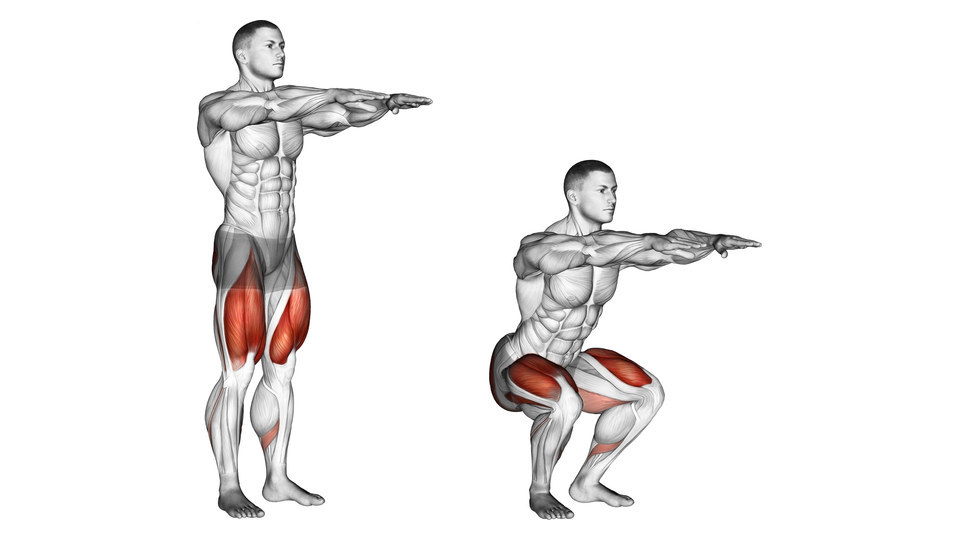
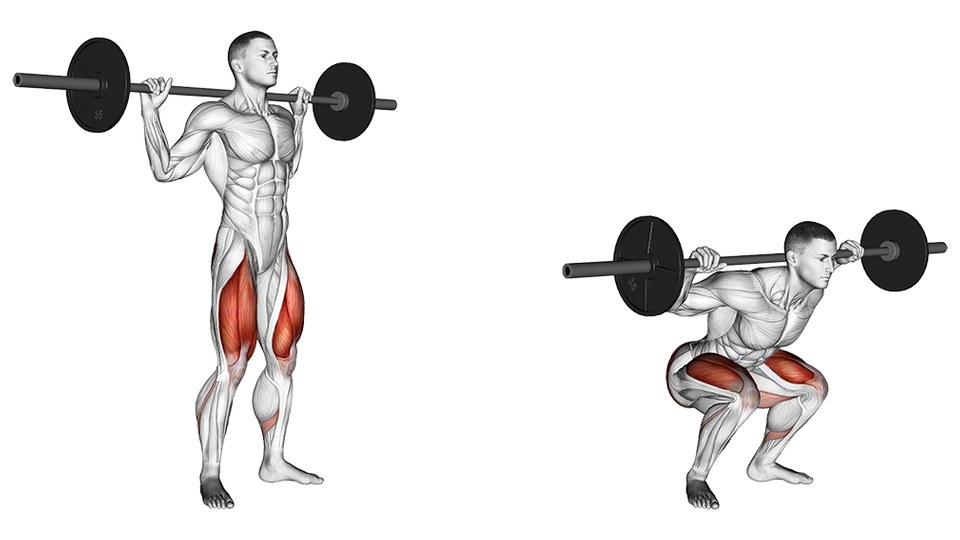
- Front squatSupports a barbell across the front of the shoulders rather than holding one weight in the hands.

- Kettlebell goblet squat — Holds the horns or sides of a kettlebell at the chest; the squat pattern stays the same.
Related tools
Frequently asked questions
What muscles does the goblet squat work?
The quadriceps are the main target. The gluteus maximus and adductor magnus help extend the hips, and the soleus assists at the ankle.
How do you hold a dumbbell for a goblet squat?
Hold it vertically at your chest with both palms under the upper end. Keep it close rather than reaching it forward.
How deep should a goblet squat be?
Use the deepest range in which your whole feet stay planted, your knees continue to follow your toes and you can reverse the movement under control.
Can you do goblet squats with a kettlebell?
Yes. Hold the kettlebell by its horns or sides at the chest. It is the same movement with a different implement.
Sources
- Anatomy, Bony Pelvis and Lower Limb: Thigh Quadriceps Muscle. StatPearls. https://www.ncbi.nlm.nih.gov/books/NBK513334/
- Anatomy, Bony Pelvis and Lower Limb, Gluteus Maximus Muscle. StatPearls. https://www.ncbi.nlm.nih.gov/books/NBK538193/
- Anatomy, Bony Pelvis and Lower Limb: Thigh Adductor Magnus Muscle. StatPearls. https://www.ncbi.nlm.nih.gov/books/NBK534842/