
Dumbbell good morning
Also called dumbbell good mornings, DB good morning, single dumbbell good morning.
What is a dumbbell good morning?
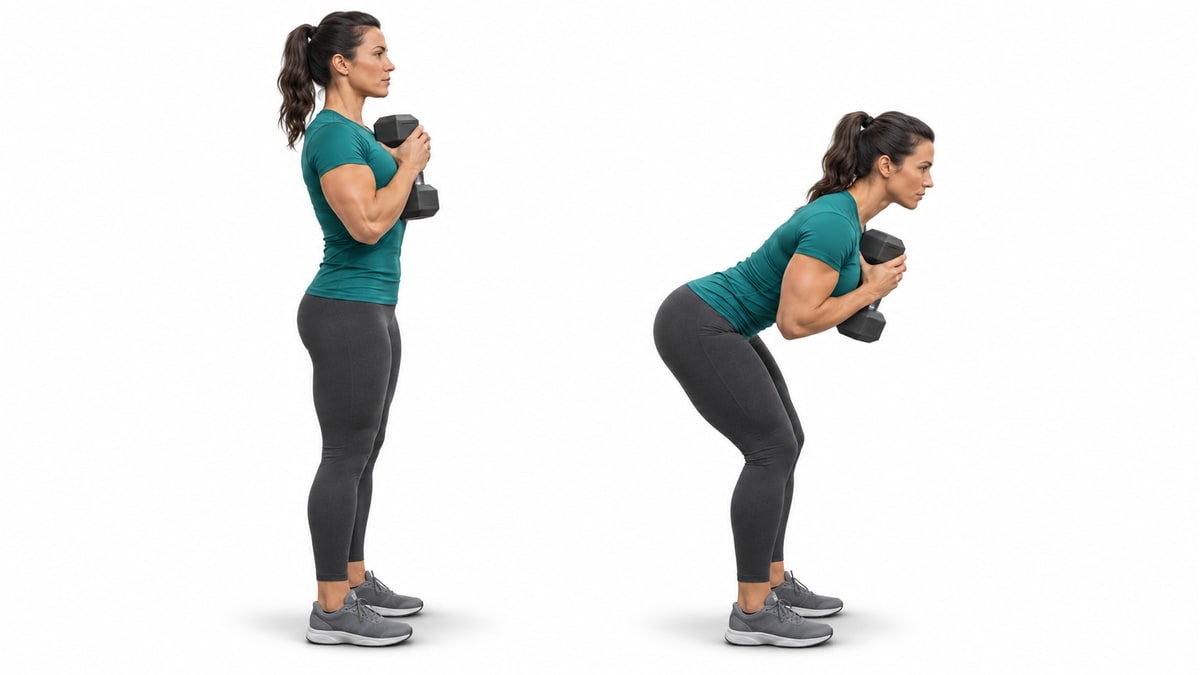
A dumbbell good morning is a standing hip hinge with a dumbbell held against the upper chest in both hands. Your hips move back as your torso tips forward, then straighten to bring you upright. This guide uses one front-held dumbbell rather than a bar across the upper back.
How do you perform a dumbbell good morning?
Set up
- Choose a light dumbbell you can lift and lower with both hands. Bring it close against your upper chest, keeping a secure two-handed grip and your elbows bent.
- Set your feet roughly hip-width apart. Soften your knees, brace your middle and settle into a comfortable, steady back position.
Execution
- Send your hips behind you as your torso tilts forward. Keep the dumbbell close to your chest and the bend in your knees nearly unchanged.
- End the descent before your back starts to round or you have to let the weight drop away from your chest.
- Push through your feet and bring your hips forward until you are standing upright, without leaning back. Repeat with the same controlled range.
- After the final repetition, stand fully upright, lower the dumbbell in front of you with both hands, then bend your hips and knees to place it on the floor.
Common mistakes
Letting the arms straighten during the hinge
The dumbbell moves away from the chest and changes the load position. Use a weight you can keep securely supported for the whole repetition.
Sitting down between the heels
A growing knee bend turns the movement into more of a squat. Start with a shallow hinge and practise moving the hips behind you.
Forcing the chest closer to the floor
Extra depth does not count as a controlled hinge if you lose your back position or your hold on the dumbbell. Shorten the range instead.
Where it fits in a session
Use it as hinge practice or as accessory work in your planned lower-body session.
Choose the load around your ability to hold it at the chest as well as your ability to hinge. Finish the set while both remain controlled.
Muscles worked
Primary
Secondary
Schematic surface view. Some muscles are partly visible or not shown.
The hamstrings that cross the hip and the gluteus maximus work as you straighten the hips. The spinal erectors help keep your back position steady during the hinge.
Variations
- Barbell good morningCarries a bar across the upper back instead of holding a dumbbell at the chest.
- Dumbbell Romanian deadliftUses a hip hinge with the dumbbells hanging from straight arms.
Related tools
Frequently asked questions
Where do you hold the dumbbell in a dumbbell good morning?
This version holds one dumbbell close against the upper chest with both hands and bent elbows. It stays there as you hinge. Other front-rack versions exist, but this guide does not teach placing a dumbbell behind the neck.
What muscles does the dumbbell good morning work?
It works the glutes and the hamstrings that extend the hip, while the spinal erectors help maintain your trunk position. The biceps femoris short head does not cross the hip and is not included in the hip-extending hamstring target.
Is a dumbbell good morning the same as a dumbbell RDL?
Both are hip hinges. The difference here is the hold: the good morning keeps one dumbbell against the chest, while the Romanian deadlift lets the dumbbells hang from straight arms. Keep separate records for these different setups.
Does your chest have to reach parallel with the floor?
No. Use the range in which your back stays steady and you can keep the dumbbell supported at your chest. A shallower repetition is the option to practise when reaching lower changes either position.
Can you do a good morning without a barbell?
Yes. This front-held version uses one dumbbell. You can also rehearse the hip hinge without a weight before adding the dumbbell. Choose a load you can bring to the chest and put down under control.
Sources
- Hu Y, Raja A. Anatomy, Bony Pelvis and Lower Limb, Hamstring Muscle. StatPearls. https://www.ncbi.nlm.nih.gov/sites/books/NBK546688/
- Betts JG, et al. Anatomy and Physiology 2e, section 11.6: Appendicular Muscles of the Pelvic Girdle and Lower Limbs. OpenStax. https://openstax.org/books/anatomy-and-physiology-2e/pages/11-6-appendicular-muscles-of-the-pelvic-girdle-and-lower-limbs
- Betts JG, et al. Anatomy and Physiology 2e, section 11.3: Axial Muscles of the Head, Neck, and Back. OpenStax. https://openstax.org/books/anatomy-and-physiology-2e/pages/11-3-axial-muscles-of-the-head-neck-and-back