Good mornings
Also called barbell good morning, good morning exercise.
What is a good mornings?
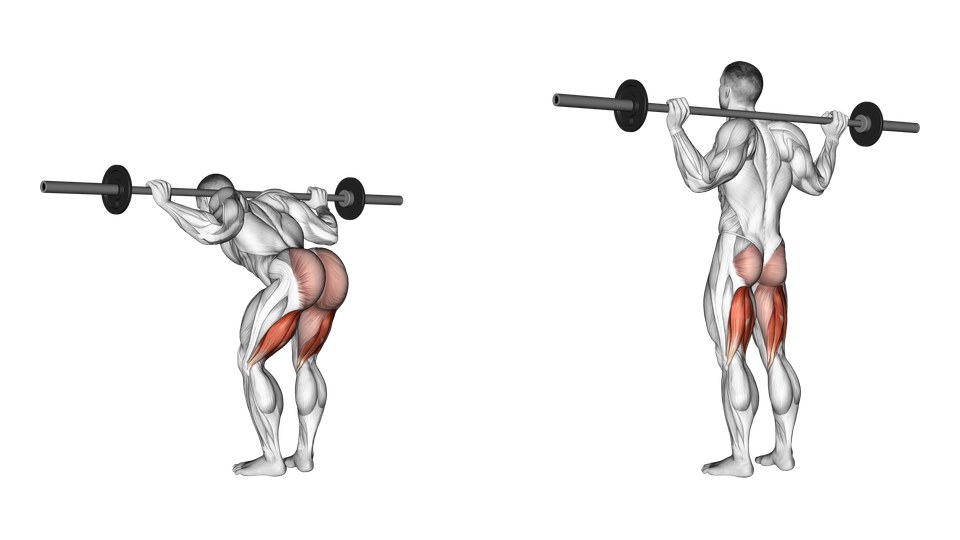
Good mornings are a barbell hip-hinge exercise. With the bar held across the upper back, you push the hips backward and lean the torso forward, training the hamstrings and glutes while the back muscles keep the spine steady.
How do you perform a good mornings?
Set up
- Place a bar securely across your upper back as for a back squat, then step into a stance around hip width.
- Brace your trunk, soften your knees and keep that small knee bend through the repetition.
Execution
- Push your hips backward while the torso inclines forward and the bar remains over the middle of your feet.
- Stop when the hamstrings limit the hinge or before your back position changes.
- Drive the hips forward to stand tall without leaning behind the finish.
Common mistakes
Turning the hinge into a squat
Excessive knee bend shifts the hips downward instead of backward and changes the movement.
Chasing a lower torso position
The useful depth ends when the hips stop moving back or the back can no longer stay steady.
Letting the bar roll toward the neck
A secure upper-back position keeps the load from shifting during the hinge.
Where it fits in a session
Usually used as posterior-chain accessory work after the main squat or deadlift.
Begin lighter than you expect and increase load only while the bar path and back position stay repeatable.
Muscles worked
Primary
Secondary
Schematic surface view. Some muscles are partly visible or not shown.
The hamstrings, gluteus maximus and adductor magnus extend the hip, while the erector spinae holds the trunk rigid against the bar.
Variations
- Bodyweight good morning — Practises the hinge without external resistance.
- Safety-bar good morning — Uses a safety squat bar and its handles for a different bar position.
Related tools
Frequently asked questions
What muscles do good mornings work?
They train the hamstrings and gluteus maximus as hip extensors, with the erector spinae holding the trunk steady and the adductor magnus assisting at the hip.
How far should you bend over in a good morning?
Hinge only as far as your hips can move backward while your spine and bar position remain steady. The torso does not need to reach parallel with the floor.
Should your knees bend during good mornings?
Use a small knee bend and keep it nearly unchanged. Too much bending turns the movement toward a squat.
Are good mornings the same as Romanian deadlifts?
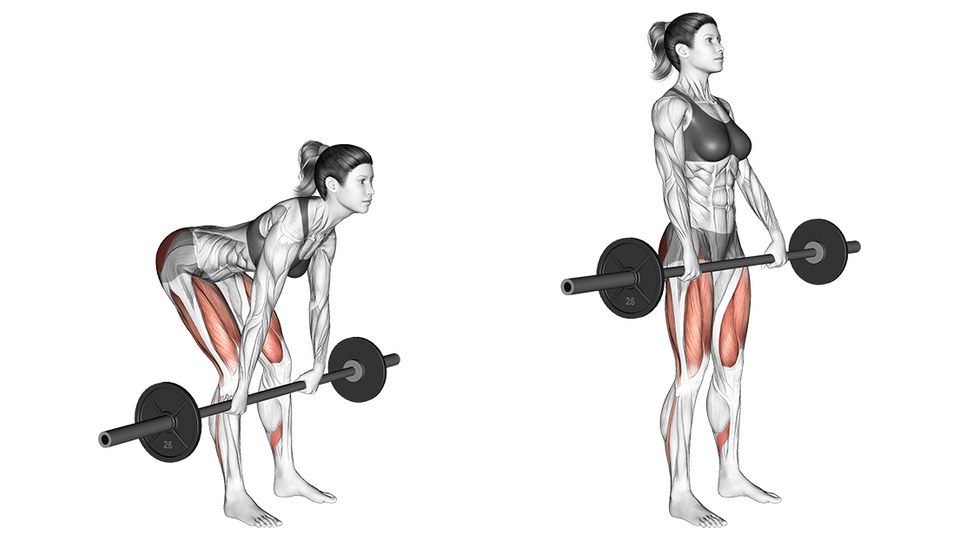
Both use a hip hinge, but a good morning carries the bar on the upper back while a Romanian deadlift holds it in the hands.
Sources
- Hu Y, Raja A. Anatomy, Bony Pelvis and Lower Limb, Hamstring Muscle. StatPearls. https://www.ncbi.nlm.nih.gov/books/NBK546688/
- Elzanie A, Borger J. Anatomy, Bony Pelvis and Lower Limb, Gluteus Maximus Muscle. StatPearls. https://www.ncbi.nlm.nih.gov/books/NBK538193/