
Dumbbell push press
Also called DB push press.
What is a dumbbell push press?
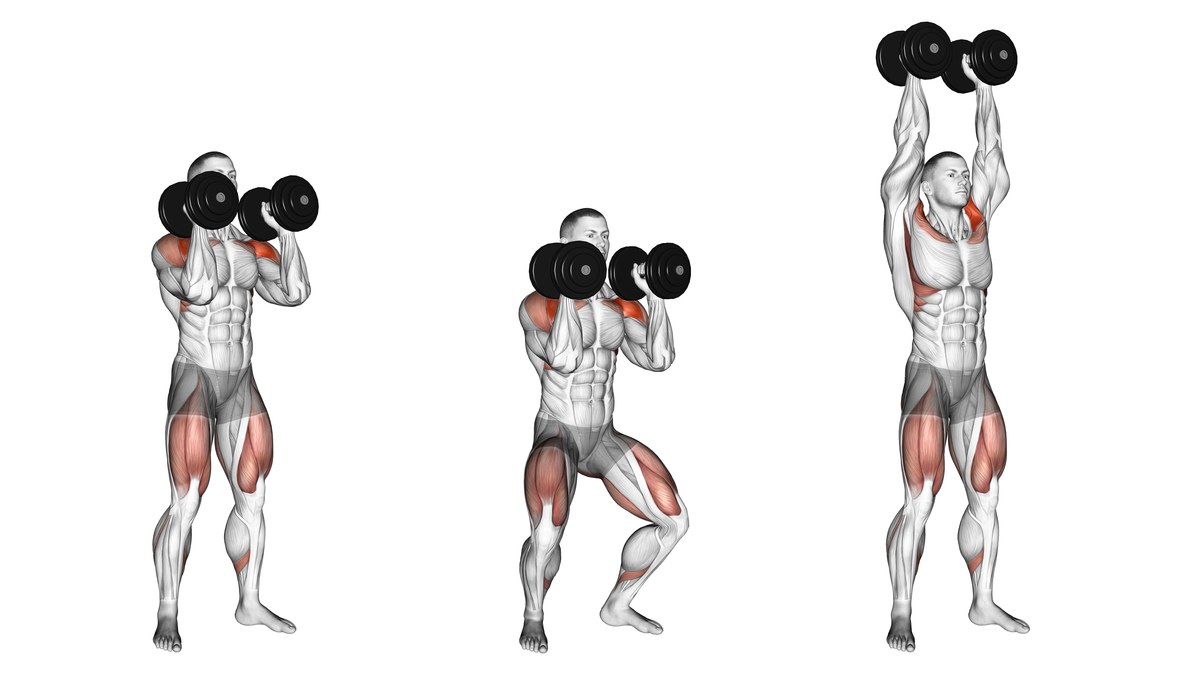
A dumbbell push press takes two dumbbells from your shoulders to overhead using a short dip and a drive from your legs. Your arms finish the press while your knees stay straight. It works the shoulders and triceps, with the quadriceps and glutes contributing to the drive.
How do you perform a dumbbell push press?
Set up
- Clear space above and around you. Bend your hips and knees to pick up two light dumbbells, then stand with the weights at your sides and your feet about hip-width apart.
- Bend your elbows to bring the dumbbells up to your shoulders, palms facing each other. Hold the handles firmly with your elbows slightly forward, then brace your middle.
Execution
- With the dumbbells held at your shoulders, make a short bend at your knees and hips. Keep your chest upright and your heels down.
- Reverse the dip immediately and push hard against the floor. Extend your legs and hips to send the weights upward, then continue the movement with your arms.
- Straighten both arms with each dumbbell above its shoulder. Stand tall and keep your knees straight as you finish; do not dip under the weights to catch them.
- Bend your elbows to lower the dumbbells back to your shoulders. Let your knees soften as the weights return, then stand upright and settle both bells before the next repetition.
- After the last repetition, lower the dumbbells from your shoulders to your sides. Bend your hips and knees to place them on the floor under control.
Common mistakes
Squatting down before every press
A push press needs only a short dip. A full squat followed by a press is a thruster. Shorten the dip so you can stay upright and change direction smoothly.
Lifting the dumbbells away from the shoulders before driving
Settle them at shoulder height first. Start their upward movement with the leg drive and follow through with your arms rather than turning the start into a strict press.
Bending the knees again under the overhead weights
Receiving the dumbbells in a second dip changes the movement into a push jerk. Use lighter weights if you cannot complete the overhead portion with straight knees.
Where it fits in a session
Practice it while you can coordinate the dip, drive and overhead finish clearly.
Begin with weights you can bring to your shoulders and lower comfortably. End the set when you need to chase the dumbbells forward, lean back or use a second dip to finish.
Muscles worked
Primary
Secondary
Schematic surface view. Some muscles are partly visible or not shown.
The shoulders and triceps press the dumbbells overhead, while the quadriceps and glutes contribute to the drive from the legs.
Variations
- Dumbbell shoulder pressPresses the dumbbells without help from a dip and drive. The linked guide teaches the seated version.
Frequently asked questions
How deep should I dip for a dumbbell push press?
Use a brief bend at the knees and hips while your torso stays upright. You should be able to reverse it directly into the upward drive. A full squat makes it a thruster rather than the push press described here.
What muscles does a dumbbell push press work?
It uses the front and side deltoids and triceps for the overhead press, with the quadriceps and gluteus maximus contributing to the leg drive. The upper-body press and lower-body drive are parts of the same repetition.
How is it different from a dumbbell shoulder press?
The push press starts the weights with a dip and leg drive. A strict shoulder press uses the arms to press while the legs stay still. The two movements have different execution rules, so keep their training records separate.
Can I bend my knees as the dumbbells come down?
Yes. Soften your knees as you receive the weights at your shoulders, then reset before the next repetition. The knee bend to avoid is a second dip underneath the weights while they are still going up; that is a push jerk.
Should I press both dumbbells at the same time?
Yes, for the two-dumbbell version taught here. Drive both weights upward together and settle both at your shoulders before the next rep. A single-arm push press uses one dumbbell and is a separate variation.
Sources
- Miniato MA, Anand P, Varacallo MA. Anatomy, Shoulder and Upper Limb, Shoulder. StatPearls. Updated 2023. https://www.ncbi.nlm.nih.gov/books/NBK536933/
- Betts JG, et al. Anatomy and Physiology 2e, section 11.6: Appendicular muscles of the pelvic girdle and lower limbs. OpenStax, 2022. https://openstax.org/books/anatomy-and-physiology-2e/pages/11-6-appendicular-muscles-of-the-pelvic-girdle-and-lower-limbs