
Dumbbell thruster
Also called double dumbbell thruster.
What is a dumbbell thruster?
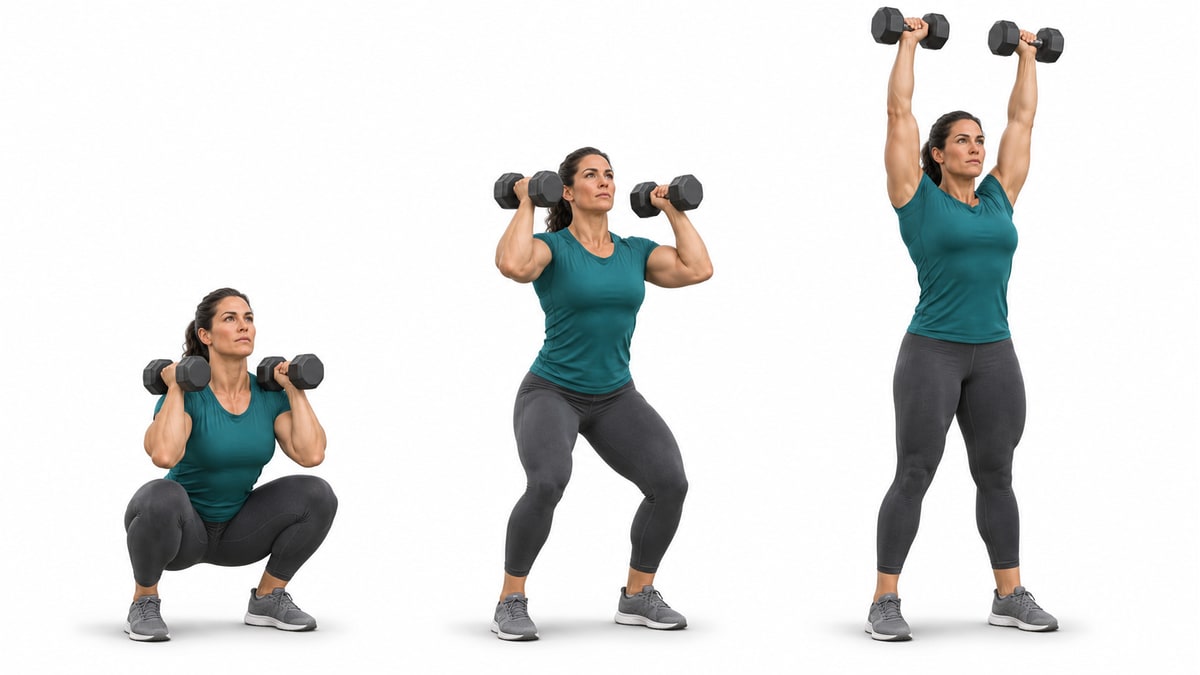
A dumbbell thruster combines a front squat with an overhead press, using a separate dumbbell at each shoulder. Drive up from the squat and carry that motion into pressing both weights overhead. Lower them to your shoulders before the next squat. The squat and press form one continuous upward movement.
How do you perform a dumbbell thruster?
Set up
- Clear space overhead and beside your feet. Place two equal, light dumbbells outside your feet, bend your hips and knees to grip the handles, then stand with the weights at your sides.
- Dip slightly, then extend your legs and bend your elbows to bring the weights close to your body up to your shoulders. Point your elbows forward and settle one end against each shoulder, palms facing each other. Stand around shoulder width.
Execution
- Brace your midsection and squat, bending your hips and knees together. Keep your elbows forward, heels down and knees following your toes. Aim to bring your hips below your knees without losing the shoulder support.
- Push through your feet to rise, then press both dumbbells as your hips and knees straighten. Continue upward without pausing at shoulder height, finishing with straight arms and legs and the weights balanced above your shoulders.
- Lower both weights under control to your shoulders. Settle them there before bending into the next squat.
- After the final rep, return the dumbbells to your shoulders, then lower them to your sides. Bend your hips and knees to place them on the floor beside your feet, keeping your grip until they are resting securely.
Common mistakes
Stopping upright before pressing
That separates the squat from the press. Choose a lighter pair and keep the upward movement flowing from your legs into your arms.
Bending the knees again to catch the weights overhead
A second dip changes the finish into a jerk. Reduce the load so you can finish the press with your legs straight.
Starting the next squat while the dumbbells are still descending
Let both weights reach their shoulder support first. Slow the return rather than chasing the weights down into the squat.
Where it fits in a session
Practise the squat-to-press timing before using the movement in a faster workout.
Use a pair you can bring to your shoulders, press together and lower under control. End the set when the squat and press become separate efforts or you need another knee bend to finish overhead.
Muscles worked
Primary
Secondary
- None listed in this guide
Schematic surface view. Some muscles are partly visible or not shown.
The quadriceps and gluteus maximus drive the squat ascent. The front deltoids and triceps contribute to the press. This list describes the main movers across both parts, without ranking their involvement.
Variations
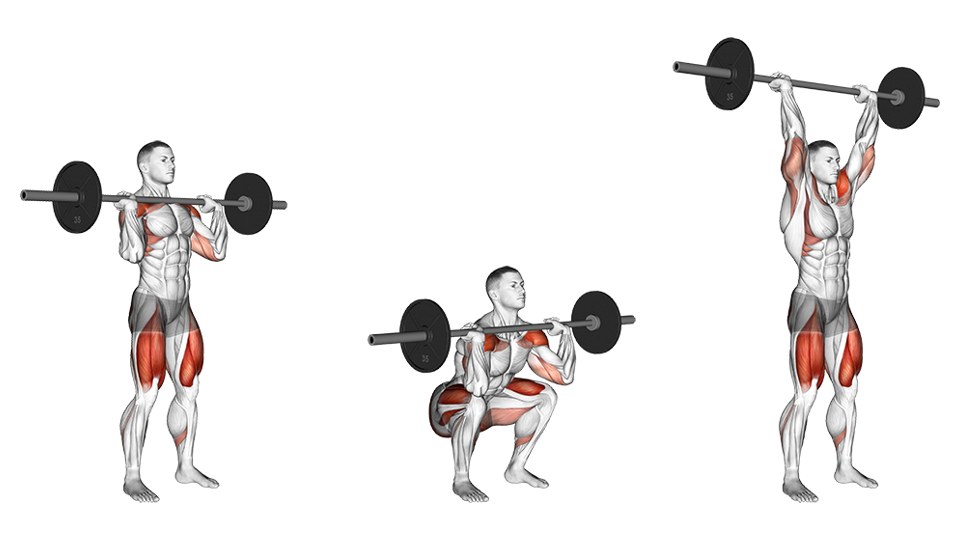
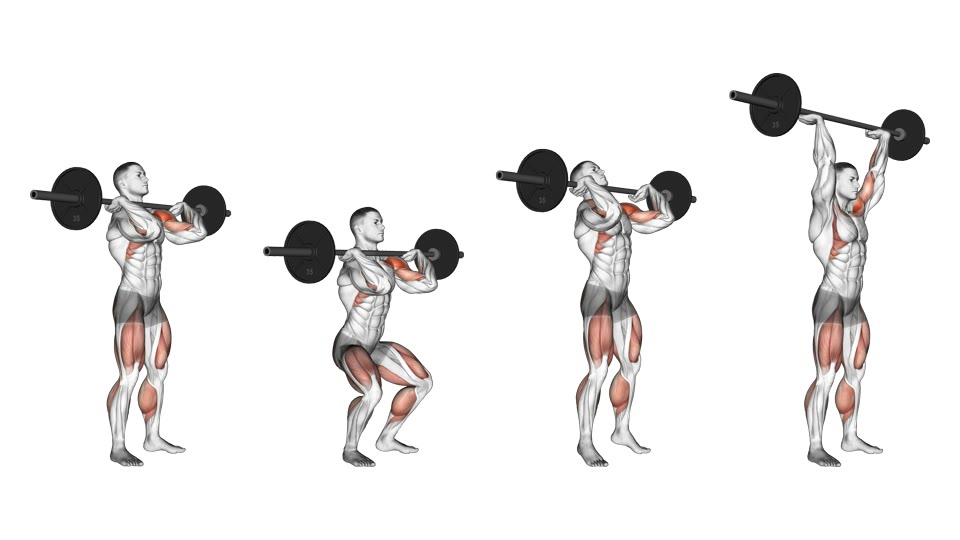
- Barbell thrusterUses one bar supported across the fronts of the shoulders instead of two separate weights.
Frequently asked questions
What muscles does the dumbbell thruster work?
The quadriceps and gluteus maximus work as you stand from the squat. The front deltoids help raise your upper arms, and the triceps straighten your elbows for the overhead finish.
Is a dumbbell thruster the same as a squat and press?
The names can overlap. In this guide, a thruster carries the squat's upward drive straight into the press. Squatting, stopping upright and then performing a strict press is a separate combination.
How is it different from a dumbbell push press?
A thruster starts with a full squat. A push press uses a short dip and leg drive. Both finish overhead with straight legs; adding a second knee bend to receive the weights makes it a jerk-style finish.
Which way should my palms face?
Start with your palms facing each other and an end of each dumbbell resting at the front of its shoulder. Your hands may turn slightly as you press; keep a full grip and the weights under control rather than forcing one hand angle throughout.
How deep should I squat?
The full version takes your hips below knee height. Work within a range where you can keep your heels down and the weights supported at your shoulders. A deliberately shallower squat is a scaled version while you practise the movement.
Sources
- J. Gordon Betts et al. Anatomy and Physiology 2e: Appendicular muscles of the pelvic girdle and lower limbs. 2022. https://openstax.org/books/anatomy-and-physiology-2e/pages/11-6-appendicular-muscles-of-the-pelvic-girdle-and-lower-limbs
- Mohammed A. Miniato; Prashanth Anand; Matthew A. Varacallo. Anatomy, Shoulder and Upper Limb, Shoulder. StatPearls, 2023. https://www.ncbi.nlm.nih.gov/sites/books/NBK536933/