Incline cable press
Also called incline cable chest press, cable incline bench press, seated incline cable press.
What is an incline cable press?
The incline cable press is a compound chest exercise performed on an incline bench between two low pulleys. You press a separate handle with each arm upward from the upper chest, extending the elbows as the hands travel slightly inward. It mainly trains the pectoralis major, with the anterior deltoids and triceps assisting.
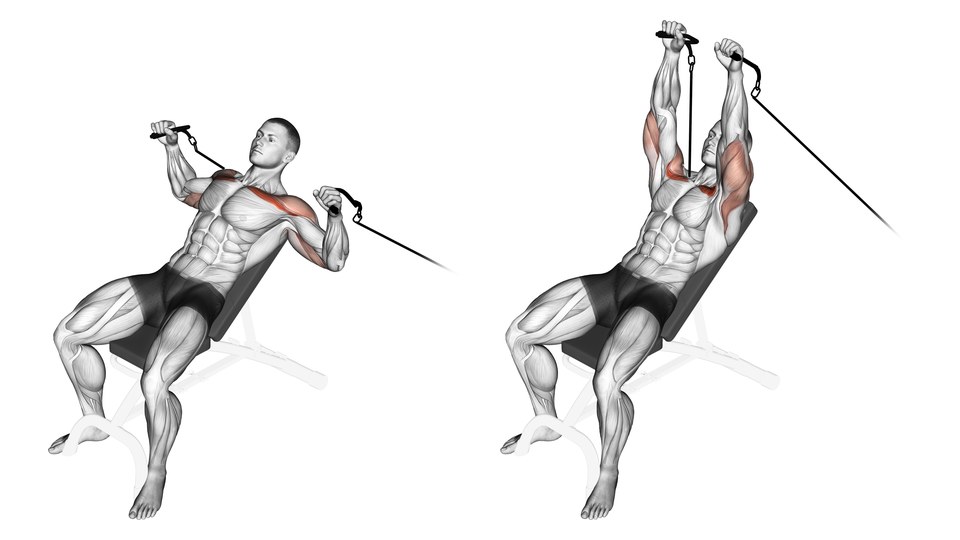
How do you perform an incline cable press?
Set up
- Center an adjustable bench between the cable columns, set the backrest to a low incline and put both pulleys in their lowest positions. Attach single handles and select the same load on both sides.
- Sit on the bench, take one handle at a time and lie back with the handles just outside your upper chest.
- Plant your feet and keep your head, upper back and glutes on the bench. Set your shoulder blades against the pad and stack each wrist over its elbow.
Execution
- Press both handles upward and slightly inward, letting the elbows straighten while the handles remain separate.
- Keep your wrists aligned with your forearms and your upper back and hips on the bench as the cables pull from below.
- Return the handles along the same path until they are beside your upper chest, stopping before your shoulders roll forward or lift from the pad.
- After the last rep, hold the handles close to your chest, sit up and return them one at a time without letting the stacks pull them from your hands.
Common mistakes
Leaving the bench off-center between the pulleys
One cable then pulls from a different angle or distance, so the two arms are no longer performing the same repetition.
Keeping the elbows almost straight throughout
A fixed elbow angle turns the movement into an incline cable fly. This press begins with bent elbows and finishes by extending them.
Setting the bench nearly upright
As the backrest approaches vertical, the movement becomes closer to a shoulder press than the incline chest press described here.
Letting the shoulders roll forward at the bottom
The handles have travelled farther only because the shoulder blades left their supported position. End the descent while the upper back remains settled on the pad.
Losing control of a handle while getting on or off the bench
Each cable is already under tension before the first rep and after the last one. Move the handles one at a time and keep hold of them until the stack settles.
Where it fits in a session
Early in a chest or push session, as the main cable press or after another compound press.
Use a load that lets both handles follow the same path and leaves enough control to get onto and off the bench deliberately.
Muscles worked
Primary
Secondary
Schematic surface view. Some muscles are partly visible or not shown.
The pectoralis major is the main target. The anterior deltoid helps move the upper arm through the inclined press, while the triceps straightens the elbow.
Variations
- Single-arm incline cable press — Uses one handle at a time while the incline bench still supports the torso.
- Flat cable bench press — Uses the same low-pulley setup with the bench flat and the press travelling more horizontally.
- Standing incline cable press — Presses upward from low pulleys without a bench, so the legs and trunk must resist the cable pull.
- Incline cable fly — Keeps a slight, fixed elbow bend and moves at the shoulder instead of extending the elbows like a press.
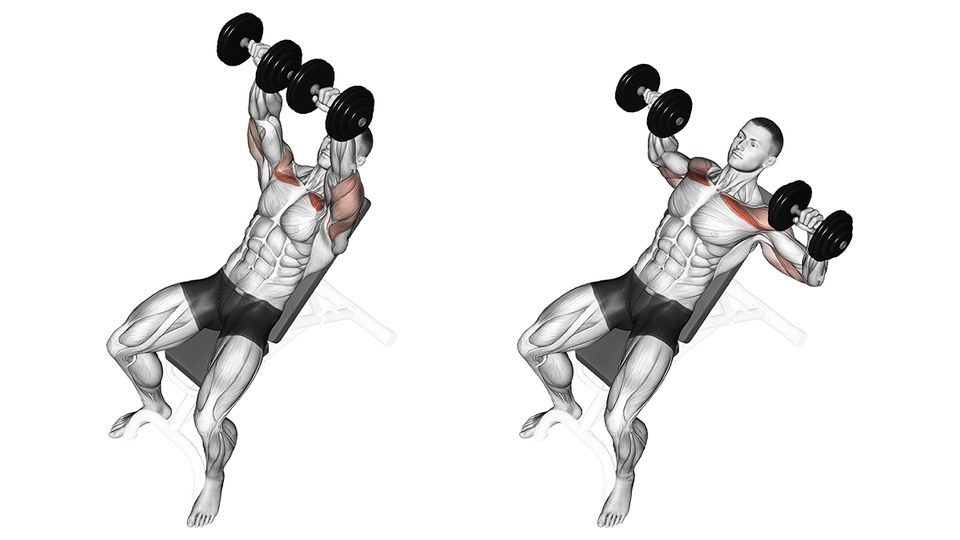
- Incline dumbbell pressUses the same supported incline position with a dumbbell in each hand instead of cables.
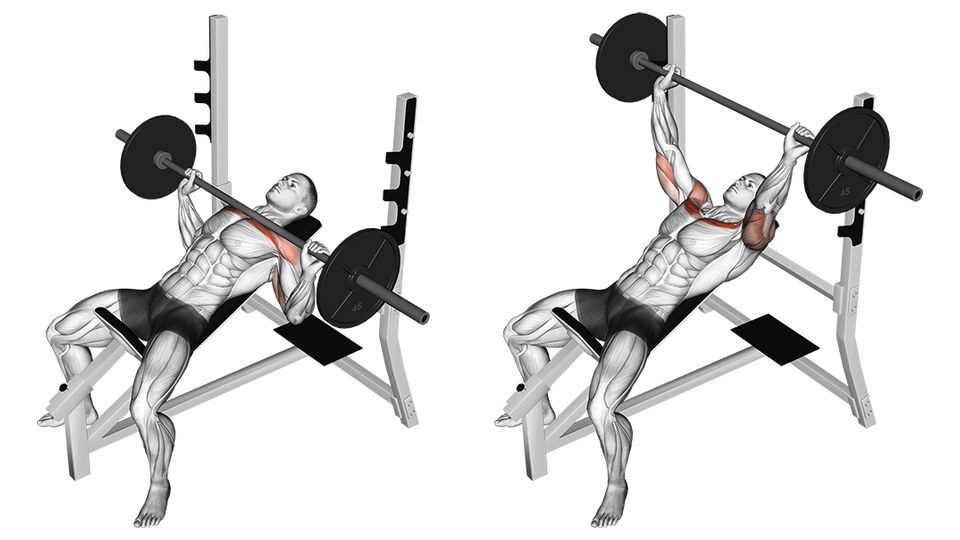
- Incline barbell bench pressUses one bar taken from a rack rather than two independently moving handles.
Frequently asked questions
What muscles does the incline cable press work?
It mainly trains the pectoralis major. The anterior deltoids assist at the shoulders, and the triceps extend the elbows during the press.
Is an incline cable press the same as an incline cable fly?
No. The press starts with bent elbows and straightens them as the handles move upward, so the triceps contribute. A fly keeps a slight, nearly fixed elbow bend and moves the arms through a wider arc.
Where should the pulleys be set?
For the version on this page, use two pulleys in their lowest positions and center the incline bench between them. That makes the cables pull upward and outward from below the bench.
What bench angle should I use?
Start with a low incline and keep the setting consistent when you track the exercise. Raise it only while the movement still feels like a chest press; a nearly upright backrest changes the lift toward a shoulder press.
Should the handles touch at the top?
No. They can travel slightly inward, but they do not need to collide. Finish with the elbows straight under control and each arm holding its own cable path.
How is this different from an incline dumbbell press?
Both use an incline bench and let the arms move independently. Here, each handle is pulled by a low cable rather than by a dumbbell held against gravity, so the equipment setup and direction of resistance are different.