
Incline barbell bench press
Also called incline bench press, incline barbell press, barbell incline press.
What is an incline barbell bench press?
The incline barbell bench press is a bench press performed on a bench tilted roughly 15 to 45 degrees above flat. It works the pectoralis major first, as any bench press does, with the anterior deltoid and triceps brachii assisting and the serratus anterior holding the shoulder blade against the pad. Tilting the bench raises the path of the arm, so the press runs closer to overhead and the bar meets the chest higher up.
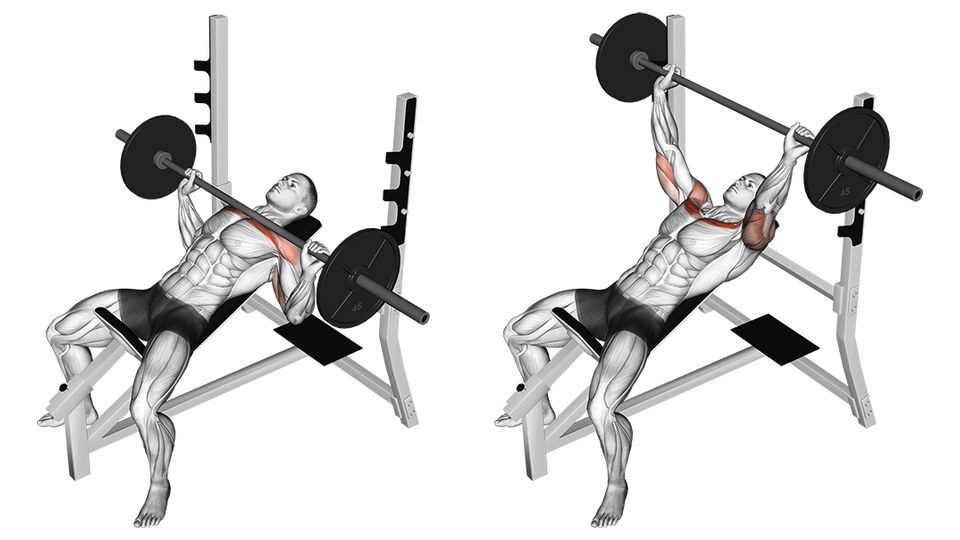
How do you perform an incline barbell bench press?
Set up
- Set the bench to about 30 degrees and place it under the bar. Set the hooks so the bar clears with a short press.
- Lie with your head, upper back and glutes on the pad and your feet flat. Pull your shoulder blades back and down.
- Grip the bar a little wider than shoulder width, with your forearms roughly vertical when the bar reaches your chest.
Execution
- Unrack without lifting your shoulders from the pad, then hold the bar above your shoulders with your arms straight.
- Lower the bar under control to your upper chest, keeping your elbows about 45 to 60 degrees from your torso. Touch lightly or stop just short; do not bounce.
- Press up and slightly back until your arms are straight over your shoulders. Keep your feet planted, hips down and shoulder blades on the pad.
- After the last rep, guide the bar into the hooks and make sure both sides are secure before releasing your grip.
Common mistakes
Setting the bench too steep
Keep tilting the bench and the arm ends up travelling nearly straight overhead, which makes this a shoulder press on a nearly upright bench, at a weight you have had to cut to do it. Stop around 45 degrees: past that you are not doing the lift you set up for.
Lowering the bar to the sternum, out of flat-bench habit
With the bench tilted, the bar cannot reach the sternum with your forearms vertical: the elbows have to travel out and back to put it there, which deepens the bottom of the rep and buys nothing for it. Touch higher, where your forearms stay under the bar.
Flaring the elbows out level with the bar
The same thing as the touch point, arrived at from the other direction: flare the elbows and the bar lands lower down your chest whether you meant it to or not. It feels stronger off the chest, which is why it creeps in, and what it buys is a deeper bottom position for the chest and the front of the shoulder to hold.
Sliding up the bench set after set
It happens a few millimetres at a time, which is why it is easy to miss. Each rep starts fractionally higher up the pad, the touch point creeps down toward the sternum, and the last reps of the set are not the lift the first ones were. The correction is feet and glutes, not willpower.
Carrying the flat-bench load straight over
Almost everyone presses less on an incline, and refusing to accept that does not make the incline stronger — it makes the reps shorter, the arch bigger and the bar path flatter until the lift quietly becomes a flat bench press done on an angled bench. Load it for what it is.
Where it fits in a session
Early in a pressing session, either as the day's main press or as the second press straight after flat bench while you are still fresh.
This is a heavy compound and it wants to be treated as one — a full working slot with real sets, not two sets tacked on after the accessories. It also punishes fatigue more than a flat bench does, because the first thing to go when you tire is the shoulder blade position, and once that goes the bottom of the rep is where you least want to be sloppy. If you press it after flat bench, expect the working weight to reflect that.
Muscles worked
Primary
Secondary
Schematic surface view. Some muscles are partly visible or not shown.
The pectoralis major is the main chest muscle used in this press. The anterior deltoid assists at the shoulder, the triceps extends the elbow and the serratus anterior helps position the shoulder blade. Incline research can help explain regional chest emphasis, but activation readings do not tell us what percentage of the lift each muscle performs or how much it will grow.
What lifters actually do
About half of regular RepCount users have logged an incline barbell bench press at some point, and it appears in roughly one workout in twenty. What the logs show is that it is an addition to pressing work rather than a replacement for it: the flat bench press is in the same session more than a third of the time, and the movements it most often sits beside otherwise — lateral raises, pushdowns, triceps extensions, dumbbell presses — are the rest of an ordinary chest and shoulder day. It also gets a proper slot rather than a token one: something over three sets, in a session of about seven exercises.
Most often trained alongside
Share of incline barbell bench press sessions that also include each exercise.
- Bench press37%
- Pushdowns21.9%
- Triceps extensions14.9%
- Dumbbell press13.9%
Figures come from workouts tracked in RepCount.
Scientific studies on the incline bench press
Bench-angle studies ask different questions: how muscle activity changes during a set, how much weight a lifter can press, and where the chest grows after training. Those outcomes should not be treated as interchangeable.
An incline is a reasonable option for upper-chest training, but the research does not establish one best angle for everyone. The direct growth study used a Smith machine, and activation studies do not prove that 30 degrees is superior. Use a repeatable setup and judge its progress separately from your flat bench.
Does incline training grow the upper chest more?
An eight-week study compared flat presses, 44-degree incline presses and a combination. All pressing used a Smith machine. The incline-only group gained more thickness at the uppermost chest measurement site; the other two sites showed no clear difference between groups.
Although 47 untrained men completed training, only 30 had muscle-thickness data. This is limited evidence for regional emphasis, not proof that every incline angle or a free barbell produces the same result. It also does not show that combining exercises is generally inferior.
What was held constant?
Training took place once weekly, with four sets initially and six later. The combined group split those sets between flat and incline, so it performed fewer incline sets than the incline-only group. Strength was tested isometrically at a fixed elbow angle, rather than with a dynamic one-rep maximum.
Is 30 degrees the best angle?
A study of 30 trained adults tested barbell presses at 0, 15, 30, 45 and 60 degrees. Upper-chest activity was numerically highest at 30 degrees, but the direct comparisons did not clearly distinguish 0, 15, 30 and 45 degrees. Upper-chest activity was lower at 60 degrees than at those other angles.
The anterior deltoid became more active as the bench rose in several comparisons. A separate study of 12 competitive bench pressers found no clear chest-activation difference between flat and 25-degree incline presses. These are short-term electrical measurements, not a growth contest between bench settings.
Should the incline working weight be lower?
The 12 competitive bench pressers lifted less for six reps on the 25-degree incline than on the flat bench, using the same wide grip. The five-angle study also recorded lower average maximum loads as the bench rose.
That supports choosing a load for the incline itself. It does not give you a personal conversion ratio: the study populations, angles, grips and tests differ, and RepCount’s exercise logs do not record bench angle.
Variations
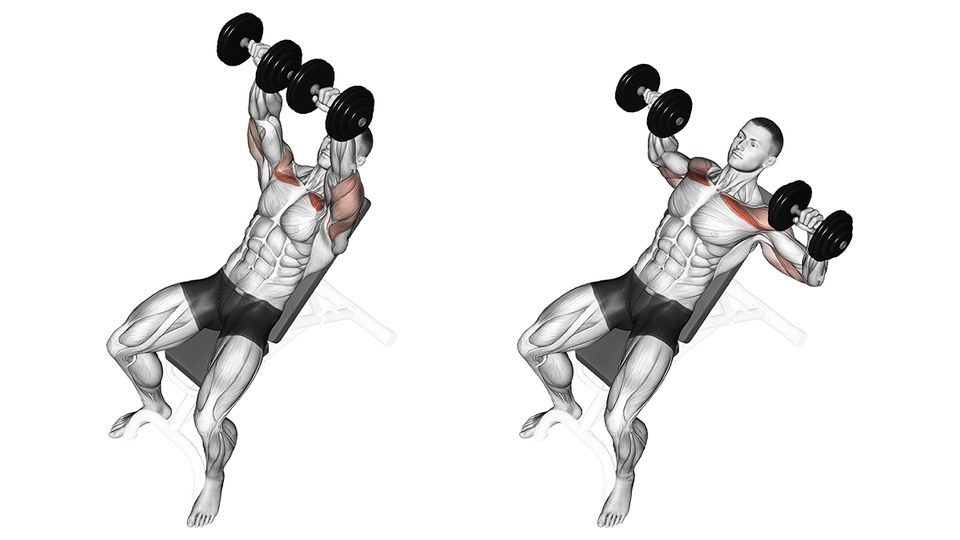
- Incline dumbbell pressEach arm holds its own line, and the hands can travel together and rotate at the top.
- Low-incline barbell press — The shallow end of the range, close enough to flat that the touch point barely moves.
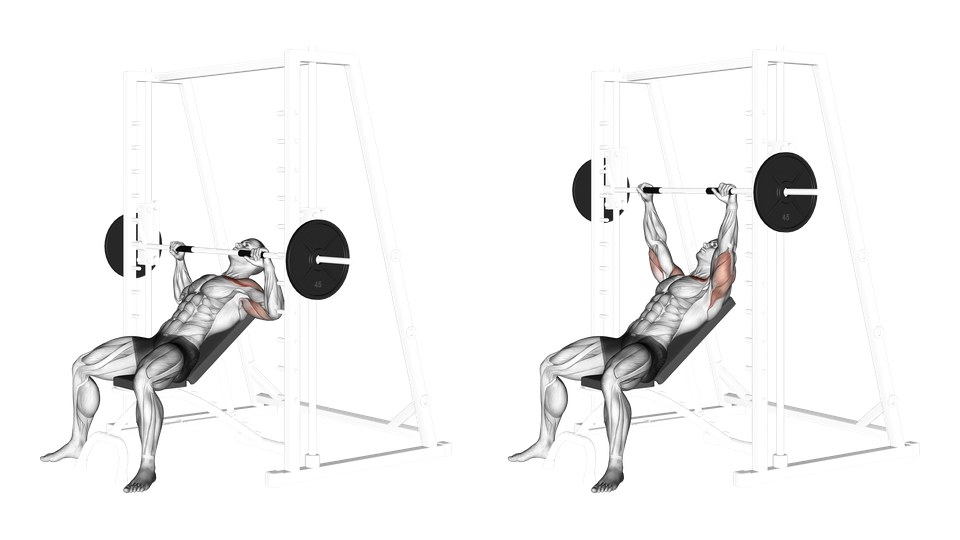
- Smith machine incline pressBar path is fixed by the rails, so the setup has to put your chest where the path already is.
- Close-grip incline bench press — Narrower hands, longer range at the elbow, more of the lift left to the triceps.
- Reverse-grip incline bench press — Underhand grip, which tucks the elbows in on its own rather than by instruction.
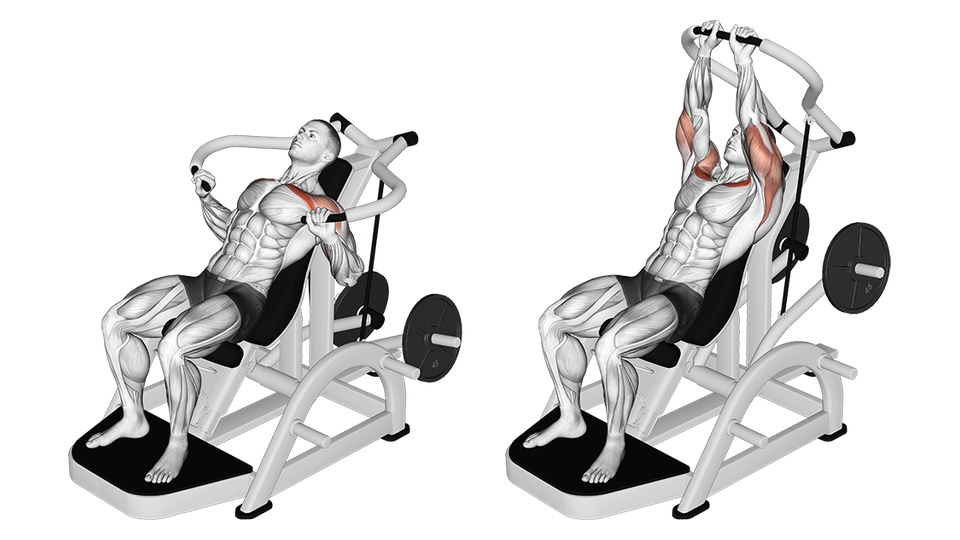
- Incline machine chest pressSeat and path preset, useful when there is no spotter for the last hard set.
Related tools
Frequently asked questions
What muscles does the incline bench press work?
The pectoralis major is the main target, with the anterior deltoid and triceps assisting and the serratus anterior helping position the shoulder blade. Bench angle can change measured muscle activity, but it does not isolate the upper chest or remove the other pressing muscles.
What angle should the bench be for an incline bench press?
About 15 to 45 degrees is the range used in this guide, with 30 degrees as a practical starting point. Research does not establish one universally best angle within it. Keep the setting consistent when tracking progress. The point where the bar meets your chest moves higher as the bench rises, so the illustration shows one setup rather than an angle everyone must copy.
Is the incline bench press better than the flat bench press for the upper chest?
One small Smith-machine trial found greater growth at an upper-chest measurement site with 44-degree incline training. That supports regional emphasis, but it does not establish the same advantage at every angle or with a free barbell. RepCount lifters often use both presses: flat bench appears in more than a third of logged sessions containing an incline barbell press.
Is the incline bench press bad for your shoulders?
Pectoralis major tendon tears are relatively rare, but of the reported cases roughly half happen during weight-bearing exercise such as the bench press, with the arm loaded in extension and external rotation — which is to say at the bottom of a press, with the elbows out. That is a fact about where the injuries cluster, not a reason to avoid the lift. It does make the bottom of the rep the part worth being deliberate about, and it is why where the bar touches on an inclined bench is a real question rather than a stylistic one.
Do people actually do the incline barbell bench press?
About half of regular RepCount users have logged one. It shows up in roughly one workout in twenty, and when it does it is part of a full pressing session rather than a session of its own: alongside the flat bench press more than a third of the time, and otherwise beside lateral raises, pushdowns, triceps extensions and dumbbell presses. Those sessions run to about seven exercises, with something over three sets of the incline press in them. These figures come from workouts tracked in RepCount.
What is the difference between the incline barbell press and the incline dumbbell press?
Mechanically, the bar fixes both hands in one plane and at one spacing, so the two arms cannot drift apart or come together, and it lets you load more than a pair of dumbbells you have to get into position on your own. Dumbbells move independently, so each arm has to hold its own line, and the hands can travel toward each other and rotate at the top of the press. Neither of those is established here as producing more muscle than the other. Plenty of lifters log both.
Should you lift less on the incline than on the flat bench?
Almost everyone does, and it is not a sign of a weak point. We do not publish a ratio between the two, because our own logs do not record the bench angle: a ratio averaged over angles we cannot see would be a number rather than a measurement. Judge the lift on whether the weight has moved over the past few months with the bench at the same angle, not against your flat bench.
Sources
- Solari F, Burns B. Anatomy, Thorax, Pectoralis Major. StatPearls. https://www.ncbi.nlm.nih.gov/books/NBK525991/
- Elzanie A, Varacallo MA. Anatomy, Shoulder and Upper Limb, Deltoid Muscle. StatPearls. https://www.ncbi.nlm.nih.gov/books/NBK537056/
- McCausland C, Sawyer E, Eovaldi BJ, Varacallo MA. Anatomy, Shoulder and Upper Limb, Shoulder Muscles. StatPearls. https://www.ncbi.nlm.nih.gov/books/NBK534836/
- Tiwana MS, Sinkler MA, Bordoni B. Anatomy, Shoulder and Upper Limb, Triceps Muscle. StatPearls. https://www.ncbi.nlm.nih.gov/books/NBK536996/
- Lung K, St Lucia K, Lui F. Anatomy, Thorax, Serratus Anterior Muscles. StatPearls. https://www.ncbi.nlm.nih.gov/books/NBK531457/
- Chaves SFN et al. Horizontal and incline bench press training. 2020. https://pmc.ncbi.nlm.nih.gov/articles/PMC7449336/
- Rodríguez-Ridao D et al. Five bench inclinations and muscle activity. 2020. https://pmc.ncbi.nlm.nih.gov/articles/PMC7579505/
- Saeterbakken AH et al. Bench press variations in competitive athletes. 2017. https://pmc.ncbi.nlm.nih.gov/articles/PMC5504579/