
Incline dumbbell press
Also called incline dumbbell bench press, incline press with dumbbells, incline chest press.
What is an incline dumbbell press?
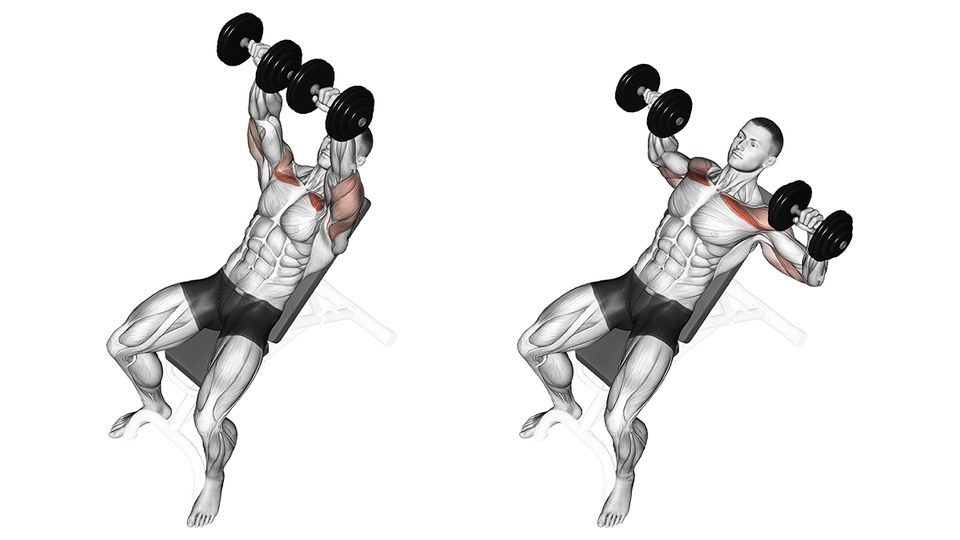
The incline dumbbell press is a chest press performed on a bench set about 15 to 45 degrees above flat, with a dumbbell in each hand. It is used to focus on the upper chest while the rest of the pectoralis major, anterior deltoid and triceps also contribute. Each arm controls its own weight. The exact angle and whether the palms face forward or toward each other are setup choices, not a proven ranking for muscle growth.
How do you perform an incline dumbbell press?
Set up
- Set the bench to about 30 degrees. Sit at the end with one dumbbell upright on each thigh, close to your hips.
- Use your knees to guide the dumbbells up as you lie back. Plant your feet, and keep your head, upper back and glutes on the bench.
- Pull your shoulder blades back and down. Hold the dumbbells just outside your shoulders, palms forward, with each wrist directly over its elbow.
Execution
- Press the dumbbells up and slightly inward over your upper chest. Keep your wrists over your elbows and your elbows about 45 to 60 degrees from your torso.
- Lower under control until the dumbbells reach shoulder level or slightly below. Stop sooner if your shoulder blades start to lift.
- Press back to straight arms without locking your elbows hard or touching the dumbbells together, then repeat.
- To finish, bring the dumbbells to your chest, tuck your chin and sit up with them. Do not drop them out to the sides while you are lying down.
Common mistakes
Setting the bench too steep
As the backrest approaches upright the movement turns into a seated shoulder press. The front delt takes over, you press less weight, and you have added a shoulder press rather than a second chest movement.
Hauling the dumbbells into the start position with your arms
The setup is the most exposed moment of the whole lift: the shoulder is being loaded near the end of its range with no leverage and no chance to brace. Kicking each dumbbell up with a knee as you lie back means the first thing your shoulder does under load is a rep, not a rescue.
Flaring the elbows straight out to ninety degrees
It is the weakest place to press from, and at the bottom it leaves the arm loaded in extension and external rotation — the position around half of reported pectoralis major tears are sustained in, during weight-bearing exercises such as the bench press. Those tears are rare, so this is a reason to tuck rather than a reason to worry. Tucking to roughly 45 to 60 degrees costs nothing in range and keeps the joint stacked.
Letting the shoulder blades come off the bench at the bottom
When the blades slide forward the ribcage flattens and the shoulder rolls forward with them, so the stretch moves off the chest and onto the front of the shoulder. You also lose the fixed base the press pushes against, which is why the weight suddenly feels heavier on the last reps.
Cutting the reps short at the top
The top is where the load is lightest and the range is cheapest to keep, so it is a strange place to save effort. If you are stopping high because the dumbbells feel unstable up there, that is a weight problem, not a range problem.
Trying to match your flat bench weight
The incline is a different leverage position, so the number is going to be lower and that means nothing about you. Chasing the flat bench figure is how the hips come off the bench and the reps get short.
Pressing the hips off the bench to finish a rep
Arching the hips up flattens your torso relative to the dumbbells, which quietly turns the set into a shallower incline than the one you set the bench to. You have made it a flatter press with extra steps and lost the reason you chose the angle.
Where it fits in a session
Early in a push or upper-body session. It works as the main press of the day, or as the second press after a flat barbell bench while you are still fresh enough to control two independent weights.
A compound movement with each arm loaded separately, which changes how close to failure it is sensible to go. There is no rack to fail into: the only way out of a rep you cannot finish is to control the dumbbells down to your sides and sit up, and that gets harder the heavier you go. Leaving a rep or two in reserve on the heavy sets is a practical decision here rather than a conservative one. Working in the range where you can still set the weights down deliberately at the end of a set is what keeps the movement trainable week to week.
Muscles worked
Primary
Secondary
Schematic surface view. Some muscles are partly visible or not shown.
This guide uses the incline press to focus on the clavicular region of the pectoralis major. The sternocostal region also contributes, the anterior deltoid acts at the shoulder and the triceps extends the elbow. The target list is not a measured division of the workload. Bench-angle experiments do not establish how much each muscle will grow, and an incline does not isolate the upper chest.
What lifters actually do
Just under three in five regular RepCount users have logged an incline dumbbell press, and it turns up in roughly one workout in ten. The movement it shares a session with most often is the barbell bench press, in 36.8% of them — so in a large minority of those workouts it sits alongside the flat bench rather than in place of it. The rest of the company is shoulders and triceps: lateral raises in 26.5%, pushdowns in 21.8%, the dumbbell shoulder press in 18.0%. That is a push day, and one that often carries both presses. Which of them comes first is not something these figures record. Typical use is a little over three sets, in a session of about seven exercises.
Most often trained alongside
Share of incline dumbbell press sessions that also include each exercise.
- Bench press36.8%
- Pushdowns21.8%
- Triceps extensions15.8%
Figures come from workouts tracked in RepCount.
Scientific studies on the incline dumbbell press
Research using dumbbells has measured how bench angle changes muscle activity. Evidence about muscle growth needs a separate check, especially when the training study uses a different implement.
Incline dumbbell pressing involves both the chest and the front of the shoulder. Steeper positions increased front-deltoid activity in a small experiment, but that does not identify the best angle for growth. The upper-chest growth finding below comes from a Smith machine and cannot simply be transferred to dumbbells.
How does bench angle change shoulder involvement?
In 24 active college-aged women, front-deltoid activity was higher during a 45-degree incline dumbbell press than during a flat press, and higher again during an 85-degree shoulder press. This pattern appeared while both lifting and lowering.
Each woman used 4.5 kg in each hand for every position. That makes this a comparison at one fixed weight, not a test with equally hard sets. It helps explain the change toward shoulder pressing as the bench rises, but does not establish an optimal angle or a muscle-growth ranking.
Sources
Does an incline prove greater upper-chest growth?
The dumbbell experiment measured electrical activity during five reps, not growth over a training program. It also measured activity in the sternocostal chest region: using an incline did not switch the rest of the chest off.
An eight-week trial found more growth at an upper-chest measurement site with 44-degree incline pressing than with flat pressing or a combination. However, all its pressing used a Smith machine, and only 30 untrained men had muscle-thickness data. That supports a possible regional effect of incline training, but is not direct proof that incline dumbbells outperform flat dumbbells.
Variations
- Neutral grip incline dumbbell press — Palms facing each other throughout. Some lifters prefer it at the bottom of the rep.
- Low incline dumbbell press — Bench at roughly 15 to 20 degrees, closer to a flat press than to a shoulder press.
- Single arm incline dumbbell press — One side at a time, which shows up a strength difference between arms and asks more of the trunk.
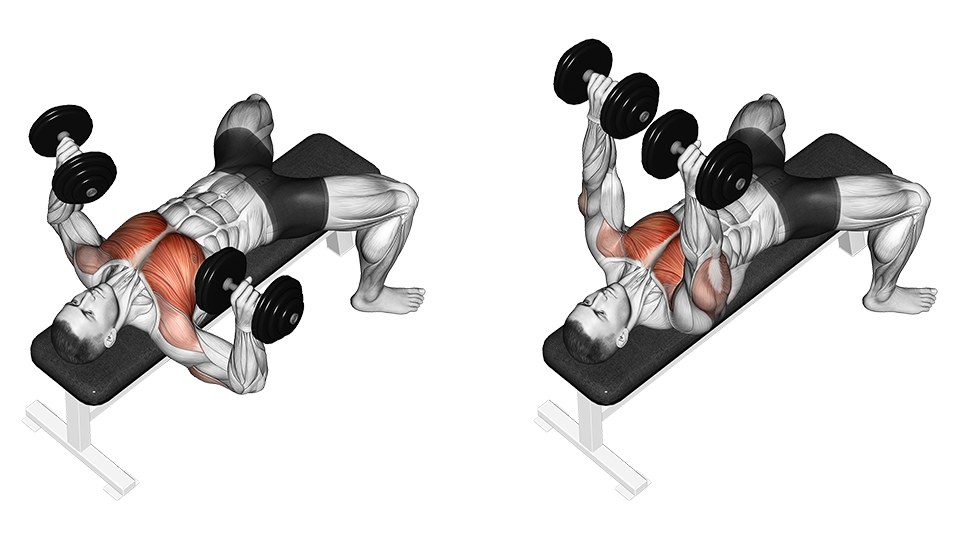
- Flat dumbbell bench pressThe same movement with the bench flat, which is the other end of the angle choice rather than a different exercise.
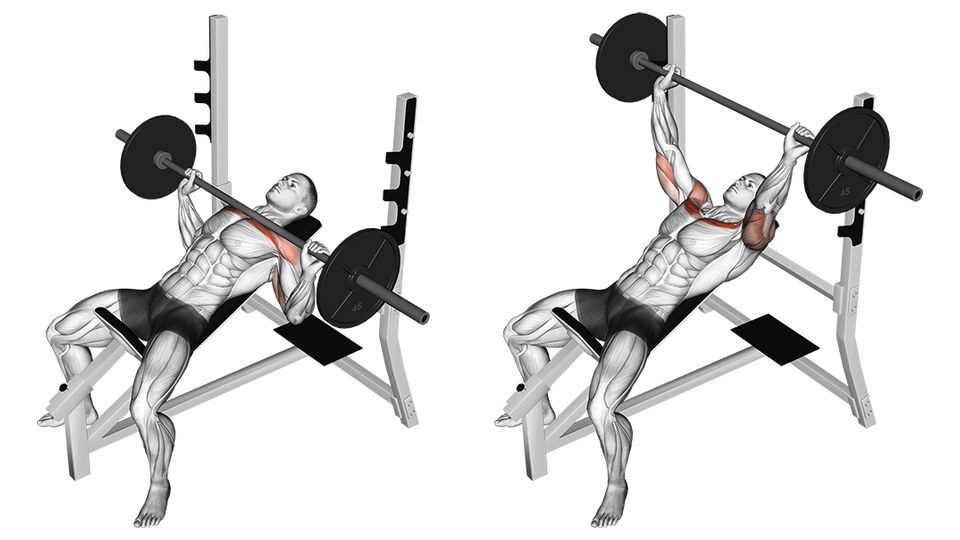
- Incline barbell bench pressSame angle, one bar. Heavier and more stable, with less range at the bottom and no independent arms.
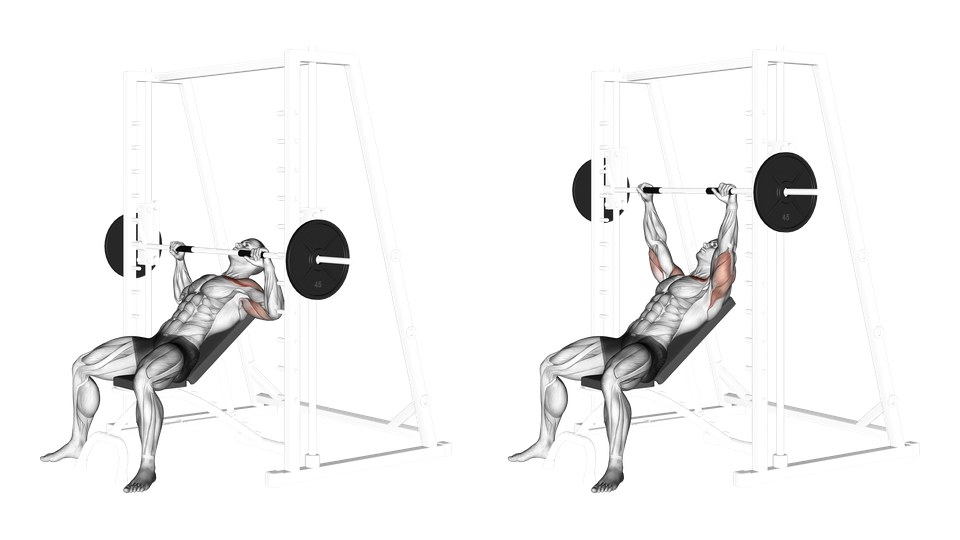
- Smith machine incline pressFixed bar path, so no balancing. Bench position relative to the bar has to be set deliberately.
Articles
Related tools
Frequently asked questions
What muscles does the incline dumbbell press work?
The clavicular region of the pectoralis major is the target used in this guide, with the sternocostal region, anterior deltoid and triceps also contributing. An incline does not isolate the upper chest. Muscle-activity measurements cannot tell you how much each muscle will grow.
What angle should the bench be for an incline dumbbell press?
Anywhere from about 15 to 45 degrees, and within that range it is a preference rather than a right answer. Around 30 degrees is the common middle and a sensible place to start. What is worth knowing is what happens at the edges: the flatter you go the closer you are to a flat dumbbell press, and the more upright you go the closer you are to a seated shoulder press, which at 90 degrees is exactly what you are doing. Any illustration of this movement has to show one angle, and that is not a recommendation.
Should my palms face forward or face each other?
Either. Palms forward, palms turned toward each other, or somewhere between are all normal ways to do this lift, and nothing makes one of them correct. Some lifters prefer a neutral grip at the bottom of the rep, which is a report rather than a rule. The thing that matters is picking one and staying with it for a while, because changing grip changes what the weight on the dumbbell means.
Is the incline dumbbell press better than the flat bench press?
Neither is universally better. The incline changes the pressing position, and dumbbells allow each arm to move independently. The regional growth study described below used a Smith machine, so it does not settle incline versus flat dumbbell growth. In RepCount’s logs, the barbell bench press appears alongside incline dumbbell pressing in over a third of its sessions; many lifters use both.
Why can I press less on an incline than on a flat bench?
Because it is a different position, not because something is wrong. The angle changes your leverage, and dumbbells add the cost of stabilising two weights that can drift apart. Expect a lower number and judge the lift against your own previous incline sets rather than against your flat bench.
How do you get the dumbbells into position safely?
Sit on the end of the bench with a dumbbell standing on each thigh near the hip, then kick one knee at a time to drive the weights up as you lie back, so your legs do the lifting. Coming out of the set is the same in reverse: bring the dumbbells to your chest, tuck your chin and sit up with them. Getting in and out is where the shoulder is most exposed on this lift, because it is loaded near the end of its range before you are braced.
How deep should you lower the dumbbells?
Until they are level with your shoulders or a little below, as far as you can go while your shoulder blades stay pinned to the bench. The moment the blades slide forward and the shoulders roll, the stretch has moved off the chest and onto the front of the shoulder, and that is the point to stop at rather than push past.
Is a given weight on the incline dumbbell press good?
There is no dependable public dataset of incline dumbbell press weights by bodyweight and training age, so a confident number would be a guess dressed up. The useful test is whether you can complete your target reps with your shoulder blades still set and the reps ending where they began, and whether the weight or the reps have moved over the last couple of months.
Do I need the incline dumbbell press if I already bench?
For a lot of lifters it is not a replacement. It appears in roughly one workout in ten, and the exercise it most often shares a session with is the barbell bench press, alongside lateral raises, pushdowns and the dumbbell shoulder press — a push day carrying both presses. Whether you need a second press is a question about your week rather than about the movement.
How many sets should I do?
Lifters who log this in RepCount average a little over three sets of it in a session of about seven exercises. It is a compound movement with each arm carrying its own weight and no rack to fail into, so the sets are best kept in the range where you could still set the dumbbells down deliberately at the end of one.
Sources
- Solari F, Burns B. Anatomy, Thorax, Pectoralis Major Major. StatPearls. https://www.ncbi.nlm.nih.gov/books/NBK525991/
- McCausland C, Sawyer E, Eovaldi BJ, Varacallo MA. Anatomy, Shoulder and Upper Limb, Shoulder Muscles. StatPearls. https://www.ncbi.nlm.nih.gov/books/NBK534836/
- Tiwana MS, Sinkler MA, Bordoni B. Anatomy, Shoulder and Upper Limb, Triceps Muscle. StatPearls. https://www.ncbi.nlm.nih.gov/books/NBK536996/
- Luczak J, Bosak A, Riemann BL. Shoulder muscle activation during dumbbell press variations. 2013. https://pmc.ncbi.nlm.nih.gov/articles/PMC4590897/
- Chaves SFN et al. Horizontal and incline bench press training. 2020. https://pmc.ncbi.nlm.nih.gov/articles/PMC7449336/