
Jumping lunge
Also called jumping lunges, lunge jump, jump lunge, alternating split jump.
What is a jumping lunge?
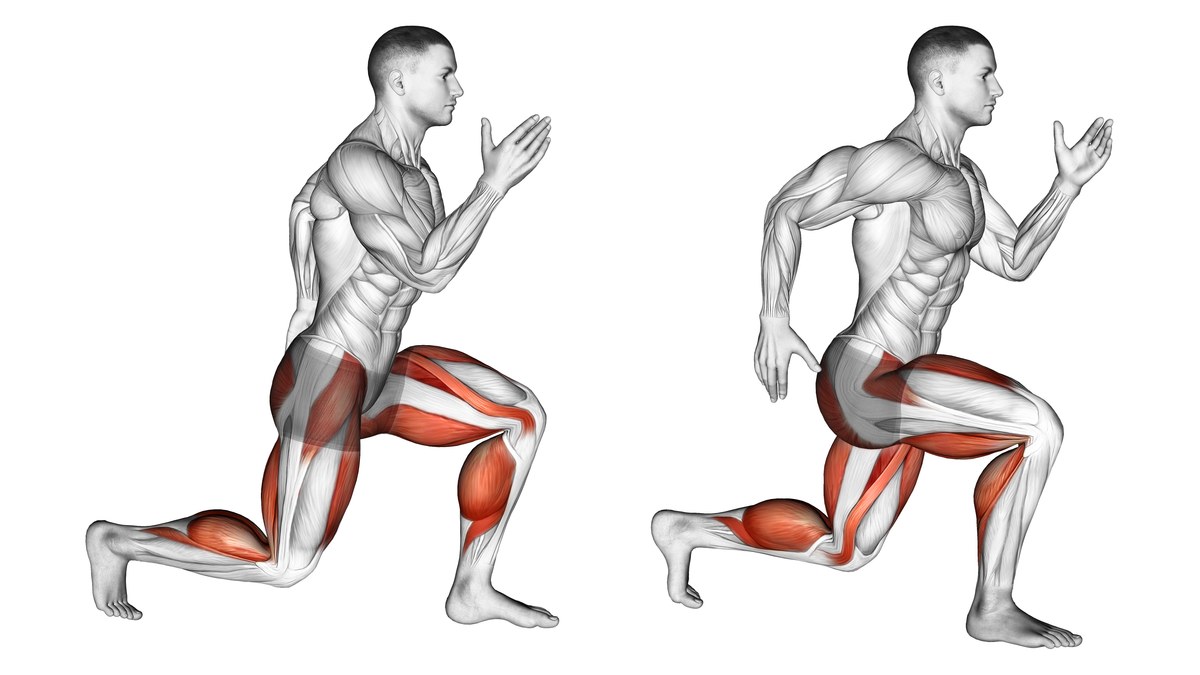
A jumping lunge is a bodyweight jump that changes which leg is forward. From a bent-knee split stance, you push off, exchange the legs in the air and land in the opposite split stance. Each landing leads into the next jump, so you alternate sides while staying in roughly the same spot.
How do you perform a jumping lunge?
Set up
- Choose a clear, level surface with secure footing and room for a long stance. Start standing with your feet about hip-width apart.
- Step one foot behind you and lower into a split stance, keeping some width between your feet. Bend both knees, lift the rear heel and keep the back knee above the floor.
Execution
- Push through both legs to jump upward, letting your arms swing with the movement. Keep your chest facing ahead.
- While airborne, move the front leg back and the rear leg forward.
- Land with the other foot in front, bending both knees as your weight settles. Keep the front foot planted, the rear heel lifted and the knees following the direction of the toes.
- Continue exchanging legs with a landing you can control each time. To finish, hold the last split landing, straighten your legs and step back into a stable standing position.
Common mistakes
Landing on a tightrope
Keep the feet on two narrow parallel tracks rather than crossing them onto one line. Reset your stance if you wobble or step sideways after contact.
Chasing height before controlling the landing
Use a smaller jump or separate the repetitions with a pause. Finish the set when you can no longer place the feet and bend the knees as intended.
Switching feet without lowering into the split stance
A quick scissor of nearly straight legs misses the bent-knee landing this guide describes. Let both knees bend on contact instead of bouncing through a rigid stance.
Where it fits in a session
Where alternating jumps fit the session you have planned.
Choose the amount of work around landings you can repeat cleanly. Take a break or use stepping lunges when the split position starts to fall apart; there is no universal rep target for this guide.
Muscles worked
Primary
Secondary
Schematic surface view. Some muscles are partly visible or not shown.
The quadriceps straighten the knees and the gluteus maximus extends the hips as you leave the floor. The calf muscles contribute at the ankles. These roles describe the jumping action; they do not rank muscle activation or predict muscle growth.
Variations
- Pause between jumps — Settle after each split landing before taking off again. This gives you time to check the stance without changing the alternating leg switch.
- Reverse lungeStep backward and return to standing without leaving the floor. Use this stepping option when you want to practise the lunge pattern without jumping.
Frequently asked questions
What muscles do jumping lunges work?
The quadriceps and gluteus maximus contribute to straightening the knees and hips during takeoff. The gastrocnemius and soleus in the calves help at the ankles. The map describes those roles, rather than a measured activation ranking.
Are jumping lunges the same as split-squat jumps?
The names sometimes overlap. This guide uses jumping lunge for a jump that swaps the forward leg each time. A split-squat jump can also mean landing with the same leg forward, so check the leg action rather than relying on the name alone.
What can I do instead of jumping lunges?
Practise reverse lunges without the jump: step back, lower under control and return to standing, then change sides. You can also pause after each jumping-lunge landing instead of linking jumps continuously. Choose the stepping version if you do not want airborne landings.
Does the back knee have to touch the floor?
No. Keep it off the floor during both setup and landing. Use a stance and depth that let you bend both knees while keeping your balance; contact with the ground is not a repetition requirement.
How do you count jumping lunges?
For this guide, count each completed jump and opposite-leg landing as one repetition. Two jumps bring the original leg back to the front. If a workout lists reps per side, track the two forward-leg positions separately and use that convention consistently.
Sources
- Bordoni B, Varacallo MA. Anatomy, Bony Pelvis and Lower Limb: Thigh Quadriceps Muscle. StatPearls, 2023. https://www.ncbi.nlm.nih.gov/sites/books/NBK513334/
- Elzanie A, Borger J. Anatomy, Bony Pelvis and Lower Limb, Gluteus Maximus Muscle. StatPearls, 2023. https://www.ncbi.nlm.nih.gov/sites/books/NBK538193/
- Binstead JT, Varacallo MA. Anatomy, Bony Pelvis and Lower Limb: Calf. StatPearls, 2026. https://www.ncbi.nlm.nih.gov/sites/books/NBK459362/