Lunge
Also called forward lunge, stationary lunge, dumbbell lunge.
What is a lunge?
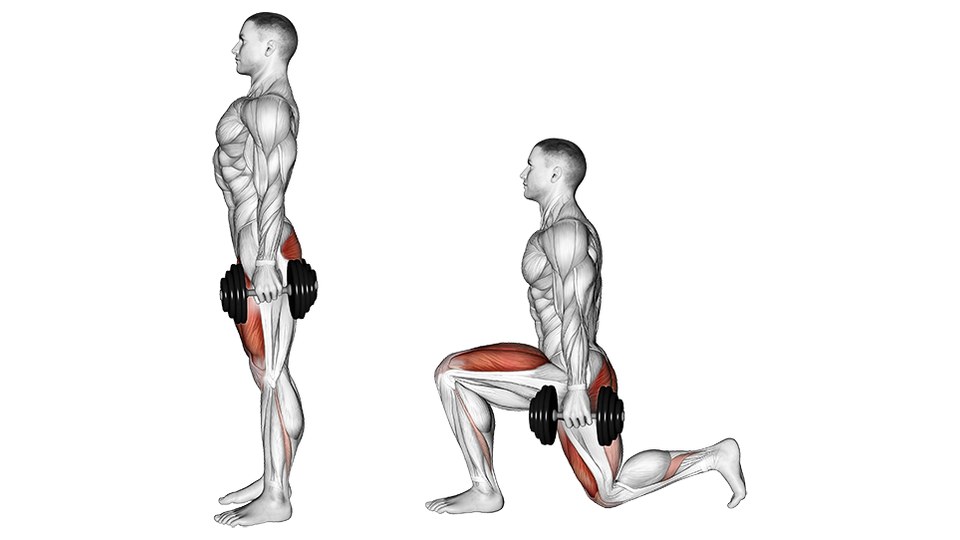
A lunge is a single-leg exercise: step out into a split stance, lower until the back knee is just above the floor, and drive back up through the front leg. The front leg does the work — the quadriceps extend the knee and the gluteus maximus extends the hip — while the hamstrings and the adductor magnus assist at the hip and the gluteus medius keeps the pelvis level. It needs no equipment to start, and it loads by holding a dumbbell in each hand.
How do you perform a lunge?
Set up
- Stand tall with your feet about hip width apart, brace lightly, and look straight ahead.
- Hold a dumbbell in each hand at your sides, or begin with no weight.
Execution
- Step forward far enough to make a stable split stance, keeping your feet about hip width apart from side to side.
- Lower under control until your back knee is just above the floor, keeping your torso upright.
- Keep your front foot flat and your knee tracking in the same direction as your toes.
- Push through your front foot to return to the starting position under control, then repeat with the other leg or finish one side.
Common mistakes
Stepping too short
A cramped stance leaves nowhere to go but forward, so the descent turns into a slide: the front heel lifts, your weight rolls onto the ball of the foot, and you spend the set catching your balance. A long step lets you drop straight down with the heel planted and the hip sharing the work with the knee.
Standing up off the back foot
Springing off the back toes feels easier because it is — it hands the rep to the leg you are not trying to train. It is the failure that hides best, because the weight on the log keeps going up while the front leg gets nothing.
Letting the front knee fall inward
A split stance is narrow side to side, so the knee drifts in as you tire, usually on the last few reps. When it dives in, the load runs across the joint instead of through it and the hip muscles that should be holding the leg out have stopped doing it.
Dropping into the bottom
Falling into the rep bangs the back knee on the floor and turns the turnaround into a bounce. Lowering under control is where the front leg does much of its work in a lunge; give that away and the set gets easier without getting better.
Where it fits in a session
Middle or end of a leg session, after the heaviest two-legged work such as squats or leg press.
Only one leg carries the load at a time, so the dumbbells stay modest while the legs work hard — expect to use a fraction of what you squat, and do not read that as the exercise being easy. Eight to twelve controlled reps per leg is a sensible starting point, and remember a set is twice the work it looks like on paper because both legs go before you rest. Add weight only once every rep is balanced: a lunge that wobbles is training your balance more than your legs.
Muscles worked
- quadriceps femoris
- gluteus maximus
- hamstrings
- adductor magnus
- gluteus medius
The tiers follow the joint actions of the front leg. Standing back up out of a lunge is knee extension and hip extension, and the quadriceps and gluteus maximus are the movers of those two actions. The secondary list is assisters and one stabiliser: the hamstrings and the hamstring portion of the adductor magnus help extend the hip, and the gluteus medius holds the pelvis level while most of the load sits on one leg. The anatomy supports those two tiers; it does not support a finer ranking inside them, so none is attempted.
What lifters actually do
About three in ten regular RepCount users have logged lunges, but they appear in only about one in fifty workouts — widely tried, rarely kept. When they do show up it is nearly always inside a full leg day: squats feature in over four in ten lunge sessions, leg extensions in about the same, and leg curls, leg press and calf raises each in roughly three in ten. Typically about three sets in a session of six or seven exercises, which is single-leg accessory work slotted in around the main lifts rather than the centrepiece of the day.
Most often trained alongside
Share of lunge sessions that also include each exercise.
- Squat43.1%
- Leg extension40.8%
- Leg curl31.2%
- Leg press29%
- Calf raise28.3%
Figures come from workouts tracked in RepCount.
Variations
- Walking lunge — Each rep travels forward into the next one instead of stepping back, which raises the balance demand and needs floor space.
- Reverse lunge — Step backward instead of forward. It keeps the front shin more upright and is easier to control on the way down, which is why some lifters prefer it. A preference, not a correction.
- Split squat — Both feet stay planted in the split stance for the whole set, so there is no stepping to balance and you can load it heavier.
- Bulgarian split squat — Back foot rests on a bench behind you, putting almost the whole load on the front leg.
- Lateral lunge — Step out to the side, which takes the inner thigh through a long range the forward version never reaches.
- Barbell lunge — Loaded with a bar on the back rather than dumbbells at the sides; the higher load placement makes it harder to balance.
- Curtsy lunge — Steps back and across behind the standing leg instead of straight back.
Frequently asked questions
What muscles do lunges work?
The front leg does most of the work. Standing back up is knee extension and hip extension, so the quadriceps and the gluteus maximus are the prime movers. The hamstrings and the hamstring portion of the adductor magnus assist at the hip, and the gluteus medius works to keep the pelvis level — the same stabilising job it does whenever most of your weight is on one leg. The back leg mostly balances.
Are lunges better than squats?
They do different jobs, and lifters treat them that way: squats show up in over four in ten of the workouts that contain lunges. A squat loads both legs at once and takes heavy weight easily. A lunge trains one leg at a time and adds a balance demand a squat never asks for. Doing both covers more ground than choosing between them.
Should I do forward or reverse lunges?
This is a preference rather than a technique point. Stepping forward is the version most people mean by a lunge; stepping backward keeps the front shin more upright and is easier to control on the way down, which some lifters find more comfortable. Both train the same muscles through much the same range. Pick the one that feels better and progress it.
Should I alternate legs or finish one side first?
Either — treat it as a preference. Alternating gives each leg a short rest between reps, so the set is limited less by fatigue; finishing one side first keeps the working leg under continuous load and takes less time. The rep itself is identical both ways.
Do I need weights to lunge?
No. A bodyweight lunge is a real exercise, and owning the balance before loading it is time well spent. When bodyweight gets easy, a dumbbell in each hand is the simplest progression — and because only one leg carries the load at a time, those dumbbells stay small next to what you would put on a squat bar.
How deep should a lunge be?
Until the back knee is just above the floor, or lightly brushes it. That bottom position is what keeps depth honest, because every rep then travels the same distance instead of getting shorter as you tire. If you cannot get near the floor with your torso upright, use a shorter range and work deeper over a few sessions rather than folding forward to reach it.
Are lunges worth doing?
About three in ten regular RepCount users have logged lunges, but they turn up in only about one in fifty workouts — a movement plenty of lifters have tried and few have kept. What the logs show is where they belong: when lunges appear it is nearly always inside a full leg day, with squats in over four in ten of those sessions and leg extensions in about the same. If your leg day is squats plus machines, lunges are probably the single-leg work missing from it.
Sources
- Anatomy, Bony Pelvis and Lower Limb: Thigh Quadriceps Muscle. StatPearls. https://www.ncbi.nlm.nih.gov/books/NBK513334/
- Anatomy, Bony Pelvis and Lower Limb, Gluteus Maximus Muscle. StatPearls. https://www.ncbi.nlm.nih.gov/books/NBK538193/
- Anatomy, Bony Pelvis and Lower Limb, Hamstring Muscle. StatPearls. https://www.ncbi.nlm.nih.gov/books/NBK546688/
- Anatomy, Bony Pelvis and Lower Limb: Thigh Adductor Magnus Muscle. StatPearls. https://www.ncbi.nlm.nih.gov/books/NBK534842/
- Anatomy, Bony Pelvis and Lower Limb, Gluteus Medius Muscle. StatPearls. https://www.ncbi.nlm.nih.gov/books/NBK557509/