
Landmine Romanian deadlift
Also called landmine RDL, landmine Romanian deadlifts.
What is a landmine Romanian deadlift?
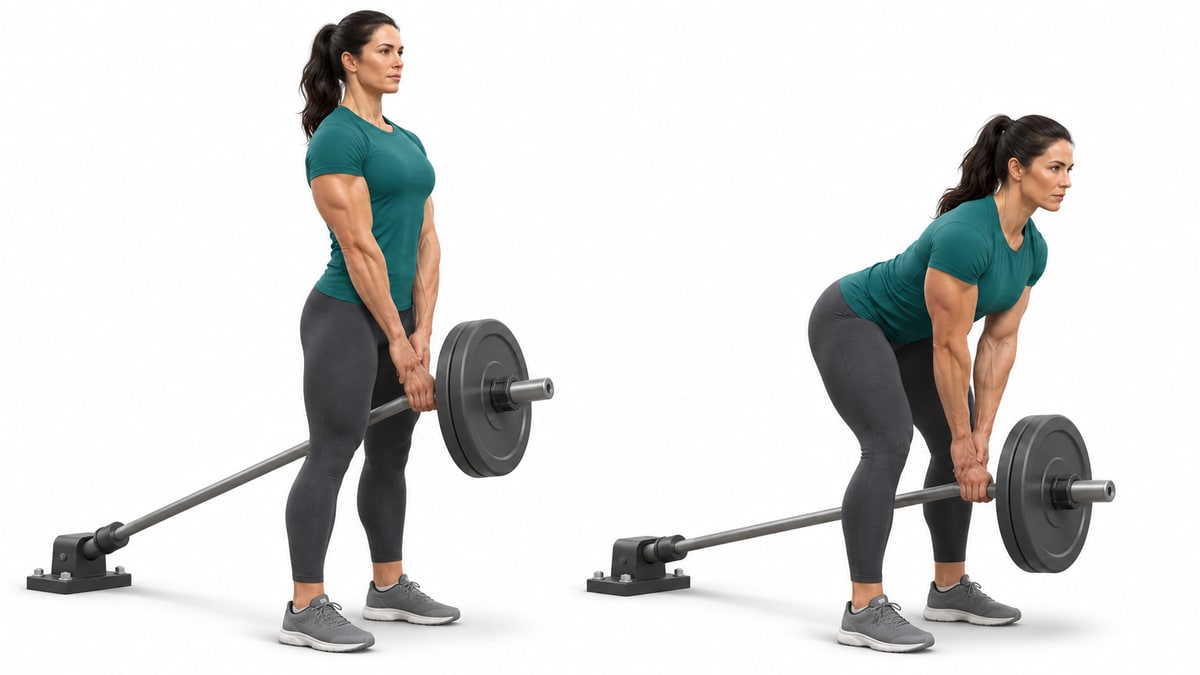
A landmine Romanian deadlift is a hip hinge using a barbell anchored at one end. In this version you face away from the anchor, straddle the bar and hold the shaft with both hands just behind the loaded sleeve. From standing, you move your hips back and then stand again, keeping a small knee bend.
How do you perform a landmine Romanian deadlift?
Set up
- Fix one end of the barbell in a secure landmine attachment. Load the free sleeve lightly, secure the plates with a collar and clear the bar's path.
- Face away from the anchor with the bar between your legs and the plates in front of your toes. Place your feet about hip-width apart.
- Bend your hips and knees to wrap both hands around the shaft just behind the loaded sleeve, one hand in front of the other. Brace, keep your back steady and stand with straight arms.
Execution
- Soften your knees, then move your hips backward as your torso tips forward. Let your hands follow the bar's arc while keeping both feet flat and your back position steady.
- Lower only as far as you can keep that position, with your knees staying at roughly the same bend. Reverse before the plates land or your back starts to round.
- Bring your hips forward to stand upright again, leaving your arms long. Finish tall without leaning backward, then begin the next hinge.
- After the last rep, bend your hips and knees to settle the plates fully on the floor before opening your hands.
Common mistakes
Squatting farther down on every rep
A progressively deeper knee bend changes the hinge into a squat-like movement. Set a small bend before lowering and keep it nearly unchanged during each repetition.
Reaching for the floor with the shoulders
The plate does not have to touch down during each repetition. End the descent when you can no longer move back at the hips without changing your back position.
Trying to save a slipping grip
Stop the set and lower the plates under control if your hands begin to open. Reduce the load or use equipment designed for a secure landmine grip rather than balancing a loose attachment on the bar.
Where it fits in a session
Use it as the planned hinge exercise in a lower-body or full-body session.
Begin with a load you can grip securely through every rep. Keep the same bar, plate position and range when comparing sessions; record landmine work separately from free-bar RDLs.
Muscles worked
Primary
Secondary
Schematic surface view. Some muscles are partly visible or not shown.
The gluteus maximus and the hamstrings that cross the hip help straighten it as you stand. The spinal erectors help hold your trunk position. These roles do not rank muscle growth or show how much each muscle works.
Variations
- Romanian deadliftUses a free barbell held across the thighs instead of a bar anchored behind you.
- Dumbbell Romanian deadliftUses a dumbbell in each hand, with no anchored bar between the feet.
Frequently asked questions
Do I face toward or away from the landmine?
This guide teaches the straddled version: the anchor is behind you and the plates are in front. Both hands grip the shaft just behind the loaded sleeve. A purpose-built landmine handle can use a different hand position; follow its setup instructions rather than fitting a loose handle around the bar.
How is this different from a landmine squat?
In this RDL your arms stay long and most of the visible movement comes from folding and straightening at the hips, with a small knee bend. A landmine squat has more knee bending and commonly holds the loaded end at the chest. Keep those movements separate.
How low should I lower the bar?
Use the range in which your feet stay planted, your back position stays steady and the bend in your knees changes little. Plate size can limit the descent. Stop before the plates touch down rather than rounding farther to reach a particular height.
What muscles does the landmine RDL work?
The main hip extensors here are the gluteus maximus and the hamstrings that cross the hip. Your spinal erectors also work to hold the trunk position. That does not establish a growth ranking between the glutes and hamstrings.
Can I compare the weight with my barbell RDL?
Treat them as separate lifts. A landmine rotates around its anchor, and where the plates sit along the bar affects its resistance. The plate total alone is not an equivalent free-barbell load. Keep your landmine setup consistent when tracking progress.
Sources
- Betts JG, et al. Anatomy and Physiology 2e. Section 11.6, appendicular muscles of the pelvic girdle and lower limbs. OpenStax, 2022. https://openstax.org/books/anatomy-and-physiology-2e/pages/11-6-appendicular-muscles-of-the-pelvic-girdle-and-lower-limbs
- Hu Y, Raja A. Anatomy, Bony Pelvis and Lower Limb, Hamstring Muscle. StatPearls, updated 2026. https://www.ncbi.nlm.nih.gov/sites/books/NBK546688/
- McCurdy KW, Koldenhoven RM. Comparison of Muscle Activation and Range of Motion between the Traditional and Landmine Romanian Deadlift. International Journal of Strength and Conditioning. 2025. https://doi.org/10.47206/ijsc.v5i1.370