Landmine row
Also called landmine T-bar row, two-arm landmine row, landmine barbell row.
What is a landmine row?
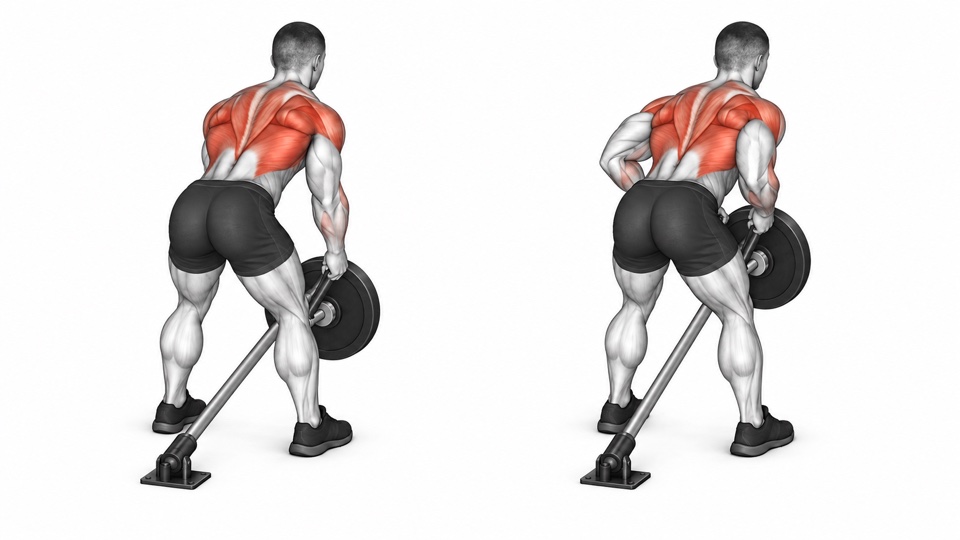
A landmine row is a bilateral row using the free end of an anchored barbell. Stand astride the bar, hinge forward, hold a neutral-grip V-handle looped beneath the bar behind the plate and row the weight toward your lower chest. It trains the lats, middle back and rear deltoids while the arms and trunk assist.
How do you perform a landmine row?
Set up
- Anchor one end of a barbell securely in a landmine attachment or protected corner, load and collar the free end, then loop a close-neutral V-handle beneath the bar immediately behind the plate.
- Stand astride the bar with feet about shoulder-width apart, hinge forward with a flat back and hold both sides of the V-handle.
Execution
- Row the free end toward your lower chest and upper abdomen by driving both elbows back.
- Keep the hip hinge and stance steady instead of standing up to finish the pull.
- Lower the bar along the same arc until both arms are straight and the shoulders can reach forward under control.
Common mistakes
Standing up as the plate rises
Keep the torso angle steady so the repetition remains a row instead of turning into hip extension.
Letting one elbow lead
Keep both hands on the V-handle and drive the elbows back together so the plate stays centered between the legs.
Placing the handle in front of the plate
Loop the V-handle beneath the bar directly behind the secured plate so it cannot slide off the free end.
Where it fits in a session
Use it as a main horizontal pull or after heavier supported rows.
Record the plates loaded on the bar, and use the same V-handle position and torso angle from set to set.
Muscles worked
Primary
Secondary
Schematic surface view. Some muscles are partly visible or not shown.
Both sides of the back and rear shoulders row the anchored bar while the elbow flexors, forearms and trunk muscles assist.
Variations
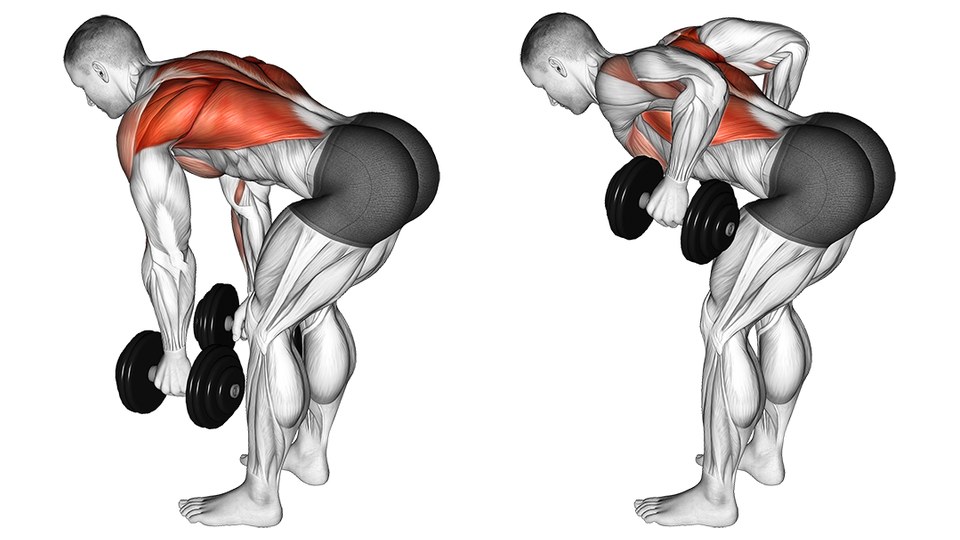
- Single-arm landmine row — Stands beside the bar and rows the free end with one arm, often with the other hand braced on the thigh.
Related tools
Frequently asked questions
What muscles does the landmine row work?
It trains the lats, middle and lower trapezius, rhomboids and rear deltoids. The biceps, forearms and spinal erectors assist.
Where should you pull the bar?
Row the plate toward the lower chest and upper abdomen while keeping both elbows moving back together.
Is a landmine row the same as a T-bar row?
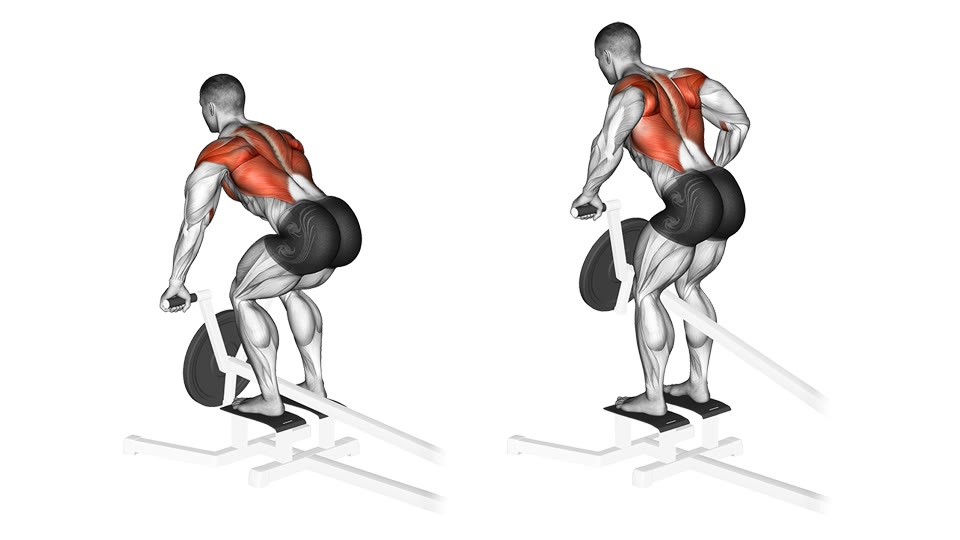
The movements are closely related. This guide uses an anchored free barbell with a V-handle, while the T-bar-row guide covers a dedicated fixed plate-loaded station.
Where should the V-handle go?
Loop it beneath the bar directly behind the secured plate, then hold its parallel grips with both hands.