
Lateral step-down
Also called side step-down, lateral heel tap.
What is a lateral step-down?
A lateral step-down is a single-leg exercise in which you stand on a step, lower your free heel to the floor beside it, and rise through the leg that stays on the step. It works the quadriceps and gluteus maximus. This guide teaches the bodyweight heel-tap version.
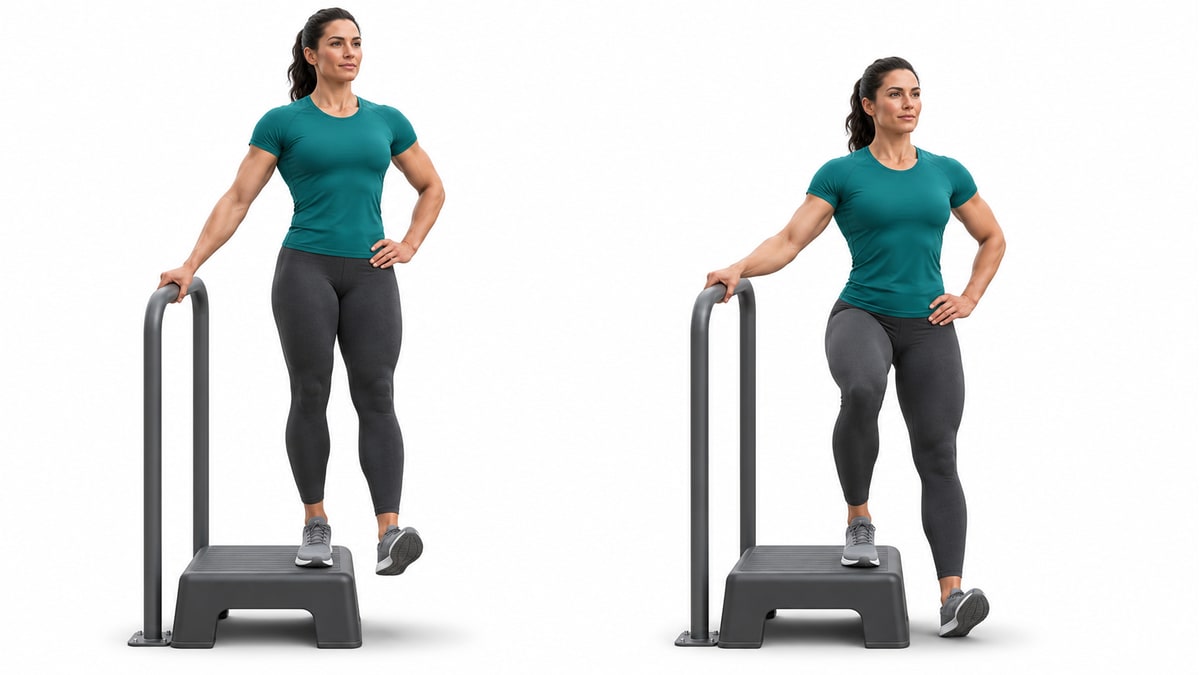
How do you perform a lateral step-down?
Set up
- Choose a low, stable exercise step with space beside it. Have a fixed rail or support within reach if you need help balancing.
- Stand on one leg near the side edge, with that whole foot supported. Hold the other leg just off the side with its knee straight and toes lifted.
Execution
- Bend the knee and hip of the leg on the step to lower the free heel toward the floor beside you. Keep your hips level and your supporting knee pointing along your toes.
- Touch the floor lightly with the free heel, keeping your weight on the foot that stays on the step.
- Press through the supported foot and straighten that knee and hip to stand again. Leave the free foot off the step.
- After your repetitions, place the free foot fully on the floor, shift your weight onto it, and bring the other foot down. Set up with the opposite leg.
Common mistakes
Pushing off the tapping foot
Keep the tap light so the leg on the step performs the return. Lower the step if you need a push from the floor.
Reaching the floor by dropping one hip
Bend the supporting leg to lower yourself. Use a shorter step if you have to tip your pelvis or lean far sideways to reach the floor.
Losing the supporting heel or knee position
Keep the whole foot down and the knee following the direction of the toes. Reduce the height if the heel lifts or the knee repeatedly falls inward.
Where it fits in a session
Use it for single-leg work in a lower-body session, starting with bodyweight.
Record repetitions per leg and step height. Keep the height and any hand support consistent when comparing sessions; add repetitions before choosing a taller step.
Muscles worked
Primary
Secondary
- None listed in this guide
Schematic surface view. Some muscles are partly visible or not shown.
The quadriceps straighten the supporting knee, while the gluteus maximus helps straighten the hip. The free foot only taps the floor.
Variations
- Lateral step-upStarts beside the platform and lifts you onto it. The linked guide finishes with both feet on top.
- Forward step-upStarts in front of the platform and steps onto it; the linked guide uses dumbbells.
Frequently asked questions
How is a lateral step-down different from a forward step-down?
In a lateral step-down, the free heel lowers beside the step. In a forward step-down, it reaches in front. Both begin on the step and return through the supporting leg; keep the direction consistent when recording your repetitions.
Is this the same as a lateral step-up?
A lateral step-up starts beside the platform and lifts you onto it. This step-down starts on top, lowers one heel to a light floor tap, and returns without bringing the free foot onto the platform.
How high should the step be?
Start low enough to touch your free heel down without dropping a hip, lifting the supporting heel or pushing off the floor. Use a shorter step if you cannot control the full repetition.
Can I hold something for balance?
Yes. A light hand on a fixed rail or other stable support is an option. Use enough help to stay steady without pulling yourself up, and record whether you used support.
Should my free foot take my weight at the bottom?
No. This version uses a light heel tap. Keep your weight on the leg on the step and use that leg to rise again.
Sources
- Bordoni B, Varacallo MA. Anatomy, Bony Pelvis and Lower Limb: Thigh Quadriceps Muscle. StatPearls. https://www.ncbi.nlm.nih.gov/sites/books/NBK513334/
- Elzanie A, Borger J. Anatomy, Bony Pelvis and Lower Limb, Gluteus Maximus Muscle. StatPearls. https://www.ncbi.nlm.nih.gov/sites/books/NBK538193/