Machine crunch
Also called seated machine crunch, ab crunch machine, lever seated crunch.
What is a machine crunch?
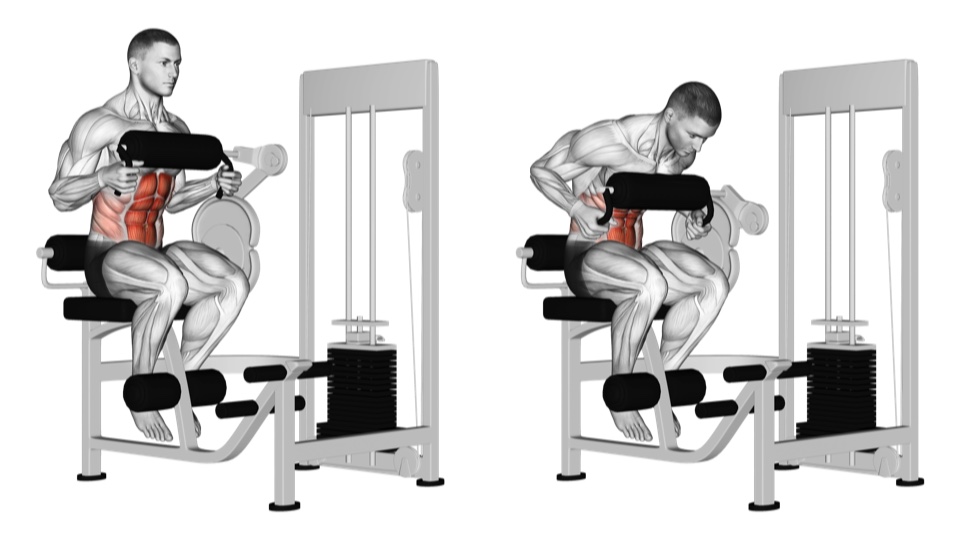
A machine crunch is a seated abdominal exercise performed against a padded lever or handles. You keep the hips in the seat and shorten the distance between the ribs and pelvis by curling the trunk forward, then return without letting the weight stack pull you upright.
How do you perform a machine crunch?
Set up
- Adjust the seat and pads so the machine's pivot sits near your waist and you can hold the handles or pad without straining your shoulders.
- Plant your feet, secure your lower legs if the machine provides rollers and choose a load you can move without pulling with the arms.
Execution
- Exhale and curl your ribs toward your pelvis as you press the pad or handles forward.
- Pause in the shortened position without lifting your hips or turning the rep into a hip hinge.
- Return slowly until the abdomen lengthens, stopping before the stack settles or your lower back overextends.
Common mistakes
Pulling with the arms
The handles connect you to the machine; they are not the movement. Keep the grip quiet and create the motion by curling the trunk.
Folding only at the hips
A hip hinge moves the torso forward without shortening the abdominal wall much. Curl the rib cage toward the pelvis instead of keeping the back rigid.
Letting the stack slam down
Losing the return makes the next rep start from a different position. Control the machine until the abdomen is long and the plates nearly touch.
Where it fits in a session
Use it after compound lifts or alongside another trunk exercise when you want abdominal work that can be progressed with a weight stack.
Machine designs differ, so keep the same seat setting and record the machine used. Add weight only while the hips stay down and the trunk, not the arms, drives the lever.
Muscles worked
Primary
Secondary
Schematic surface view. Some muscles are partly visible or not shown.
The rectus abdominis flexes the trunk, while the obliques help produce and control the same motion.
Variations
- Cable kneeling crunch — Uses a high cable and kneeling position instead of a seated lever machine.
- Machine crunch with shoulder pads — Loads through pads over the shoulders rather than a chest pad or hand grips.
Frequently asked questions
What muscles does the machine crunch work?
It mainly trains the rectus abdominis. The internal and external obliques assist with trunk flexion and control.
Should your back round during a machine crunch?
Yes, the trunk needs to flex for the ribs to move toward the pelvis. The movement should be controlled rather than forced through the lower back.
Why do I feel a machine crunch in my hips?
You may be hinging at the hips instead of curling the trunk, or the seat may be poorly adjusted. Keep the hips planted and think about bringing the ribs toward the pelvis.
Sources
- Flynn W, Vickerton P. Anatomy, Abdomen and Pelvis: Abdominal Wall. StatPearls. https://www.ncbi.nlm.nih.gov/books/NBK551649/
- Varacallo MA, Scharbach S, Al-Dhahir MA. Anatomy, Anterolateral Abdominal Wall Muscles. StatPearls. https://www.ncbi.nlm.nih.gov/books/NBK470334/