
Machine lateral raise
Also called lateral raise machine, machine lateral raises, seated machine lateral raise, lever lateral raise.
What is a machine lateral raise?
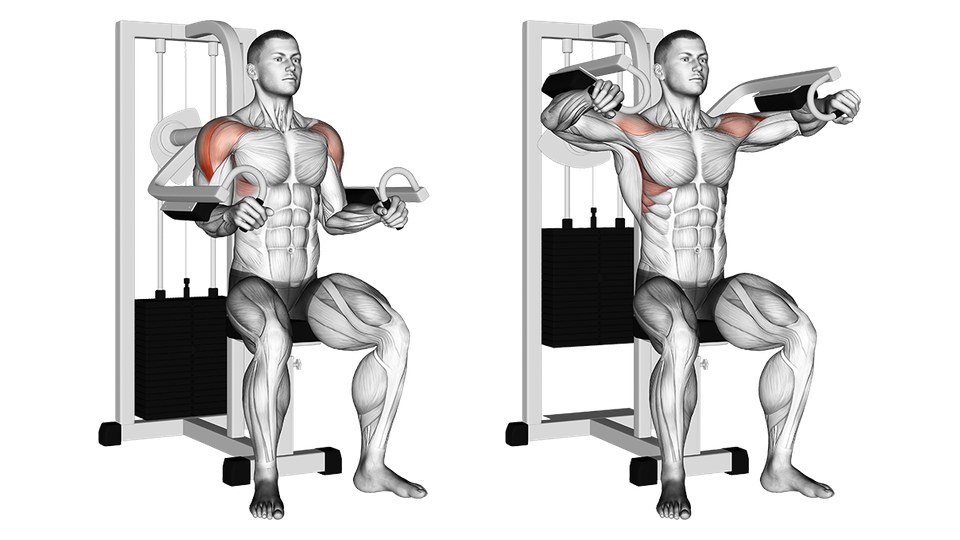
The machine lateral raise trains the lateral deltoid by guiding the upper arms out to the sides against padded levers. Adjust the machine's pivot and pads to your shoulders and elbows, then raise to about shoulder height without shrugging.
How do you perform a machine lateral raise?
Set up
- Adjust the seat so the machine's shoulder pivot lines up closely with your shoulder joints and the pads rest securely near your elbows.
- Sit tall against the back pad, hold the handles if provided and let your upper arms rest at your sides without hunching.
Execution
- Drive your upper arms into the pads and raise them out to the sides.
- Stop around shoulder height while your neck stays long and your torso remains against the pad.
- Lower the levers under control to the starting position without letting the stack slam.
Common mistakes
Setting the seat at the wrong height
If the machine pivot and shoulders are far apart, the pads follow an awkward arc. Adjust the seat before loading the movement.
Shrugging the weight up
The shoulders rise toward the ears instead of the upper arms moving cleanly out. Reduce the load and keep the neck long.
Dropping the levers into the stack
The return becomes uncontrolled and the next rep begins with a bounce. Slow the final part of the descent.
Where it fits in a session
Use it as direct shoulder work after pressing or as the main lateral-raise variation in a machine session.
Keep the seat and pad settings consistent. Do not trade the same shoulder-height range for a heavier stack number.
Muscles worked
Primary
Secondary
Schematic surface view. Some muscles are partly visible or not shown.
The lateral deltoid is the main target as the upper arms move away from the torso; the anterior deltoid and supraspinatus assist.
Variations
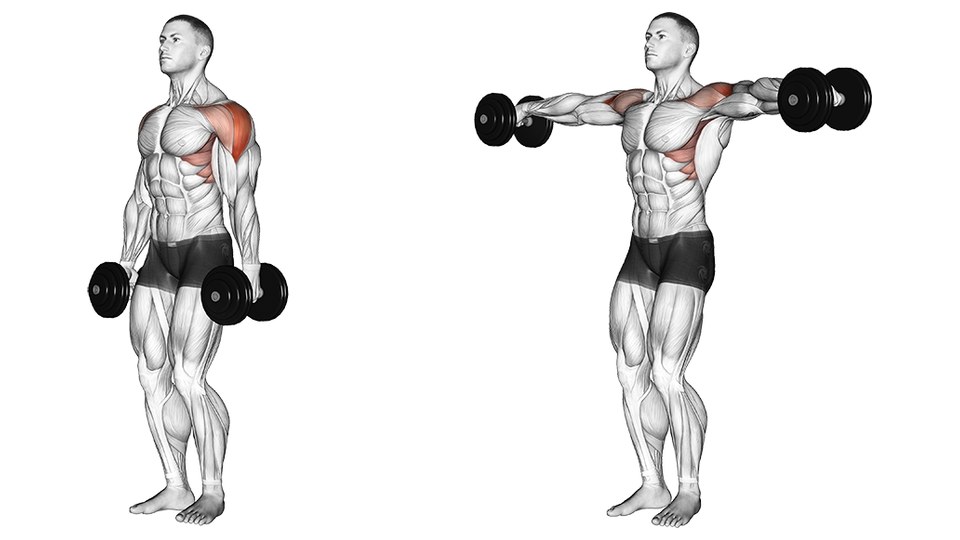
- Dumbbell lateral raiseUses free weights, so the arms choose their own path rather than following pads.
- Cable lateral raise — Uses a low cable, commonly one arm at a time.
- Single-arm machine lateral raise — Raises one lever at a time when the machine has independent arms.
Frequently asked questions
What muscles does the machine lateral raise work?
The lateral deltoid is the main target. The anterior deltoid and supraspinatus assist as the upper arm moves away from the body.
How high should you raise the machine arms?
Around shoulder height is a practical endpoint. Stop earlier if reaching it requires shrugging or losing contact with the back pad.
Where should the pads sit?
Place them near the elbows on the outside of the upper arms, then set the seat so the machine pivot lines up closely with your shoulders.
Is the machine lateral raise better than dumbbells?
Neither is universally better. The machine guides the path and simplifies setup; dumbbells let each arm choose its own path. Use the one you can perform and progress consistently.
Sources
- Elzanie A, Varacallo MA. Anatomy, Shoulder and Upper Limb, Deltoid Muscle. StatPearls. https://www.ncbi.nlm.nih.gov/books/NBK537056/