
Pelvic tilt
Also called supine pelvic tilt, posterior pelvic tilt exercise.
What is a pelvic tilt?
A pelvic tilt gently changes the angle of the pelvis. For a small posterior tilt while lying with the knees bent, bring the front of the pelvis slightly toward the ribs so the lower-back curve reduces, then release. The hips stay on the floor.
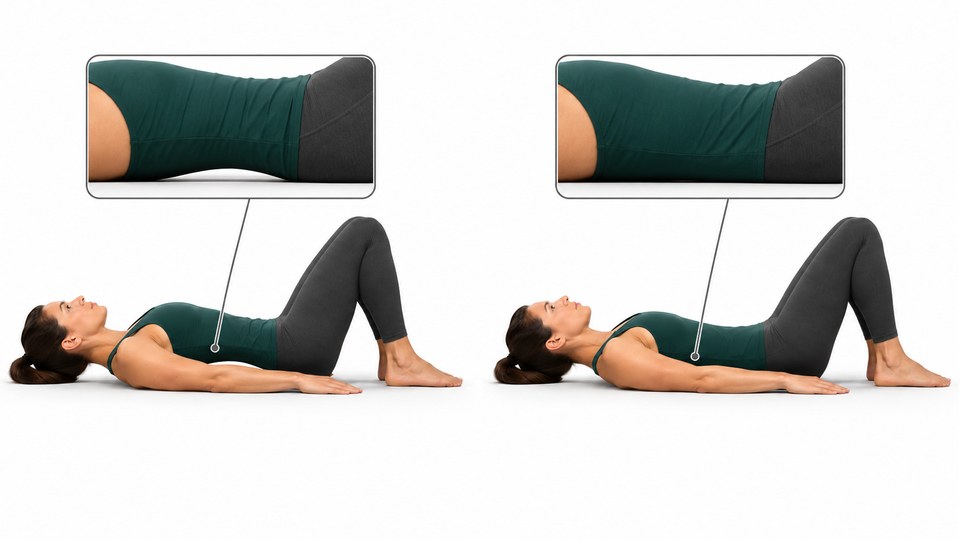
How do you perform a pelvic tilt?
Set up
- Lie back with bent knees and planted feet, letting your arms rest at your sides.
- Start with a comfortable small curve beneath your lower back; keep the buttocks supported.
Execution
- Breathe out gently and roll the front of the pelvis a little toward the ribs, reducing the gap under your lower back.
- Keep the movement small, without pushing through your feet to lift the hips.
- Release back to the starting position and breathe normally before repeating.
Common mistakes
Lifting into a bridge
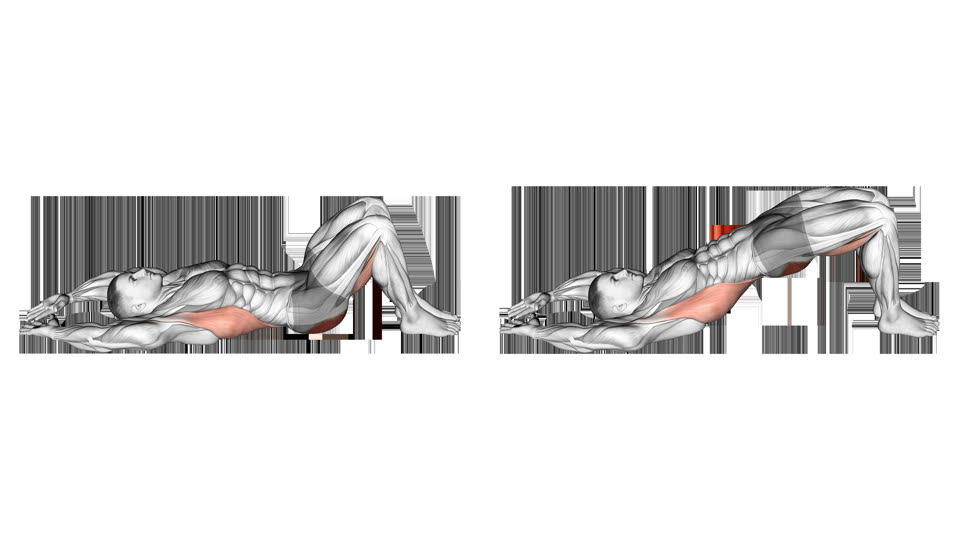
Keep the buttocks down. A bridge is a different exercise that raises the hips.
Pressing down as hard as possible
Use a small comfortable motion. More pressure against the floor is not the goal.
Holding the tucked position all day
This is a movement drill. Do not turn the finishing position into a rule for standing or walking.
Where it fits in a session
Use as a chosen abdominal-control drill in a session you can manage comfortably.
Choose a short set that leaves breathing and movement controlled. Keep the starting position and range consistent before adding repetitions. Record any variation in the set notes.
Muscles worked
Primary
Secondary
Schematic surface view. Some muscles are partly visible or not shown.
These labels describe anatomical roles in the small posterior-tilt version, rather than a measured effort ranking.
Variations
- Smaller posterior tilt — Use less pelvic movement and release between repetitions.
Frequently asked questions
Which muscles contribute to a pelvic tilt?
The rectus abdominis and obliques contribute to abdominal tension and pelvic control. The target list describes this small posterior-tilt version, not a measured ranking of muscle effort.
Should I lift my bottom?
Keep it resting on the floor for this drill. If the hips rise, you have moved into a bridge rather than the small pelvic roll described here.
Do I need to flatten my back completely?
Use the small range that feels comfortable. Reduce the lower-back gap gently; do not force contact or push hard through your feet.
Will this correct my standing posture?
Practise the small pelvic movement, then release it. A natural back curve does not have to disappear, and the finishing position is not a posture to hold throughout the day.
Can I use this after pregnancy?
Choose a version that fits your recovery and any advice from your maternity or pelvic-health team. Stop if the movement brings on pain, urine or bowel leakage, or pelvic heaviness, and get advice for symptoms that persist or recur. Being able to perform this drill is not a test of readiness for harder training.
Sources
- Shahab Shahid, MBBS; reviewer Uruj Zehra, MBBS, MPhil, PhD. Rectus abdominis muscle. Kenhub. https://www.kenhub.com/en/library/anatomy/rectus-abdominis-muscle
- Gordana Sendić, MD; reviewer Declan Tempany, BSc (Hons). Internal abdominal oblique muscle. Kenhub. https://www.kenhub.com/en/library/anatomy/internal-abdominal-oblique-muscle
- Jana Vasković, MD; reviewer Declan Tempany, BSc (Hons). External abdominal oblique muscle. Kenhub. https://www.kenhub.com/en/library/anatomy/external-abdominal-oblique-muscle