Overhead press
Also called military press, standing barbell press, strict press, shoulder press, OHP.
What is an overhead press?
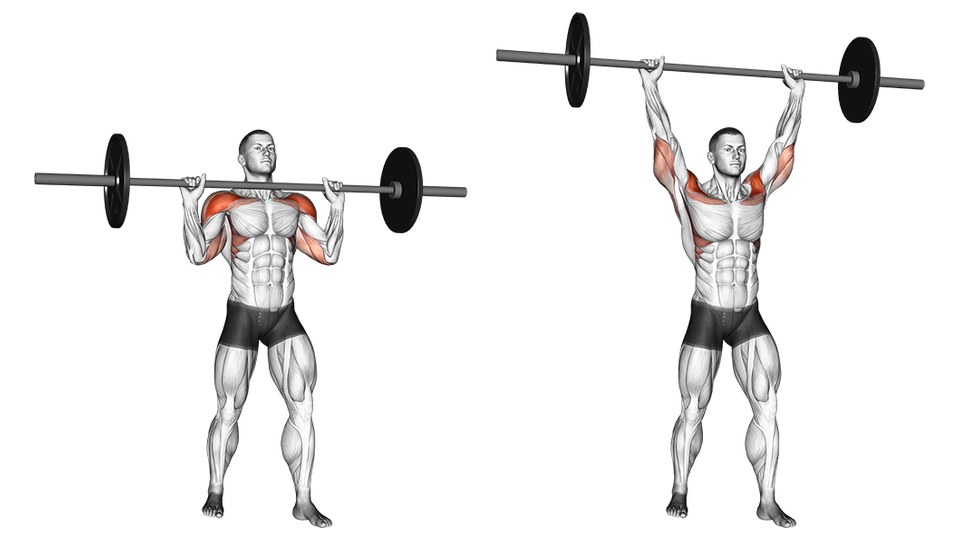
The overhead press is a strict press of a barbell from the front of the shoulders to straight arms above the head, with no help from the legs. The anterior deltoid leads the press, the lateral deltoid raises the arm with it and the triceps straightens the elbow; behind that, the serratus anterior and the trapezius rotate the shoulder blade upward so the arm can reach overhead in the first place, and the rotator cuff keeps the humerus seated in the socket. It can be done standing or seated, with a barbell or with dumbbells. Those variations change the load and stabilising demands. This guide teaches the standing barbell version.
How do you perform an overhead press?
Set up
- Set the rack so the bar sits around upper-chest height. Grip it just outside shoulder width, with your forearms close to vertical.
- Stand up to unrack the bar and rest it on the front of your shoulders. Keep your wrists under the bar and your elbows slightly forward.
- Step clear with your feet about shoulder width apart, or one foot slightly forward if that feels steadier. Squeeze your glutes, brace your midsection and keep your torso upright.
Execution
- Take a breath, hold your brace and press the bar up, moving your head back just enough for the bar to clear your face. Do not lean back or dip your knees.
- Once the bar clears your forehead, bring your head through and finish under control with straight arms, raised shoulders and the bar over the middle of your feet.
- Lower the bar under control along the same path to the front of your shoulders, moving your head back out of the way. Reset your brace before the next rep.
- After the final rep, walk the bar into the rack and make sure both ends are supported before you let go.
Common mistakes
Leaning back until it becomes a standing incline press
A slight arch through the upper back as the bar passes your face is normal; the bar has to clear your head. The fault is the torso tipping back far enough that the bar path swings forward and up and you are pressing at an angle instead of overhead. That hands part of the work to the upper chest, takes range away from the shoulders, and leaves your lower back holding an extended position under load for the whole set. It also hides the real problem: a press that only moves when you lean is a press that is too heavy, and you will keep adding lean instead of weight.
Swinging the bar forward around your face instead of moving your head
If the bar goes around your chin, it finishes in front of your shoulders rather than above them. Holding a load out in front of the joint that is supporting it means the shoulders fight a lever for the entire lockout, which caps the weight you can hold there and is why the top of the lift feels unstable.
Holding the shoulders down and back at the top
Getting the arm fully overhead needs the shoulder blade to rotate upward, which is the job the serratus anterior and the trapezius do together. Blocking that on purpose, usually because a cue borrowed from the bench press said to, removes the last part of the range from every rep.
Starting each rep with the bar held out in the hands rather than resting on the shoulders
A bar parked in front of the shoulders instead of on them starts every rep from a longer lever, so the hardest position in the lift is the one you begin in. It is also why some people's wrists ache after pressing: the bar is sitting back in the palm with the wrist bent under it.
Letting a knee dip creep in
A dip and drive is a push press, which is a good exercise and a different one. The problem is not the leg drive, it is that it arrives gradually and unannounced — you conclude your press has gone up when what actually changed is which movement you are doing.
Treating it as shoulder isolation and pressing it last
It is a compound lift, and the deltoids and triceps that drive it have already done the bench, the incline and the pushdowns by the time it comes round at the end of a push day. Pressing overhead after all of that measures how tired you are more than what you can press. Choosing to run it as accessory work is a preference; reading the number afterwards as what you can press is the error.
Where it fits in a session
Early in an upper-body or push session, as the first or second lift.
Expect smaller jumps than on the bigger barbell lifts. The muscles doing the work here are small next to the ones driving a squat or a deadlift, so the same absolute increment is a much larger relative one and the lift stalls sooner. If you are new enough that the bar still goes up every session, it will keep going up until it stops, and on this lift it stops first. After that, progress is measured over months rather than weeks. Sets in the low single digits, reps in the mid single digits.
Muscles worked
Primary
Secondary
Schematic surface view. Some muscles are partly visible or not shown.
Split by what each group does, not by a strength ranking. The primary list is the muscles that produce the movement, and the anterior deltoid leads it: the bar starts in front of the shoulders and finishes above them, so the arm is raised more by flexion, the anterior head's action, than by abduction, the lateral head's. The lateral deltoid and the triceps, which extends the elbow, work with it, so all three are primary and the list is in that order. The secondary list is the muscles that make the position reachable rather than ones you would press without: the serratus anterior works with the upper and lower trapezius to rotate the scapula upward, which is what allows the arm to be lifted overhead at all, while the supraspinatus and the rest of the rotator cuff hold the head of the humerus in the shallow glenoid socket. The upper chest also contributes. Its inclusion here does not establish a precise point in the rep where it stops working, or rule out activity elsewhere in the chest. Standing, the trunk also holds a rigid position under a load that is above it. That is a stabilising demand rather than a target, so it is not listed as a muscle here.
What lifters actually do
The barbell overhead press is a minority lift. Only about a third of regular RepCount users have ever logged one, and it turns up in roughly four workouts in every hundred — well behind dumbbell shoulder pressing, which most of them have logged at some point. The lifters who do press overhead give it just under four sets in a session, more than they give a hammer curl — not the profile of a finisher. And in practice it is a push-day lift, not a shoulder-day one. The five movements it most often shares a session with are lateral raises, the bench press, pushdowns, the incline dumbbell press and triceps extensions: shoulder and triceps work and more pressing, with nothing that pulls anywhere near the top. The typical session around it holds about seven exercises.
Most often trained alongside
Share of overhead press sessions that also include each exercise.
- Bench press31.6%
- Pushdowns18.2%
- Triceps extensions13.2%
Figures come from workouts tracked in RepCount.
Scientific studies on the overhead press
Shoulder-press studies compare posture, equipment and bar path. Most measure muscle activity during a few repetitions, which can describe the exercise without telling us which version produces more growth.
Changing the press changes the load you can lift and the activity of particular muscles. Standing and seated presses, dumbbells and barbells, and front and behind-the-neck presses should be tracked as distinct variations. The studies below do not establish a universal winner for growth.
Do dumbbells and a barbell produce the same result?
In a study of fifteen men, the standing dumbbell press allowed less weight for a maximum single repetition than either the standing barbell press or the seated dumbbell press. During repetitions at eighty percent of each version’s maximum, standing dumbbells produced more front-deltoid activity, while the standing barbell produced more triceps activity.
That is a different distribution of effort, not proof that one implement builds more muscle. Compare progress within the same variation; a lighter dumbbell total does not by itself mean a less demanding set.
Does sitting remove the core demand?
A separate study of fifteen men tested seated and standing dumbbell presses. Rectus abdominis and external oblique activity were higher while standing. The measured back-extensor activity showed no clear seated-versus-standing difference.
Sitting therefore did not simply switch off the trunk muscles. The result concerns dumbbells, including one-arm versions, rather than a direct measurement of this standing barbell press. It also does not show how much core strength or muscle growth the exercise would produce.
Is pressing behind the neck better for the shoulders?
Two seated barbell studies found that moving the bar in front of or behind the head changed muscle activity, but their findings did not line up for every muscle. In the earlier study, behind-the-neck pressing produced more side-deltoid activity. The later study found no clear side-deltoid difference.
Both found greater upper-chest activity with the front press. Grip and torso position also differed between the versions, so the comparison was more than bar path alone. Neither study measured muscle growth or injuries, and neither directly tested the standing press taught here. They do not establish that you need a behind-the-neck press.
Variations
- Seated barbell overhead press — Pressed seated with back support, which changes the bracing demand and makes it a distinct variation to track.
- Standing dumbbell shoulder pressEach arm finds its own path, and the hands can rotate as they travel rather than being fixed by a bar.
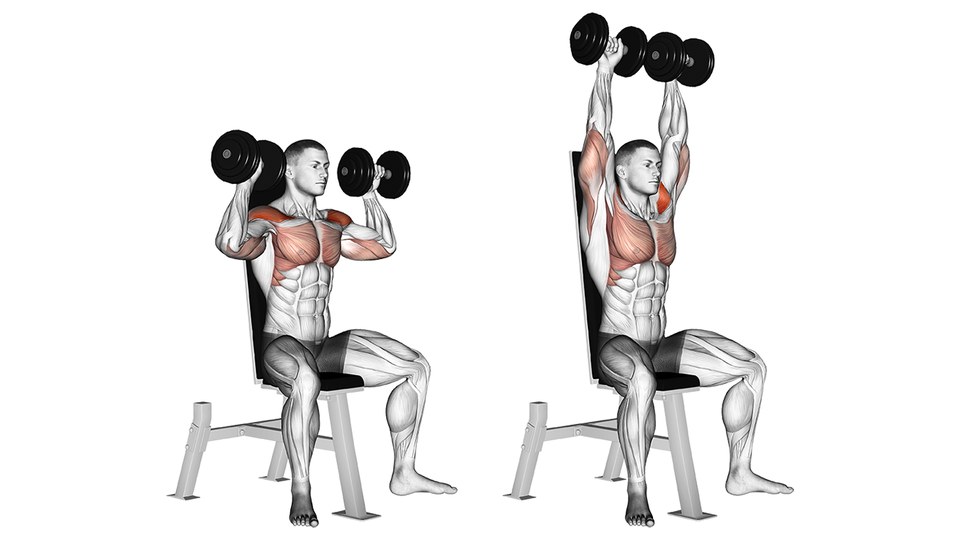
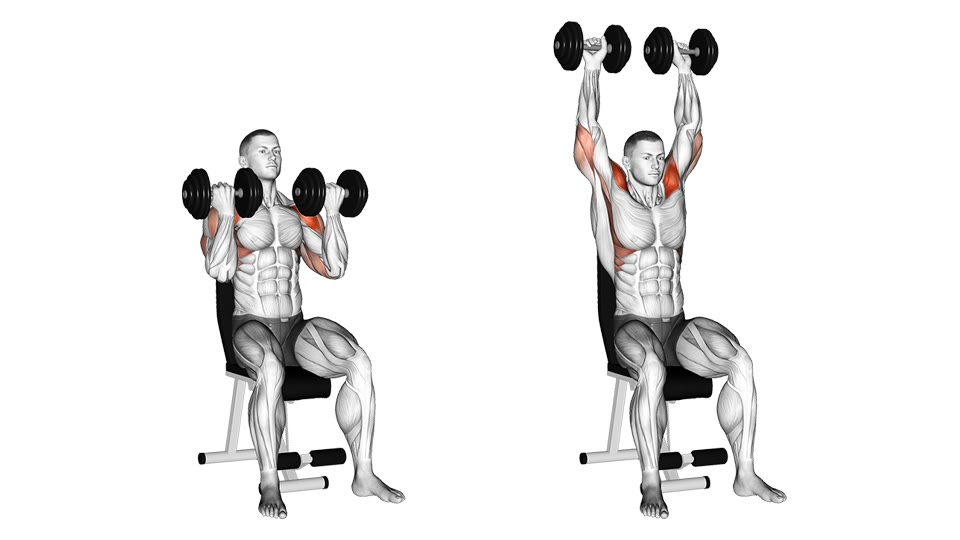
- Seated dumbbell shoulder pressBack supported and dumbbells in the hands. The easiest of these to set up on your own.
- Single-arm dumbbell or kettlebell press — One side at a time, which loads the trunk asymmetrically and shows up any difference between your arms.
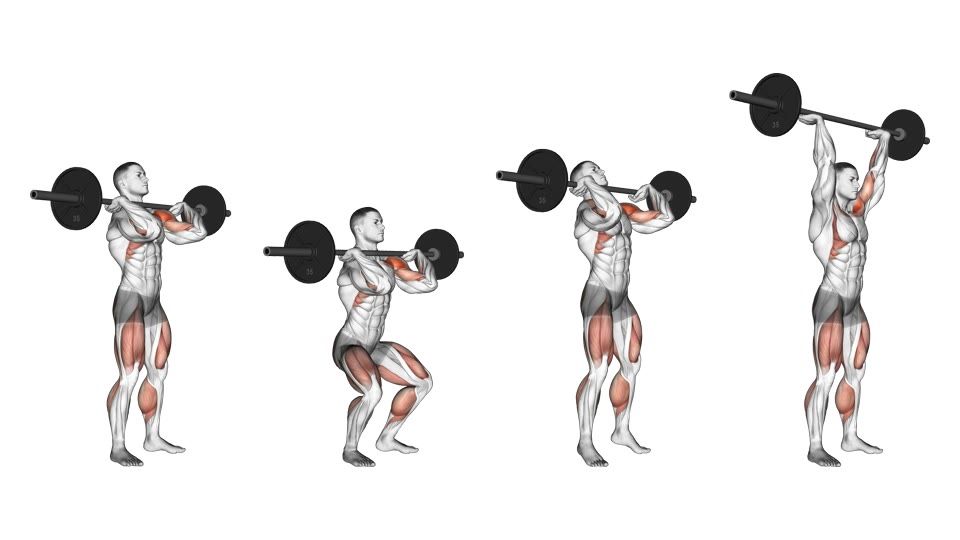
- Push pressA dip and drive from the legs starts the bar moving. As much a different lift as a variant, and worth logging separately.
- Z press — Pressed sitting on the floor with the legs straight out, which removes any help from the lower body.
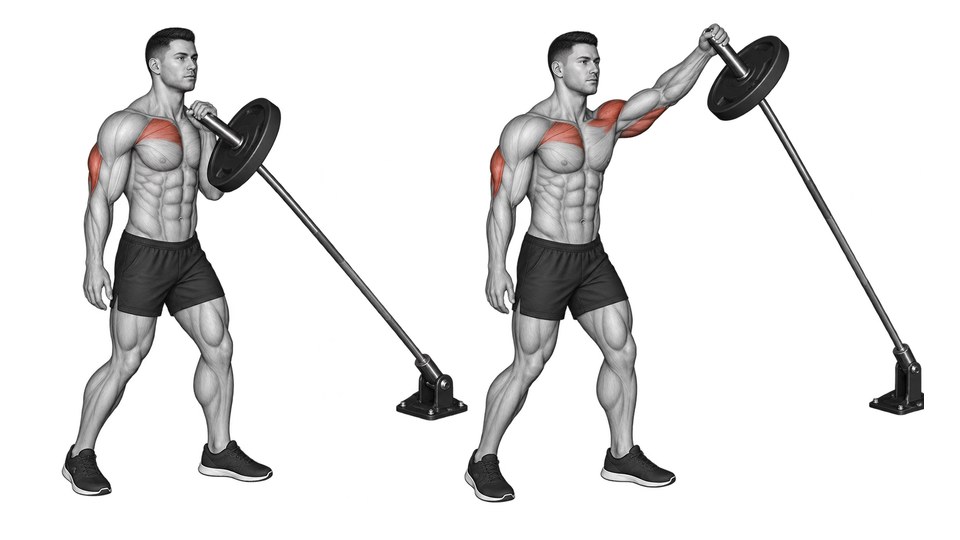
- Landmine pressOne end of a barbell is anchored, so the bar travels on an arc rather than straight up.
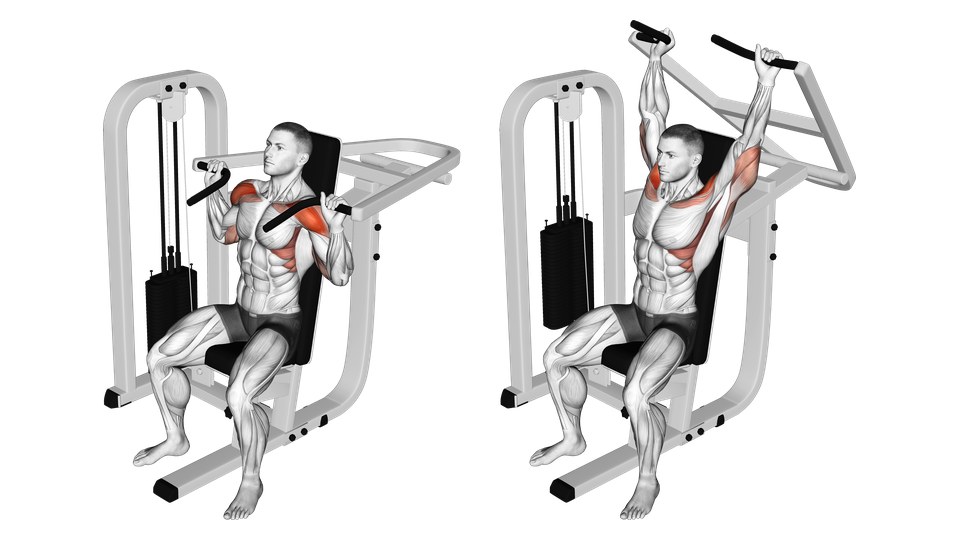
- Machine shoulder pressPath fixed by the machine, which makes it the easiest version to take close to failure without a spotter.
- Behind-the-neck press — The bar travels behind the head, which asks for considerably more shoulder external rotation and thoracic extension than the front version. Many lifters cannot reach that position.
Articles
Related tools
Frequently asked questions
What muscles does the overhead press work?
Three muscles do the pressing: the anterior deltoid, which flexes the arm at the shoulder, the lateral deltoid, which abducts it, and the triceps brachii, which straightens the elbow. The anterior deltoid leads: the bar starts in front of the shoulders and finishes above them, so the arm is raised more by flexion than by abduction. Behind them, the serratus anterior works with the upper and lower fibres of the trapezius to rotate the shoulder blade upward, and that upward rotation is what makes overhead lifting possible at all. The supraspinatus and the other rotator cuff muscles hold the head of the humerus against the shallow socket of the shoulder blade while this happens. The clavicular head of the pectoralis major can contribute to the press; the studies do not define an exact angle at which its contribution ends.
Is the military press the same as the overhead press?
In everyday use, yes — most people use the two names for the same lift, a strict barbell press from the shoulders to overhead with no help from the legs. Some lifters reserve "military press" for a stricter version with a narrow stance, but there is no standard definition of the term, so treat any distinction as that particular speaker's own rather than a rule.
Should you press standing or seated?
Both are useful variations. Standing adds a balance and bracing demand, but sitting does not remove all trunk activity. Studies also show that changing posture can change the maximum load and activity of particular muscles. Choose according to your training goal and compare progress within the same version.
Barbell or dumbbells for overhead pressing?
A barbell fixes your hands relative to each other; dumbbells let each arm travel on its own path. A small study found different maximum loads and muscle-activity patterns, including more triceps activity with the standing barbell and more front-deltoid activity with standing dumbbells. That does not settle which builds more muscle.
Is the overhead press a core exercise?
Your trunk helps maintain position during the standing press. A dumbbell study found more abdominal activity standing than seated, but no clear posture difference in the measured back extensors. That cannot quantify the core demand of this barbell version, or tell us whether overhead pressing replaces direct core training.
Why is my overhead press so much lighter than my bench press?
Because less muscle is available and there is nothing to push against. The bench press brings in the whole of the pectoralis major, the largest muscle of the front of the chest, and gives you a bench to brace on; the overhead press is driven by the deltoid and the triceps, with your own trunk providing the base. How much lighter varies with build and training history, and this page does not put a number on it. The useful comparison is against your own overhead press a few months ago.
Does the overhead press train the side delts, or do I still need lateral raises?
The lateral deltoid abducts the arm and is one of the three muscles doing the pressing, so it is trained by the movement; the anterior deltoid leads the press, but the lateral head is working with it on every rep. Whether adding lateral raises on top produces more than pressing alone is a training question this page does not try to answer. What the logs show is that lifters do not treat it as an either-or: lateral raises are the movement most often logged in the same session as an overhead press.
Is the overhead press worth doing?
It is a minority lift, which is worth knowing before you decide. Only about a third of regular RepCount users have ever logged a barbell overhead press, and it turns up in roughly four workouts in every hundred; most of them have logged a dumbbell shoulder press instead. The ones who do press a barbell overhead give it just under four sets in a session, more than they give a hammer curl, and they put it on a push day rather than a shoulder day.
How wide should you grip the bar?
Just outside shoulder width is the usual answer, and the reason is that it puts your forearms close to vertical under the bar when it is resting on your shoulders. Beyond that there is a range rather than a right answer, and small differences in shoulder width and arm length move it. Set it once, write it down, and stop adjusting it between sessions — a grip that changes every week makes the weight on the bar uninterpretable.
Sources
- Elzanie A, Varacallo MA. Anatomy, Shoulder and Upper Limb, Deltoid Muscle. StatPearls. https://www.ncbi.nlm.nih.gov/books/NBK537056/
- McCausland C, Sawyer E, Eovaldi BJ, Varacallo MA. Anatomy, Shoulder and Upper Limb, Shoulder Muscles. StatPearls. https://www.ncbi.nlm.nih.gov/books/NBK534836/
- Tiwana MS, Sinkler MA, Bordoni B. Anatomy, Shoulder and Upper Limb, Triceps Muscle. StatPearls. https://www.ncbi.nlm.nih.gov/books/NBK536996/
- Jeno SH, Munjal A, Schindler GS. Anatomy, Shoulder and Upper Limb, Arm Supraspinatus Muscle. StatPearls. https://www.ncbi.nlm.nih.gov/books/NBK537202/
- Ourieff J, Scheckel B, Agarwal A. Anatomy, Back, Trapezius. StatPearls. https://www.ncbi.nlm.nih.gov/books/NBK518994/
- Lung K, St Lucia K, Lui F. Anatomy, Thorax, Serratus Anterior Muscles. StatPearls. https://www.ncbi.nlm.nih.gov/books/NBK531457/
- Solari F, Burns B. Anatomy, Thorax, Pectoralis Major. StatPearls. https://www.ncbi.nlm.nih.gov/books/NBK525991/
- Henson B, Kadiyala B, Edens MA. Anatomy, Back, Muscles. StatPearls. https://www.ncbi.nlm.nih.gov/books/NBK537074/
- Saeterbakken AH, Fimland MS. Shoulder press posture and equipment. 2013. https://pubmed.ncbi.nlm.nih.gov/23096062/
- Saeterbakken AH, Fimland MS. Core activity during dumbbell presses. 2012. https://pubmed.ncbi.nlm.nih.gov/21877146/
- Coratella G et al. Front/back barbell and machine presses. 2022. https://doi.org/10.3389/fphys.2022.825880
- Padovan R et al. High-density EMG of front/back presses. 2026. https://doi.org/10.5114/jhk/205466