Reverse curl
Also called reverse barbell curl, overhand curl, pronated curl, EZ-bar reverse curl.
What is a reverse curl?
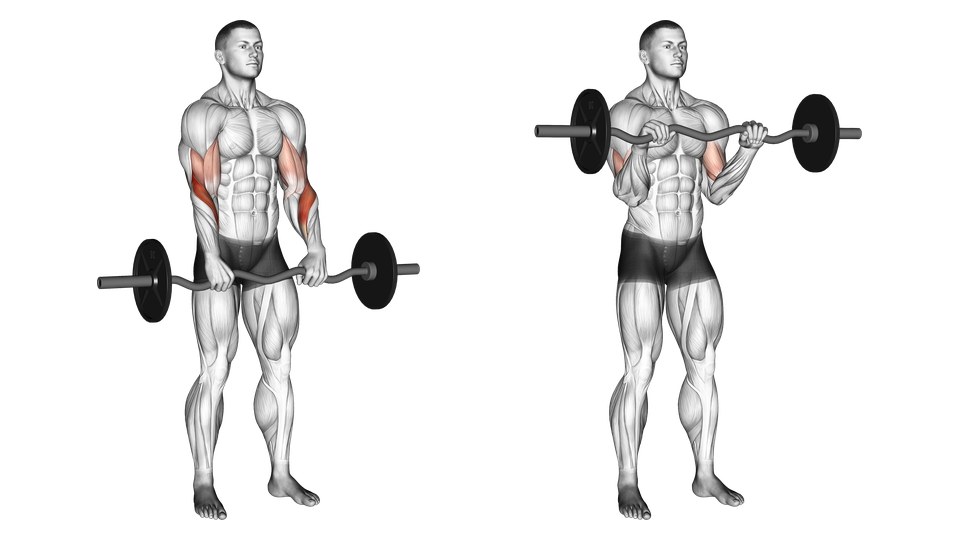
A reverse curl is an elbow curl performed with the palms facing down. This overhand grip trains the elbow flexors while making the brachioradialis and the muscles that hold the wrists especially noticeable. An EZ-bar lets the wrists sit at a less extreme angle than a straight bar.
How do you perform a reverse curl?
Set up
- Hold an EZ-bar with an overhand grip around shoulder width, thumbs wrapped and arms straight.
- Stand tall, brace your trunk and keep your wrists in line with your forearms and your elbows by your ribs.
Execution
- Curl the bar upward by bending your elbows without swinging your torso or lifting your upper arms.
- Stop before the wrists fold or the elbows move forward, then lower the bar under control.
- Finish with the arms straight while keeping control of the overhand grip.
Common mistakes
Letting the wrists fold forward
A bent wrist makes the bar harder to control and changes where the load is supported. Keep the knuckles and forearms in one line.
Swinging a load that is too heavy
Hip drive moves the bar without the elbow flexors controlling the hard middle of the curl. Reduce the load and keep the torso still.
Lifting the elbows to finish
Moving the upper arms forward shortens the curl at the elbow and turns the top into a shoulder movement. End the rep before that happens.
Where it fits in a session
Use it after larger pulling movements or alongside another curl when you want direct elbow-flexor and forearm work.
The overhand grip usually limits the load. Progress only while the wrists stay straight and the torso remains still.
Muscles worked
Primary
Secondary
Schematic surface view. Some muscles are partly visible or not shown.
The brachioradialis, brachialis and biceps brachii flex the elbow. The overhand grip also requires the forearm muscles to hold the wrist and bar position.
Variations
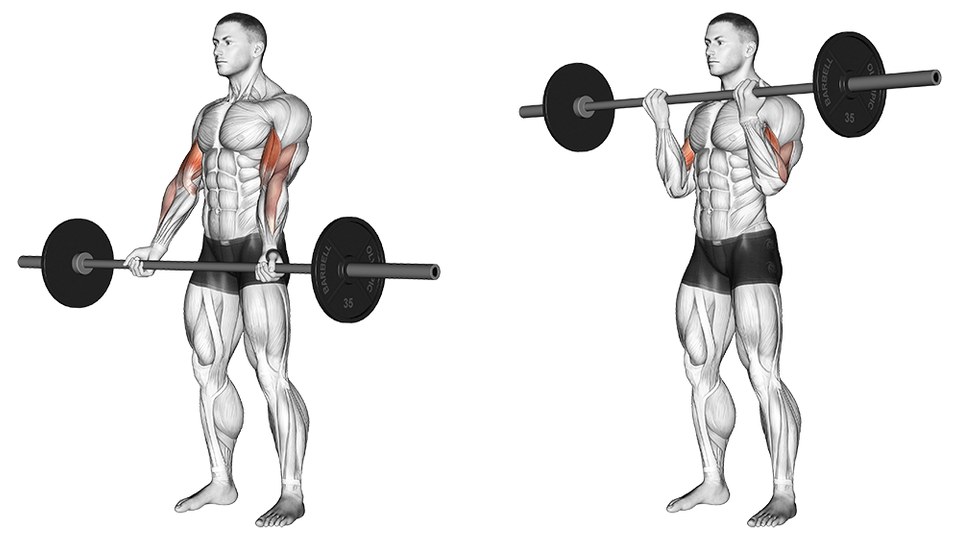
- Straight-bar reverse curl — Uses a straight bar, which fixes both wrists in full pronation.
- Cable reverse curl — Uses a straight or angled cable attachment for a different resistance direction.
Frequently asked questions
What muscles do reverse curls work?
They train the brachioradialis, brachialis and biceps brachii as elbow flexors, while the forearm muscles hold the overhand grip and wrist position.
Should you use an EZ-bar or a straight bar for reverse curls?
Either works. An EZ-bar changes the wrist angle and is often more comfortable; use the bar that lets you keep the wrists straight.
Are reverse curls a forearm exercise?
They train elbow flexion, not just the forearms. The overhand grip makes the brachioradialis and grip demand prominent, but the brachialis and biceps still contribute.
Sources
- Anatomy, Shoulder and Upper Limb, Forearm Brachioradialis Muscle. StatPearls, NCBI Bookshelf. https://www.ncbi.nlm.nih.gov/books/NBK526110/
- Plantz MA, Bordoni B. Anatomy, Shoulder and Upper Limb, Brachialis Muscle. StatPearls, NCBI Bookshelf. https://www.ncbi.nlm.nih.gov/books/NBK551630/
- Anatomy, Shoulder and Upper Limb, Biceps Muscle. StatPearls, NCBI Bookshelf. https://www.ncbi.nlm.nih.gov/books/NBK519538/
- Anatomy, Shoulder and Upper Limb, Forearm Compartments. StatPearls, NCBI Bookshelf. https://www.ncbi.nlm.nih.gov/books/NBK539784/