Reverse Nordic curl
Also called reverse Nordic.
What is a reverse Nordic curl?
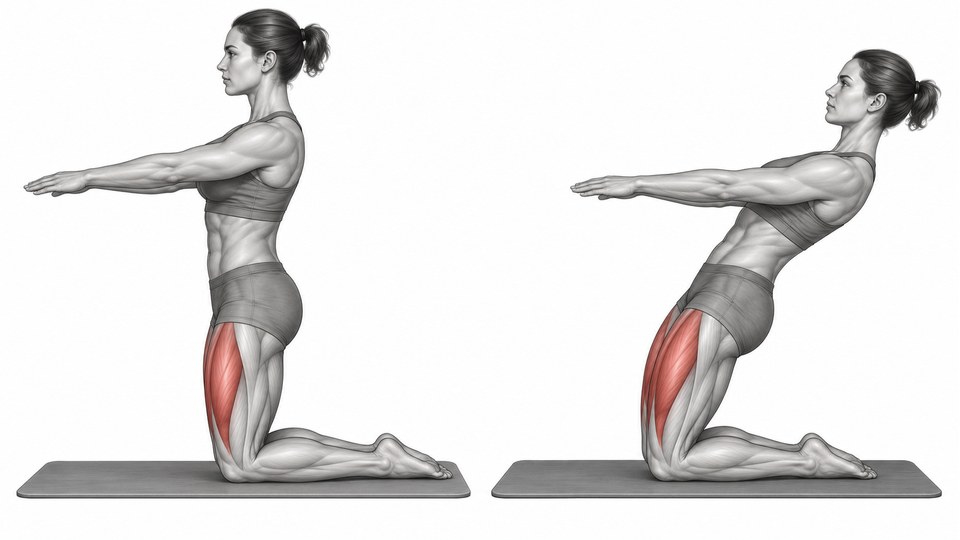
A reverse Nordic curl is a kneeling bodyweight exercise for the quadriceps. You lean your thighs and torso back together from the knees, then return to an upright kneeling position. Unlike a Nordic hamstring curl, you lean backward and do not anchor your ankles.
How do you perform a reverse Nordic curl?
Set up
- Kneel on a padded mat with your knees about hip-width apart and your shins resting on the floor.
- Lift your hips away from your heels and line up your shoulders, hips and knees. Hold your arms in front for balance.
Execution
- Lean backward slowly from your knees, keeping your hips extended and your torso in line with your thighs.
- Stop at a depth you can control without folding at the hips or arching your lower back.
- Press your shins into the mat and bring your body back to upright. Start with a small lean and repeat.
Common mistakes
Sitting back onto your heels
Bending at the hips changes the intended movement. Keep your thighs and torso aligned and reduce the lean if needed.
Forcing a deep repetition
A depth you cannot control makes the return difficult. Use a smaller range instead of dropping backward.
Where it fits in a session
Include this exercise where it fits your planned lower-body session.
Begin with a short range and a few controlled repetitions. Add depth gradually before considering external load; stop the set when you can no longer keep your hips extended.
Muscles worked
Primary
Secondary
- None listed in this guide
Schematic surface view. Some muscles are partly visible or not shown.
Variations
- Nordic curlLeans forward with the ankles secured to train the hamstrings, rather than backward to train the quadriceps.
Frequently asked questions
Is this the same as a Nordic hamstring curl?
No. A reverse Nordic curl leans backward from tall kneeling and trains the quadriceps. A Nordic hamstring curl leans forward with the ankles secured and trains the hamstrings.
Do I have to lean all the way to the floor?
No. Use the range you can lower into and return from under control. A small backward lean is a suitable starting point.
Sources
- Pereira et al. (2024). Reverse Nordic Curl Does Not Generate Superior Eccentric Activation of the Quadriceps Muscle Than Bodyweight Squat-Based Exercises. Journal of Sport Rehabilitation. https://pubmed.ncbi.nlm.nih.gov/39214520/