Leg extension
Also called knee extension, leg extensions, quad extension.
What is a leg extension?
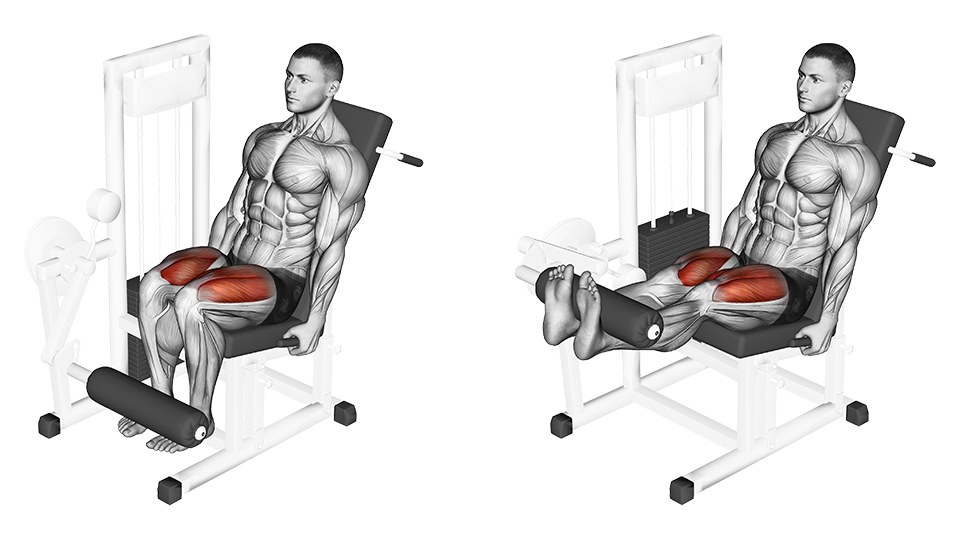
The leg extension is a machine isolation exercise for the quadriceps: you sit, hook your shins behind a pad and straighten your knees against resistance. It trains all four heads of the quadriceps — rectus femoris, vastus lateralis, vastus medialis and vastus intermedius. Of the four, only the rectus femoris also crosses the hip, which is why the angle of the seat's backrest is the setting on this machine worth paying attention to.
How do you perform a leg extension?
Set up
- Adjust the seat so the side of your knee lines up with the machine's pivot, then sit with your back against the pad.
- Set the roller low, resting against your lower shins just above your ankles.
- Recline the backrest as far as it adjusts, grip the handles and keep your hips and back against the pads.
Execution
- Point your feet forward and begin with your knees bent.
- Straighten your knees smoothly without kicking the roller.
- Stop when your legs are straight, without snapping your knees into a hard lock.
- Lower the roller under control to the start, keeping your hips and back planted.
Common mistakes
Leaving the backrest upright on a machine that reclines
Sitting upright shortens the rectus femoris at the hip before the rep starts, and it is the head this setting decides. Recline it as far as the machine goes; it costs nothing. See the scientific studies ↓
Setting the seat so your knee sits ahead of or behind the machine's pivot
The pad then drags your shin through an arc your knee is not making, so the load shifts around during the rep and the setting stops being repeatable session to session.
Using enough weight that your hips lift off the seat
Once your pelvis rotates, the hip angle you set up with is gone, which is the variable this exercise is worth controlling.
Where it fits in a session
Alongside the other machine leg work, usually after squats or leg presses rather than before them.
Isolation work for a large muscle, so it takes load well but does not need to be the heaviest thing in the session. The setting that matters is the backrest, and it is worth more attention than the weight on the stack.
Muscles worked
Primary
Secondary
- None listed in this guide
Schematic surface view. Some muscles are partly visible or not shown.
All four heads of the quadriceps, listed as co-actors rather than ranked. Nothing we could source ranks them for this exercise. One asymmetry is evidenced and it is not about ranking: the rectus femoris is the only head that crosses the hip, so the seat's backrest angle changes how much it grows, while the three vasti originate on the femur and are unaffected by it.
What lifters actually do
More than three quarters of regular RepCount users have logged a leg extension, and it appears in about one workout in eight. The movement it sits beside most often is the leg curl, in 45.8% of leg extension sessions, then the leg press in 38.1%, the squat in 30.6% and calf raises in 29.8%. Those sessions hold about six exercises and roughly three sets of the leg extension itself.
Most often trained alongside
Share of leg extension sessions that also include each exercise.
- Leg curl45.8%
- Leg press38.1%
- Squat30.6%
- Calf raise29.8%
- Seated calf raise14.5%
Figures come from workouts tracked in RepCount.
What the evidence says
Setting up a leg extension is mostly seat height and lining the machine's pivot up with your knee. Both matter and neither has been tested. The one setting with a training study behind it is how far back the seat reclines.
The anatomy is the reason. StatPearls' quadriceps chapter records that the rectus femoris originates on the anterior inferior iliac spine and the rim of the acetabulum — above the hip — while the vastus lateralis, medialis and intermedius all originate on the femur. Only the rectus femoris crosses two joints, so only the rectus femoris has its length set by where your hip is. Sit upright and it is already shortened at the hip before the rep starts.
Larsen and colleagues (2025, 22 untrained men, ten weeks) tested exactly that. Each participant trained one leg with the hip at about 90° and the other reclined to about 40°, everything else matched, including knee range of motion at 110° to 0° and sets taken to failure. Rectus femoris thickness rose 12.4% at the upper end and 15.8% at the lower end in the reclined leg, against 4.6% and 10.9% in the upright one, with the between-condition effects estimated at 1.1 mm and 0.64 mm and Bayes factors of over 100 and 88.4. The vastus lateralis showed strong evidence of no difference (BF = 0.07). That last result is what makes the finding specific rather than a general "more growth" effect: reclining changed the one head whose length the hip controls, and left the ones it does not.
The authors are more careful than the result sounds. Their conclusion is that both positions are viable for quadriceps growth, with reclining recommended specifically for maximising the rectus femoris in untrained men. They add that a lifter who wants vastus lateralis growth without rectus femoris growth — powerlifters managing a weight class is their example — should sit upright on purpose.
One acute study points the same way from a different direction. Mitsuya and colleagues (2023, nine male bodybuilders) had participants perform leg extensions at 0°, 40° and 80° of hip flexion and measured rectus femoris activity by MRI relaxation time. Activity in the upper and middle thirds of the muscle was higher at 0° and 40° than at 80°. We read this one as an abstract only — the full text sits behind an authentication wall — so take it as corroboration of direction, not as a second set of numbers. The same paper found that how hard a region felt like it was working did not match what the imaging showed, which is worth knowing before trusting a pump as feedback.
What neither study supports is a precise angle. The reclined condition in the training study was individually set and landed anywhere from 21° to 51° in practice, most gym machines recline through a narrow range or not at all, and nobody has compared 40° against a flat 0° for growth. As reasoning rather than a finding: the honest translation is "recline it as far as the machine goes", and it matters for one of the four heads rather than for the quadriceps as a whole.
Two things this page will not tell you. Whether to lock out at the top is unsettled: Pedrosa and colleagues (2022, 45 untrained women, read as an abstract only) found training the stretched bottom half of the knee extension produced more regional growth than full range or the top half, while Larsen and colleagues (2025, 23 trained lifters with about seven years of training behind them, also an abstract-only read) found knee range of motion made no difference to quadriceps growth in the leg press, with extreme evidence for the null. Different exercises, different populations, opposite answers. And whether pointing your toes in or out biases the inner or outer quadriceps is a claim we could not settle either way: the studies that would test it were reachable only as request-access stubs, so we are not asserting it and not denying it.
Variations
- Single-leg extensionOne leg at a time. Lets each side be loaded on its own, and takes about twice as long.
Articles
Related tools
Frequently asked questions
What muscles does the leg extension work?
The quadriceps, all four heads: rectus femoris, vastus lateralis, vastus medialis and vastus intermedius, all innervated by the femoral nerve. The three vasti originate on the femur and only extend the knee. The rectus femoris originates above the hip joint, on the anterior inferior iliac spine and the rim of the acetabulum, so it crosses both the hip and the knee and can flex the hip as well. That difference is why the seat position on the machine matters for one head and not the other three.
Should you lean back on the leg extension machine?
If you want rectus femoris growth and the machine reclines, yes. In a ten-week trial in 22 untrained men, each training one leg upright and one reclined, the reclined leg gained 12.4% in upper rectus femoris thickness against 4.6% for the upright leg, while the vastus lateralis grew the same either way. The study's own conclusion is measured about it: both seat positions are viable for quadriceps growth, and reclining is the recommendation specifically for maximising the rectus femoris. Many machines barely recline, and the useful version of this is "as far back as it goes" rather than a target number.
Do leg extensions build the rectus femoris?
They do, and more so with the seat reclined. The rectus femoris is the only quadriceps head crossing the hip, so hip position sets its length. A ten-week trial found roughly 40° of hip flexion produced more rectus femoris growth than sitting upright at 90°, and an acute imaging study in nine male bodybuilders — which we could read only as an abstract — found higher activity in the upper and middle rectus femoris at 0° and 40° than at 80°. The training study was in untrained men and the imaging study had nine participants, so this is a reason to change a setting, not a large or certain effect.
Should you do both legs at once or one at a time?
Either. Nothing we found favours one over the other, so it is a preference rather than a technique point. Both together is quicker; one at a time lets you load each side to what it can actually do, and it is how the seat-angle study was run.
How far should you extend your knee at the top?
This is not settled, and anyone confident about it is going beyond the evidence. A knee extension study in 45 untrained women found the stretched bottom half of the range produced more regional growth than full range or the top half. A leg press study in 23 trained lifters found knee range of motion made no difference to quadriceps growth at all. We read both only as abstracts. Different exercises and different populations, pointing opposite ways — and neither of them varied the top of the rep, which is the half of this question people actually argue about. Use a range you can control at a weight you can control.
Do toes in or toes out target different parts of the quad?
We cannot answer that from evidence we have actually read. The studies that would test foot rotation in the leg extension were reachable only as request-access stubs, and a search-result summary is not a source, so we are neither asserting nor denying it. Point your feet forward and spend the attention on the backrest instead, where there is a study.
Are leg extensions worth doing?
More than three quarters of regular RepCount users have logged one, and they turn up in about one workout in eight. In the workouts that contain one, the movement it sits beside most often is the leg curl, in 45.8% of them, then the leg press in 38.1%, the squat in 30.6% and calf raises in 29.8%. Typically about three sets, in a session of six or so exercises.
Sources
- Larsen S, Sandvik Kristiansen B, Swinton PA, Wolf M, Bao Fredriksen A, Nygaard Falch H, van den Tillaar R, Østerås Sandberg N. The effects of hip flexion angle on quadriceps femoris muscle hypertrophy in the leg extension exercise. J Sports Sci. 2025;43(2). https://doi.org/10.1080/02640414.2024.2444713 (preprint full text: https://sportrxiv.org/index.php/server/preprint/view/407)
- Mitsuya H, Nakazato K, Hakkaku T, Okada T. Hip flexion angle affects longitudinal muscle activity of the rectus femoris in leg extension exercise. Eur J Appl Physiol. 2023;123. https://europepmc.org/article/MED/36795130
- Bordoni B, Varacallo MA. Anatomy, Bony Pelvis and Lower Limb: Thigh Quadriceps Muscle. StatPearls. https://www.ncbi.nlm.nih.gov/books/NBK513334/
- Larsen S, Wolf M, Schoenfeld BJ, et al. Knee flexion range of motion does not influence muscle hypertrophy of the quadriceps femoris during leg press training in resistance-trained individuals. J Sports Sci. 2025;43. https://europepmc.org/article/MED/40113586
- Pedrosa GF, Lima FV, Schoenfeld BJ, et al. Partial range of motion training elicits favorable improvements in muscular adaptations when carried out at long muscle lengths. Eur J Sport Sci. 2022;22. https://europepmc.org/article/MED/33977835