Russian twist
Also called Russian twists, bodyweight Russian twist.
What is a russian twist?
The Russian twist is a seated bodyweight exercise in which you lean back and rotate your torso from side to side. It mainly trains the internal and external obliques, while the rectus abdominis helps hold the position.
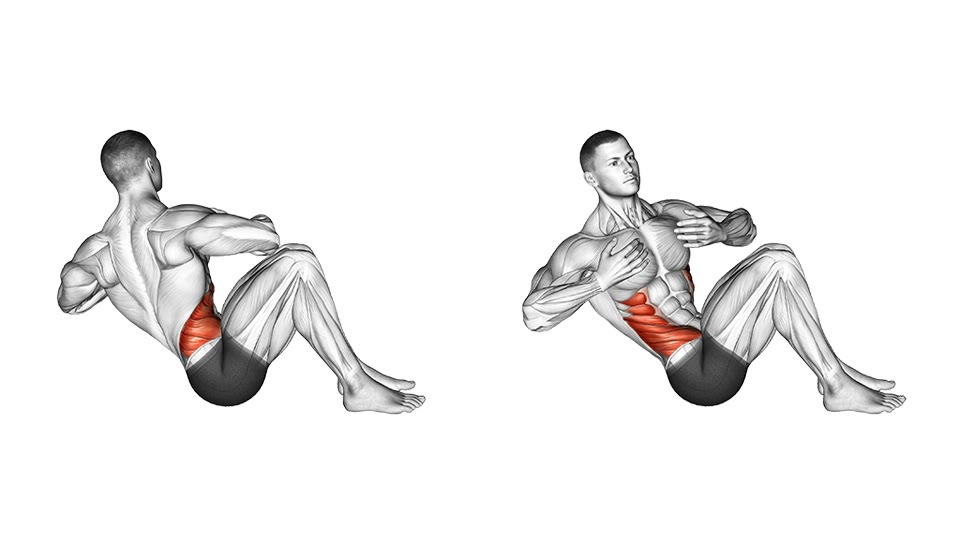
How do you perform a russian twist?
Set up
- Sit with your knees bent and feet flat, then lean back until your abdominal muscles are braced.
- Hold your hands together in front of your chest and keep your spine long rather than collapsing forward.
Execution
- Turn your chest and hands toward one side while your knees stay mostly still.
- Rotate through the centre and continue toward the other side.
- Alternate under control without sitting upright between repetitions.
Common mistakes
Waving the hands side to side
The exercise becomes much easier when the arms move but the rib cage barely turns.
Rounding and collapsing the torso
Losing the braced leaned-back position turns each rep into a shifting sit-up.
Rushing through the middle
Momentum carries the body past the point where the obliques have to control the change of direction.
Where it fits in a session
Usually placed with other trunk work after the main lifts.
Use a range you can control without the knees swaying or the hands outrunning the chest.
Muscles worked
Primary
Secondary
Schematic surface view. Some muscles are partly visible or not shown.
The obliques rotate the torso while the rectus abdominis helps hold the leaned-back position.
Variations
- Weighted Russian twist — Holds a plate, dumbbell or medicine ball once the bodyweight version is controlled.
- Feet-elevated Russian twist — Lifts both feet, increasing the balance demand.
- Cable wood chop — Uses a standing cable path instead of a seated side-to-side rotation.
Frequently asked questions
What muscles do Russian twists work?
They mainly train the internal and external obliques. The rectus abdominis also works to hold the leaned-back torso position.
Should your feet stay on the floor?
Yes for the standard bodyweight version shown here. Lifting the feet is a harder balance variation, not a requirement.
Should the hands touch the floor?
No. Rotate as far as you can while the chest leads and the knees remain steady; reaching for the floor can make the arms move farther than the torso.
Can you add weight to Russian twists?
Yes, but first keep the same controlled torso rotation without weight. A heavier object should not make the movement faster or shorter.