
Seated dumbbell calf raise
Also called dumbbell seated calf raise.
What is a seated dumbbell calf raise?
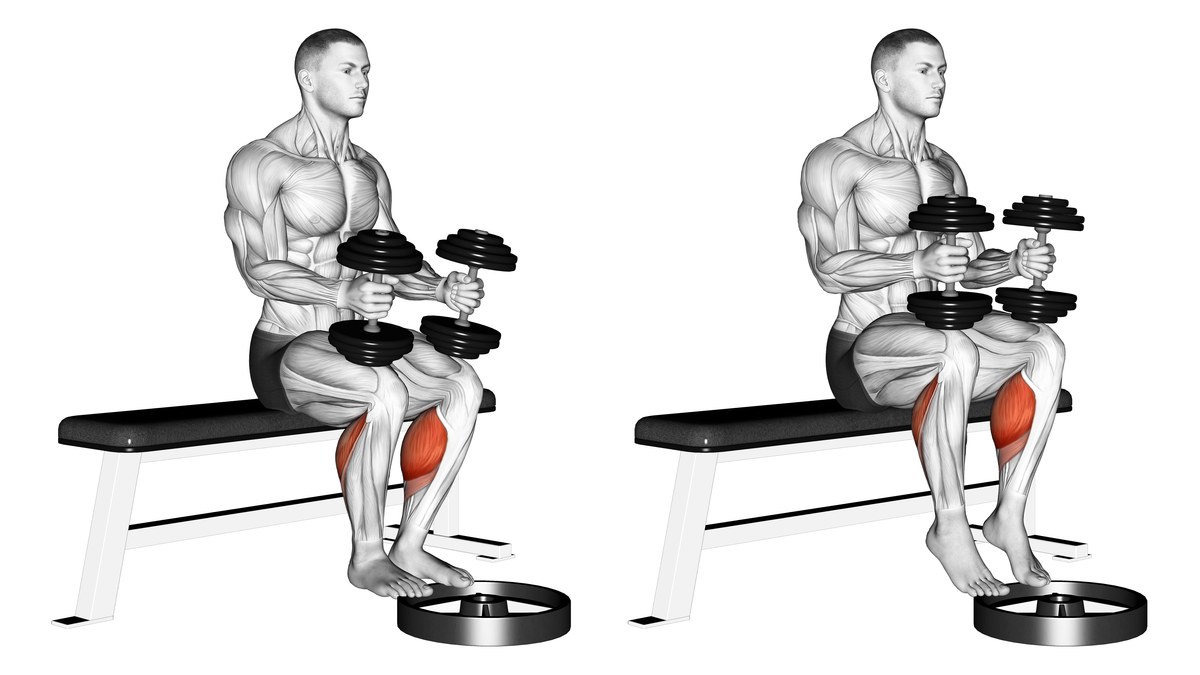
A seated dumbbell calf raise is a heel raise performed on a bench with your knees bent and a dumbbell resting on each thigh. You lift both heels while the balls of your feet stay supported, then lower them again. It trains the calves without a seated calf raise machine.
How do you perform a seated dumbbell calf raise?
Set up
- Place a firm, non-slip foot support in front of a flat bench. Sit near the end with the balls of both feet securely supported and your heels clear of the edge.
- Keep your feet about hip-width apart, facing forward, and your knees bent roughly to right angles. Stand a dumbbell on its flat end on each lower thigh, close to the knee, and steady both handles.
Execution
- Sit tall and keep your hips on the bench. Lower your heels to a comfortable starting position below the support without letting your feet slide.
- Press the balls of your feet into the support and raise both heels as high as you can control, carrying your thighs and dumbbells upward together.
- Lower your heels slowly to the starting position, keeping hold of the dumbbells and leaving the balls of your feet planted. Repeat without bouncing.
- After the last repetition, lower your heels, support the dumbbells with your hands and remove them from your thighs before standing up.
Common mistakes
Perching on the toes at the edge of the support
Give the balls of your feet enough room to stay planted through the whole repetition. If either foot slips, lower the weights and reset the support.
Rocking the torso to move the dumbbells
The lift should come from raising your heels. Choose a load you can move while staying seated and keeping the weights steady.
Rushing through short, bouncing repetitions
Use a heel height and lowering depth you can repeat under control. If the movement gets smaller as you speed up, slow down or reduce the load.
Where it fits in a session
Use it as calf work in a lower-body session, wherever it fits your plan.
Start with dumbbells you can place, control and remove on your own. Add weight only when you can repeat the movement without your feet slipping or your hands lifting the dumbbells.
Muscles worked
Primary
Secondary
- None listed in this guide
Schematic surface view. Some muscles are partly visible or not shown.
The soleus lies beneath the gastrocnemius. Both help point the foot downward at the ankle, an action called plantarflexion. This list names the main calf muscles involved; it does not mean they contribute equally.
Variations
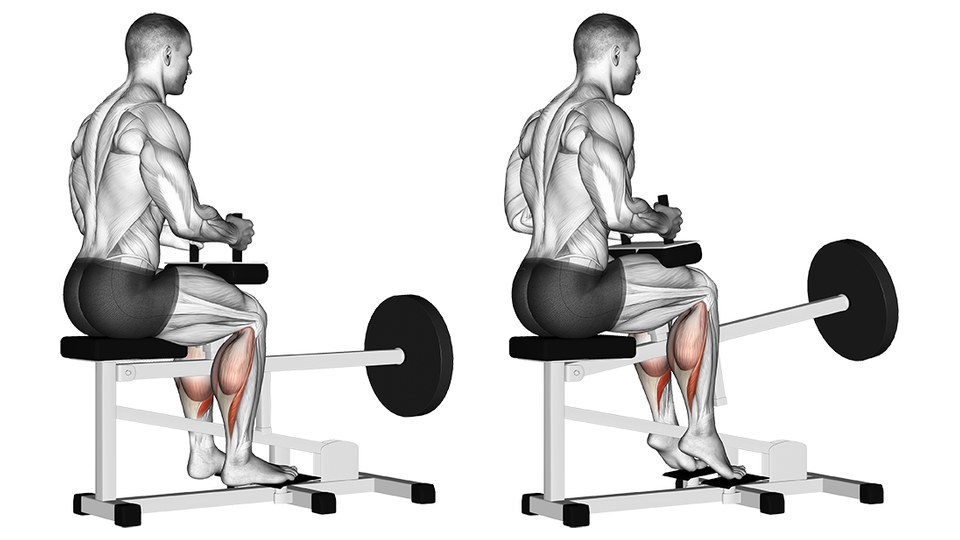
- Seated calf raiseUses a seated calf raise machine with a pad over the thighs instead of hand-held dumbbells.
Frequently asked questions
Where should the dumbbells rest?
Rest one flat end on each lower thigh just above the knee, and keep hold of the handles. Avoid balancing them on the kneecaps. A folded towel can cushion the contact, but the dumbbells still need a stable resting surface. If an adjustable dumbbell has a protruding handle end that will not sit securely, choose a different weight or setup.
Do I need a block under my feet?
A raised support gives your heels room to lower below the balls of your feet. This guide uses one; the illustration shows a weight plate. Choose a firm support that will not slide or tip, with enough space for both forefeet. You can also do the exercise from the floor, but the floor stops the lowering part of the repetition sooner.
Which muscles does a seated dumbbell calf raise work?
It works the calf muscles, including the soleus underneath the gastrocnemius. Both plantarflex the ankle: they help lift the heel while the front of the foot stays supported. The knees stay bent throughout this seated version.
How much weight should I use?
Start light enough to keep both dumbbells stable and lift and lower your heels without rocking. Your hands should hold the weights in place, not pull them upward. Getting the dumbbells onto and off your thighs must be manageable too; if it is not, use lighter ones.
Can this replace a seated calf raise machine?
It gives you a way to do loaded bent-knee heel raises with a bench and dumbbells. You hold the weights in position yourself instead of using a machine's thigh pad. Treat it as a separate setup when choosing a load; the number on a machine does not tell you which dumbbells to use.
Sources
- Abuqubo R, Graefe SB, La Rose J. Anatomy, Bony Pelvis and Lower Limb: Leg Posterior Compartment. StatPearls. Updated May 13, 2026. https://www.ncbi.nlm.nih.gov/sites/books/NBK537340/
- Bordoni B, Varacallo MA. Anatomy, Bony Pelvis and Lower Limb: Gastrocnemius Muscle. StatPearls. Updated April 11, 2026. https://www.ncbi.nlm.nih.gov/sites/books/NBK532946/?report=printable