
Smith machine deadlift
Also called Smith deadlift.
What is a Smith machine deadlift?
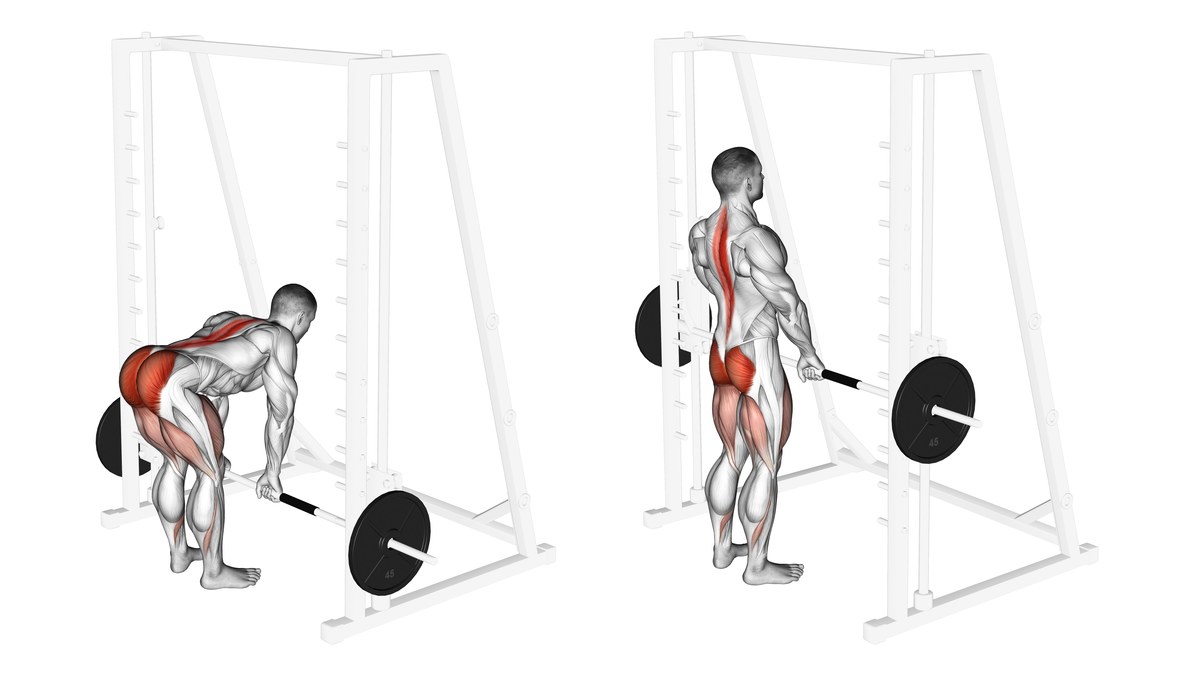
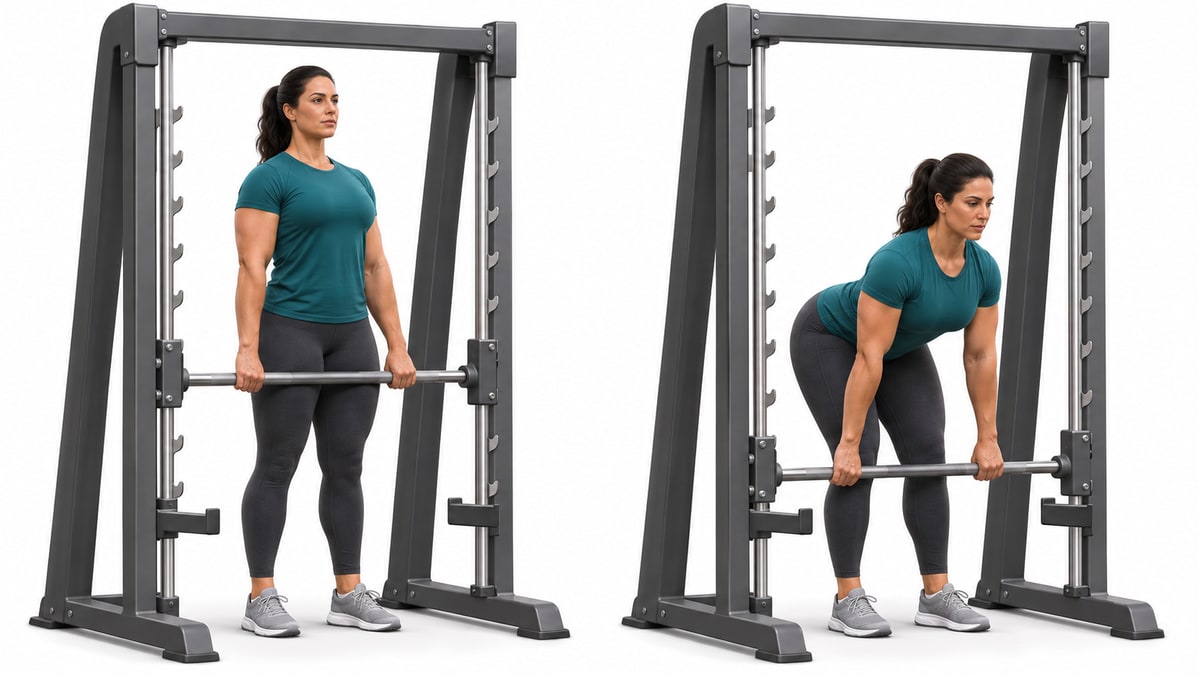
A Smith machine deadlift lifts a guided bar from a low supported position to standing. Your hips and knees bend at the bottom and straighten as you lift. Return the bar to its support and reset before each rep. The Smith Romanian deadlift is a separate movement that starts standing and lowers through a hip hinge with a small knee bend.
How do you perform a Smith machine deadlift?
Set up
- Check the machine's instructions for its working direction, hooks and safety stops. Practise releasing and securing the empty bar before adding weight.
- Set both stops at a low position you can reach with bent hips and knees and a steady back. Secure the bar on hooks just above the stops, then load both sides evenly.
- Stand about hip-width apart where the bar stays close to your legs. Bend your hips and knees, grip overhand just outside your legs with straight arms, and brace your trunk.
Execution
- Release the hooks and lower the bar gently onto the stops. Let it settle, then take a fresh breath and brace before lifting from this supported position.
- Drive through your whole feet to raise the bar along the rails, straightening your hips and knees together. Keep your arms long and your back position steady.
- Finish standing tall without leaning back. Move your hips back and bend your knees to lower the bar onto the same stops under control.
- Let the bar rest before bracing for another rep. When finished, lift to a reachable hook position, engage the hooks and check the bar is secure before letting go.
Common mistakes
Forcing a lower start than you can control
Raise the stops if reaching the bar makes your back position change. Keep both feet on the floor rather than stacking plates beneath them to reach farther down.
Straightening the knees before the bar rises
Start with a lighter load and move your hips and chest together. The knees should help lift the bar, rather than straightening while the weight stays on the stops.
Rebounding off the stops
Lower gently and let the bar become still. Reset your brace before the next pull instead of using contact with the supports to launch another repetition.
Leaning behind the bar to finish
End the lift when you are standing upright with your hips and knees straight. Do not keep pushing your hips forward or pulling your shoulders backward.
Where it fits in a session
Use it as a main lower-body lift while you are fresh enough to control each reset.
Begin with a load that lets every repetition start from a still bar. Keep the machine, foot placement and stop height consistent when comparing sessions, and add weight only when your planned repetitions stay controlled.
Muscles worked
Primary
Secondary
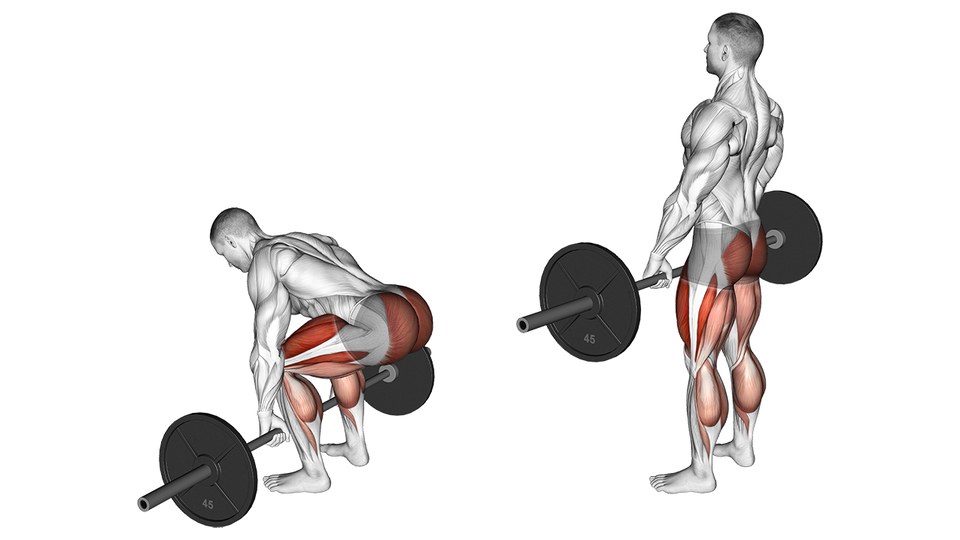
Schematic surface view. Some muscles are partly visible or not shown.
The glutes extend the hips and the quadriceps straighten the knees. The hamstrings help extend the hips, while the back muscles help keep the trunk steady. These roles describe the low-start lift; they are not a ranking of muscle activation.
Variations
- Smith machine Romanian deadliftStarts upright and lowers through a hip hinge, keeping a small knee bend rather than resetting a low bar between repetitions.
Related tools
Frequently asked questions
How is a Smith deadlift different from a Smith Romanian deadlift?
This guide starts from a low supported bar, with the knees and hips bent, and resets there between reps. A Smith Romanian deadlift starts standing, lowers by moving the hips back and keeps a small knee bend. Log the two movements separately.
How low should I set the bar?
Use a low support permitted by the machine's instructions that you can reach with both feet flat and your back steady. The illustration shows a bar near shin height, but that is an example rather than a required depth. If the machine only permits a high start, use another deadlift setup for this version.
Where should my feet go if the rails are angled?
Check the machine's working direction and test the path with the empty bar. Adjust your feet so the bar stays near your legs and pressure remains across your whole foot through the lift. Do not copy a fixed distance from another machine. Choose a different setup if you cannot find a controlled path.
What muscles does the Smith machine deadlift work?
The gluteus maximus and hamstrings extend the hips, and the quadriceps straighten the knees. The erector spinae help hold the back position as you lift. The guided bar still calls for a braced trunk; this guide does not teach curling the back up and down to move the weight.
How should I record the weight?
Check the machine label or ask gym staff about the starting resistance. Use a consistent convention for the load you record, and note the machine and stop height. Do not assume an empty Smith bar has the weight of a free barbell.
Sources
- J. Gordon Betts and colleagues. Anatomy and Physiology 2e. OpenStax, 2022. Section 11.6: Appendicular muscles of the pelvic girdle and lower limbs. https://openstax.org/books/anatomy-and-physiology-2e/pages/11-6-appendicular-muscles-of-the-pelvic-girdle-and-lower-limbs
- J. Gordon Betts and colleagues. Anatomy and Physiology 2e. OpenStax, 2022. Section 11.3: Axial muscles of the head, neck, and back. https://openstax.org/books/anatomy-and-physiology-2e/pages/11-3-axial-muscles-of-the-head-neck-and-back