Smith machine row
Also called Smith bent-over row, Smith barbell row, bent-over Smith machine row.
What is a smith machine row?
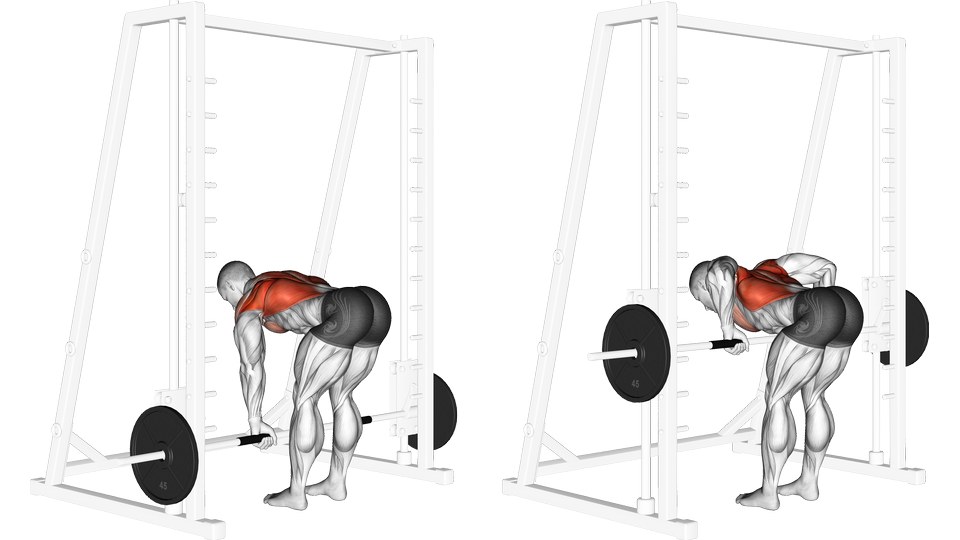
The Smith machine row is a bent-over row performed with the bar on the machine's fixed rails. You hinge forward, pull the bar toward your lower ribs or upper abdomen, and lower it until the arms are straight while keeping the torso still.
How do you perform a smith machine row?
Set up
- Set the Smith bar around knee height and stand close enough that it can travel without hitting your legs.
- Take an overhand grip just outside shoulder width, unlock the bar and step into a stable hip-width stance.
- Push your hips back, bend your knees slightly and brace with your torso inclined forward.
Execution
- Pull the bar toward your lower ribs or upper abdomen while keeping your torso angle still.
- Bring your elbows behind you and draw your shoulder blades back without shrugging.
- Lower the bar under control until your arms are straight, then repeat without standing up between reps.
Common mistakes
Standing up to finish each rep
Changing the torso angle turns the row into a moving hinge and lets the hips help lift the bar.
Setting up where the rails force the bar through the legs
The feet and hip position need to leave a clear path for the machine's fixed line of travel.
Shrugging toward the ears
A shrug changes the finish from pulling the elbows behind the torso to elevating the shoulders.
Where it fits in a session
As a main row or after vertical pulling in a back or upper-body session.
Use the Smith hooks and safeties deliberately, and keep the same foot position and torso angle when tracking load progress.
Muscles worked
Primary
Secondary
Schematic surface view. Some muscles are partly visible or not shown.
The back and rear shoulders pull the upper arms behind the torso while the elbow flexors bend the arms.
Variations
- One-arm Smith machine row — Rows one side at a time from a staggered stance beside the bar.
- Underhand Smith machine row — Uses a supinated grip while keeping the same fixed bar path.
Related tools
Frequently asked questions
What muscles does the Smith machine row work?
It trains the latissimus dorsi, middle and lower trapezius, rhomboids and rear deltoids. The biceps, brachialis and brachioradialis assist by bending the elbows.
Where should I pull the bar?
Pull toward the lower ribs or upper abdomen while keeping the forearms close to vertical. The machine's rail angle and your body proportions may shift the exact contact point.
How is a Smith machine row different from a barbell row?
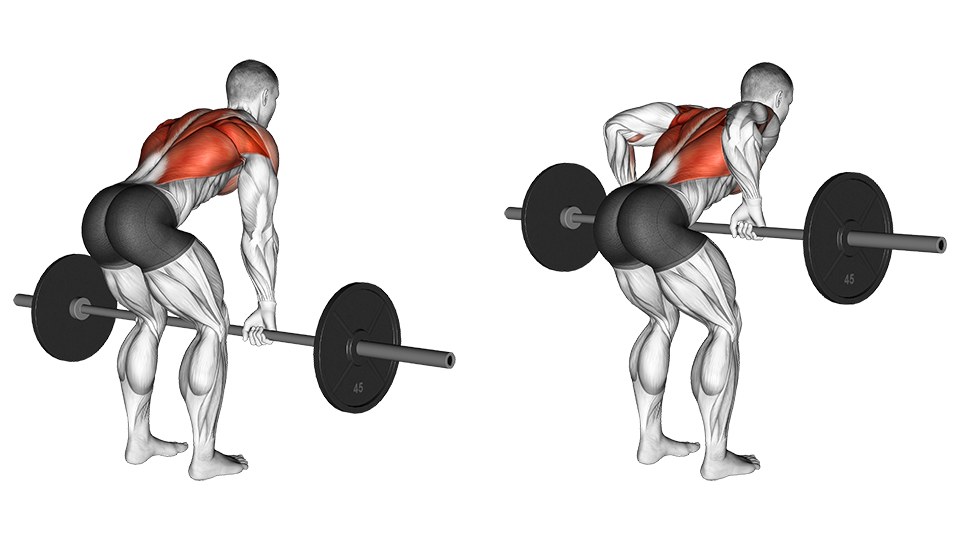
The Smith bar follows fixed rails, so you position your body around that path. A free barbell can travel slightly toward the body as you row, but it also requires you to control that path.
Should my torso move during the row?
Keep the torso angle nearly fixed. A small amount of natural movement can occur under load, but repeatedly standing up to finish the rep is no longer the bent-over row shown here.
Should I use the Smith machine safeties?
Yes. Set the stops and know how the hooks engage before the set. Machine designs differ, so follow the instructions on the equipment you are using.