Barbell bent-over row
Also called barbell row, bent-over row, bent over barbell row, bent-over barbell row.
What is a barbell bent-over row?
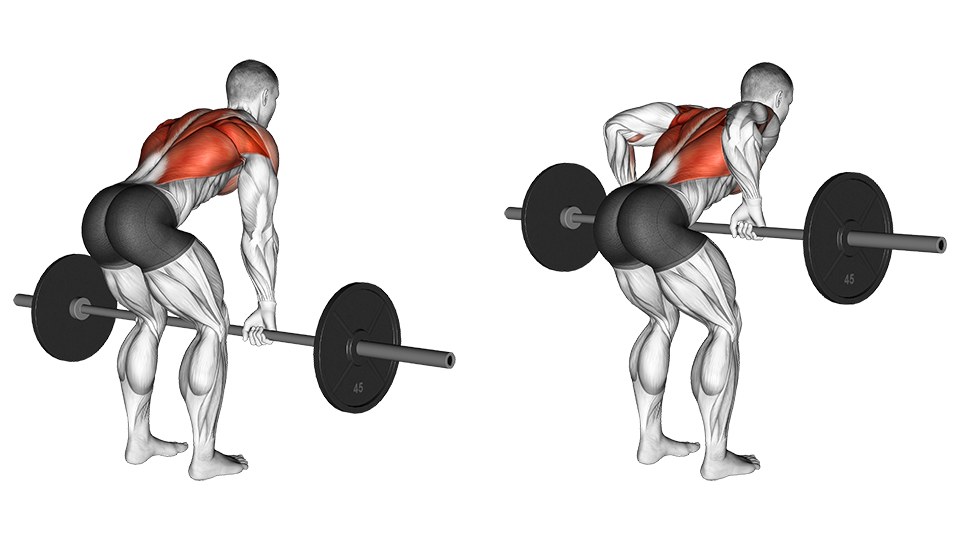
A barbell bent-over row is a horizontal pull done from a hip hinge. You hold the bar at arm's length with the hips pushed back and the torso folded forward, then pull it into your midsection by driving the elbows back and letting the shoulder blades travel toward the spine. It trains latissimus dorsi and teres major, which extend and adduct the arm, and the posterior deltoid, which extends it, along with the middle trapezius and the rhomboids, which draw the shoulder blade toward the spine, and the lower trapezius, which pulls it down. The elbow flexors bend the arm under load, and the whole hinged position is held by the spinal extensors, glutes and hamstrings working isometrically, which makes the row as much a position to hold as a weight to move. Grip and where the bar touches are choices rather than rules. Torso angle is not: close to horizontal is the strict version, and a more upright torso is a concession to hamstrings that will not let you fold further.
How do you perform a barbell bent-over row?
Set up
- Stand with your mid-foot under the bar and your feet about hip-width apart. Grip the bar overhand, just outside your legs.
- Lift the bar to standing, soften your knees, then push your hips back until your torso is close to horizontal and the bar hangs below your knees.
- Keep your back neutral and your neck in line with your spine. Brace your midsection and hold this torso angle.
Execution
- Pull the bar toward your navel by driving your elbows back and letting your shoulder blades draw together.
- Keep the bar close and your torso still. Stop when the bar touches, or nearly touches, your midsection.
- Lower the bar with control until your arms are straight, letting your shoulder blades move forward.
- Rebrace if needed, then repeat without standing up between reps.
Common mistakes
Standing up into the rep
The hips extend to help the bar up, so the last few inches come from hip drive rather than from the shoulder and the upper back. It also means the angle the load is held at changes mid-rep, which is how a heavy row turns into a scrappy partial deadlift you did not intend to do.
Rowing with the hands and stopping when the elbows reach the ribs
Elbow flexion alone can move the bar most of the way. If the elbows stop level with the torso, the shoulder blades never retract and the middle trapezius and rhomboids barely work.
Pinning the shoulder blades back and holding them there for the whole set
Retracting the shoulder blade is the job the middle trapezius and the rhomboids do. Setting them back and then holding still means they contract once and then hold, which is not the same as working through the range they act in. Set the upper back so it does not round, then let the blades travel.
Rounding the lower back to reach a bar that has drifted forward
The spinal extensors are what control the trunk folding forward, and here they do it against a load carried out in front of the hips. Every centimetre the bar drifts away from your body lengthens that lever, at exactly the point in the set where the position is hardest to hold.
Choosing the weight by what the back can pull
On a bent-over row the hinge can give out before the pull does, and it fails quietly, because the reps still complete once the torso starts rising. Nothing stops you, so the set turns into a different exercise without announcing it. Load the row for the position you can hold.
Mixing dead-stop reps and hanging reps inside one set
A rep started from the floor can be helped off the ground with hip and leg drive; a rep started in the air cannot. Doing some of each in one set means the reps are not comparable to each other, let alone to last week's set. Pick one and log that.
Where it fits in a session
Early in a back or pull session, while you are fresh enough to hold the hinge. Late in a session the hinge is the harder half to keep.
Lifters who log it average three to four sets. Because a set can be ended by the position rather than by the pull, it rewards stopping when the torso angle starts to rise and punishes grinding out a last rep. If the lower back is what gives up first for you, a chest-supported variant keeps the pulling and takes the hold away.
Muscles worked
Primary
Secondary
Schematic surface view. Some muscles are partly visible or not shown.
Two jobs, not one ranking. The primary list is the muscles that produce the movement, and it splits by joint rather than by importance. At the shoulder, latissimus dorsi and teres major extend and adduct the arm and the posterior deltoid extends it. At the shoulder blade, the middle fibres of the trapezius and the rhomboids draw it back toward the spine and the lower fibres of the trapezius pull it down. Anatomy does not support ranking those muscles against each other on this movement, and no attempt is made to. The secondary list is work of a different kind. The elbow flexors shorten under load on every rep, but the elbow is not what the exercise is for, and the forearm flexors do nothing but hold on to the bar. Infraspinatus and teres minor rotate the arm outward and, with the rest of the rotator cuff, keep the head of the humerus seated in its socket while it travels; they are secondary because the row is not what you would do to train them. The spinal extensors, glutes and hamstrings move nothing at all — they hold the hinged position isometrically from the first rep to the last, which is why holding the hinge is part of the work rather than a preliminary to it.
What lifters actually do
Fewer than half of regular RepCount users have ever logged a barbell row, and it appears in about one workout in twenty — plenty of lifters train without it. The ones who do use it average three to four sets, inside a full session of around seven exercises. The movements it most often sits beside are other pulls: about a third of the sessions containing a barbell row also contain a pulldown and close to a quarter contain a pull-up, with cable rows and curls just behind.
Most often trained alongside
Share of barbell bent-over row sessions that also include each exercise.
- Pulldowns34.4%
- Pull up23.1%
- Cable row20.6%
- Hammer curl20.6%
- Dumbbell bicep curl18.2%
Figures come from workouts tracked in RepCount.
Scientific studies on barbell rows
Holding the bent-over position is part of the row’s workload. Research on spinal loading and torso angle helps explain that demand, but it does not identify one universally best row for growth.
Bent-over rows ask the lower back to work as well as the pulling muscles. Torso angle can change muscle activity, so keep it consistent when comparing sets. These are short biomechanics studies, not tests of long-term growth or injury rates.
How much does the lower back contribute?
In a study of seven healthy men, the standing bent-over row produced greater estimated lumbar compression than an inverted row or standing one-arm cable row. The researchers used muscle recordings and a biomechanical model; they did not measure injuries. The higher load is a training demand, not proof that the exercise damages the back.
A separate study of 15 trained men found higher spinal-extensor activity during bilateral free-weight rows than machine rows. Together, these findings support treating the torso hold as part of the exercise, rather than judging the set only by whether you can pull the bar. A different row setup can change that demand, but neither study establishes which exercise will grow the most muscle.
What was actually compared?
Fenwick and colleagues matched the barbell load to the bodyweight supported through the hands during a bent-knee inverted row, then halved that load for the one-arm cable row. This matched external loading, not necessarily effort relative to each exercise’s maximum. The bar was pulled toward the chest, so the protocol was not an exact copy of this guide’s navel-directed row.
Saeterbakken and colleagues compared bilateral and unilateral free-weight, seated-cable and machine rows at matched effort levels. We read its complete abstract; detailed machine setup and loading procedures were not verified. An inverted row and a machine row are separate comparisons, and neither is automatically interchangeable with every chest-supported row.
Does leaning farther forward change muscle activity?
A small study of nine male university rugby players compared two torso angles. The more forward-bent position produced higher average lat and lower-trapezius activity, without a clear difference for the middle trapezius or biceps. Individual responses varied.
The angles were 65 and 40 degrees forward from upright, equivalent to about 25 and 50 degrees above the floor. This matters: reading them as angles from the floor would reverse the result. Neither position was fully horizontal.
The finding gives a reason to treat torso angle as part of the exercise setup, but not to chase an exact “best” angle. Participants rested their foreheads on a fixed bar to limit movement and used 70% of their maximum for each angle. The study did not measure growth, and that supported setup differs from an ordinary unsupported row.
Sources
Variations
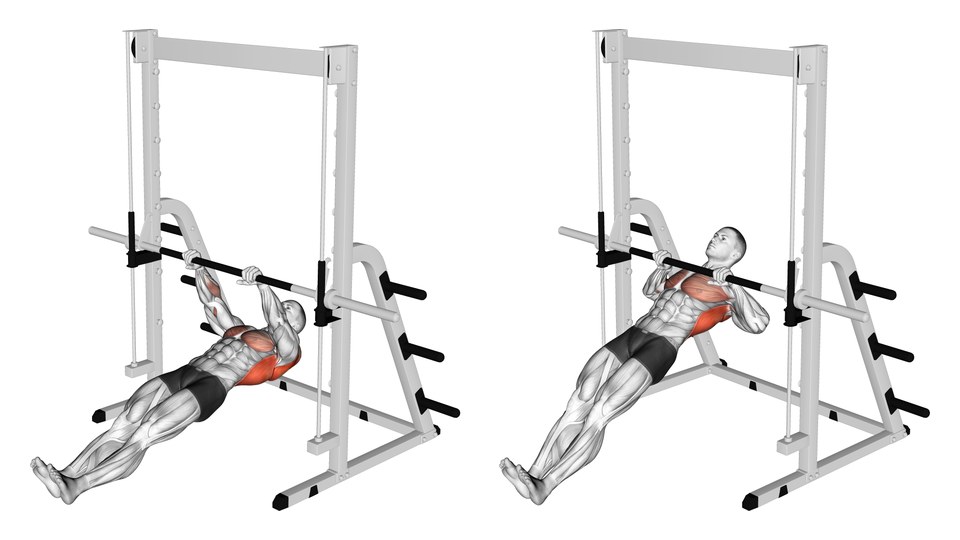
- Inverted rowMoves the body toward a fixed low bar with the feet grounded, removing the free-weight hip-hinge setup.
- Underhand grip barbell row — Supinated grip. A common variation rather than a different exercise.
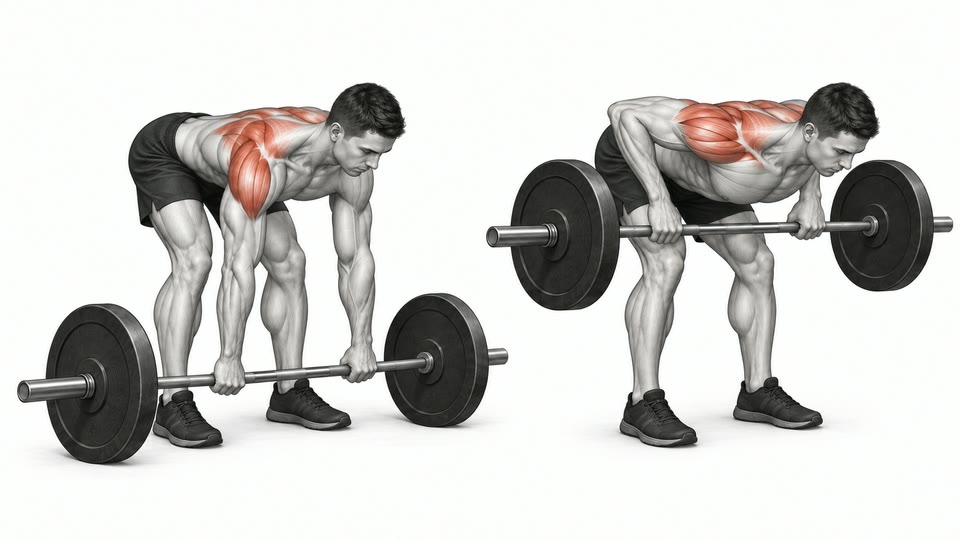
- Yates row — Underhand grip with a more upright torso than a conventional bent-over row.
- Seal row — Chest supported face-down on a raised bench, which removes the hinge entirely.
- Smith machine bent-over row — Fixed bar path, so the bar cannot drift forward away from the body.
Articles
Related tools
Frequently asked questions
What muscles does a barbell row work?
The pull comes from the shoulder and from the shoulder blade. At the shoulder, latissimus dorsi and teres major extend and adduct the arm and the posterior deltoid extends it. At the shoulder blade, the middle fibres of the trapezius and the rhomboids draw it back toward the spine and the lower fibres of the trapezius pull it down. The elbow bends under load on every rep, so biceps brachii, brachialis and brachioradialis work as well. Infraspinatus and teres minor rotate the arm outward and, with the rest of the rotator cuff, keep the head of the humerus seated while it travels — not what you would row to train, which is why they sit on the secondary list. And because you hold a hinged position throughout, the spinal extensors, glutes and hamstrings are working from the first rep to the last without moving the weight at all.
Should I use an overhand or an underhand grip?
Either. Overhand is the default and underhand is a common variation, and neither is the correct one. What an underhand grip changes is the position of your forearm, and the elbow flexors work in both: the brachialis flexes the elbow at all physiologic positions, and the brachioradialis flexes the forearm. What else a grip change does is not something this page has evidence for, so use the grip you can hold and load.
How far should I bend over?
Close to horizontal. That is the strict version of the row. Coming up toward 45 degrees is a concession to hamstrings that will not let you fold further, and it is a fair one to make — but it is the easier row, not a different style of the same one. The illustration on this page shows the more upright of the two. Whatever angle you settle on, hold it for the whole set. If your chest rises through the set, the weight picked the angle for you.
Where should the bar touch?
Somewhere between the navel and the lower ribs, and which of those you use is a choice rather than a rule — navel with the elbows close to the body, or lower ribs with the elbows out wider. Consistency matters more than the choice. Touching a different spot each rep means you are not repeating the same exercise, which makes the set impossible to compare with the last one.
Is the barbell row bad for your lower back?
The lower back works to hold the bent-over position. A small study estimated higher lumbar compression in bent-over rows than in inverted rows or standing one-arm cable rows, but did not measure injuries. That result does not make the barbell row universally unsafe or establish that every lifter should use the same variation. If holding the hinge ends your set before the pull does, a chest-supported variation reduces the need to hold an unsupported torso.
Do I have to set the bar down between reps?
No. Starting every rep from a dead stop on the floor is a specific variation, usually done with a near-horizontal torso, and a set where the bar stays in the air is a different thing. Both are fine. What mixing them inside one set costs you is comparability: a rep off the floor can be helped up with hip and leg drive and a rep from the hang cannot, so the reps stop being the same rep. If you do row from the floor, take the slack out of the bar before each pull — a loaded bar has a few millimetres of give, and pulling before it is gone is what makes the first rep snatch.
Should my shoulder blades stay pulled back the whole set?
No. Retracting the shoulder blade is exactly what the middle trapezius and the rhomboids do, so pinning the blades back before the first rep and holding them there means those muscles hold one position instead of working through the movement they produce. Set the upper back so it does not round, then let the blades travel back as the bar comes in and forward as it goes out.
Do many lifters actually do barbell rows?
Fewer than half of regular RepCount users have ever logged one, and it turns up in about one workout in twenty, so plenty of people train without it. The lifters who do use it average three to four sets, in a full session of about seven exercises. The movements it most often sits beside are other pulls: about a third of the sessions containing a barbell row also contain a pulldown, and close to a quarter contain a pull-up.
How heavy should a barbell row be?
We do not publish a number for this one, and the reason is our own data rather than a judgment about anyone else's: bodyweight is recorded on only a small share of the workouts we hold, so a weight-for-bodyweight table built from them would rest on a thin slice. The useful test is the position rather than the number. If you can complete your target reps with the same torso angle on the last rep as on the first, and the bar touching the same spot each time, the weight is right — and if that weight has moved over the past few months, the programming is working.
Sources
- Anatomy, Back, Latissimus Dorsi. StatPearls. https://www.ncbi.nlm.nih.gov/books/NBK448120/
- Anatomy, Shoulder and Upper Limb, Teres Major Muscle. StatPearls. https://www.ncbi.nlm.nih.gov/books/NBK580487/
- Anatomy, Back, Trapezius. StatPearls. https://www.ncbi.nlm.nih.gov/books/NBK518994/
- Anatomy, Back, Rhomboid Muscles. StatPearls. https://www.ncbi.nlm.nih.gov/books/NBK534856/
- Anatomy, Shoulder and Upper Limb, Deltoid Muscle. StatPearls. https://www.ncbi.nlm.nih.gov/books/NBK537056/
- Anatomy, Back, Muscles. StatPearls. https://www.ncbi.nlm.nih.gov/books/NBK537074/
- Anatomy, Shoulder and Upper Limb, Biceps Muscle. StatPearls. https://www.ncbi.nlm.nih.gov/books/NBK519538/
- Plantz MA, Bordoni B. Anatomy, Shoulder and Upper Limb, Brachialis Muscle. StatPearls. https://www.ncbi.nlm.nih.gov/books/NBK551630/
- Anatomy, Shoulder and Upper Limb, Forearm Brachioradialis Muscle. StatPearls. https://www.ncbi.nlm.nih.gov/books/NBK526110/
- Anatomy, Shoulder and Upper Limb, Forearm Muscles. StatPearls. https://www.ncbi.nlm.nih.gov/books/NBK536975/
- Anatomy, Bony Pelvis and Lower Limb, Gluteus Maximus Muscle. StatPearls. https://www.ncbi.nlm.nih.gov/books/NBK538193/
- Anatomy, Bony Pelvis and Lower Limb, Hamstring Muscle. StatPearls. https://www.ncbi.nlm.nih.gov/books/NBK546688/
- La Rose J, Madrazo-Ibarra A, Varacallo MA. Anatomy, Rotator Cuff. StatPearls. https://www.ncbi.nlm.nih.gov/books/NBK441844/
- Fenwick CMJ, Brown SHM, McGill SM. Comparison of different rowing exercises: trunk muscle activation and lumbar spine motion, load, and stiffness. 2009. https://pubmed.ncbi.nlm.nih.gov/19197209/
- Saeterbakken A et al. The Effect of Performing Bi- and Unilateral Row Exercises on Core Muscle Activation. 2015. https://pubmed.ncbi.nlm.nih.gov/26134664/
- Kanno M et al. The effect of trunk flexion angle of the upper body on primary muscle activity during bent-over row exercises. 2025. https://www.jstage.jst.go.jp/article/jscicoachingtraining/8/1/8_23/_article/-char/en