
Spanish squat
What is a Spanish squat?
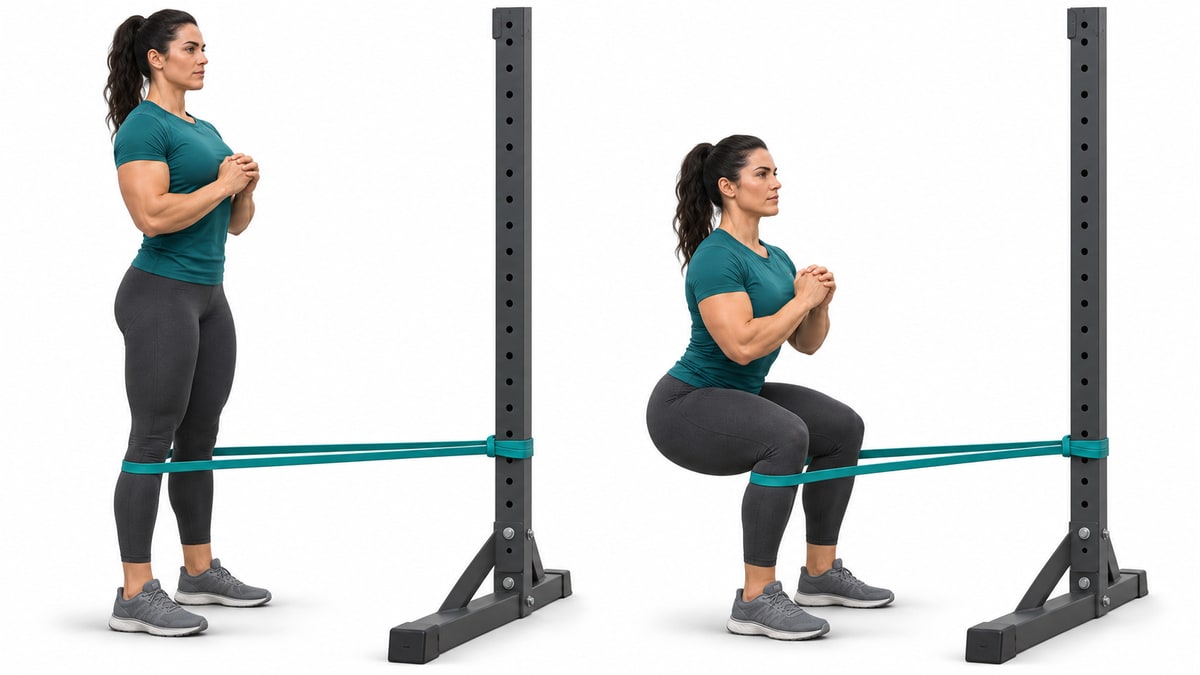
A Spanish squat is a squat with a strong band behind both knees, anchored to a rack in front of you. You sit back against the band with your feet flat and your torso upright, then stand again. It trains the quadriceps at the front of your thighs. The instructions below use repetitions; a sustained squat hold is another way to use the same setup.
How to do a Spanish squat
Set up
- Secure a long, heavy loop band to an immovable rack upright at knee height. Check the band for damage and make sure its attachment cannot slip.
- Face the rack and step into the free loop with both legs. Set the band behind your knees, against your upper calves, with your feet about shoulder width apart.
- Step back until the band is taut and supports a small backward lean. Keep your heels and forefeet planted, and test the support with a shallow squat.
Execution
- Bend your knees and sit your hips back into the band's support. Keep your chest up and your shins nearly upright as you lower.
- Stop at a depth you can hold steadily with both feet flat and the band in place. Reverse smoothly without dropping farther or bouncing.
- Straighten your legs to stand while keeping tension on the band, then repeat. After the set, stand securely and step toward the rack to release tension before stepping out.
Common mistakes
Trusting the anchor without testing it
Your setup must stay still when you lean back. If the rack moves, the attachment slips or the band is damaged, stop and fix the setup before doing a set.
Losing band tension between reps
Keep the band taut as you stand. If you have to step or lurch to catch your balance, reset your distance from the rack and rehearse a shallow rep.
Sitting lower after your feet start to lift
A deeper position is not the target if your heels or forefeet leave the floor. Shorten the descent and keep a bottom position you can reverse under control.
Where it fits in a session
Use it as additional quadriceps work in a leg session.
Start with bodyweight and a range you can repeat steadily. Keep your band, anchor height, distance from the rack and depth consistent when comparing sessions. If you use holds, track their duration separately from repetitions.
Muscles worked
Primary
Secondary
- None listed in this guide
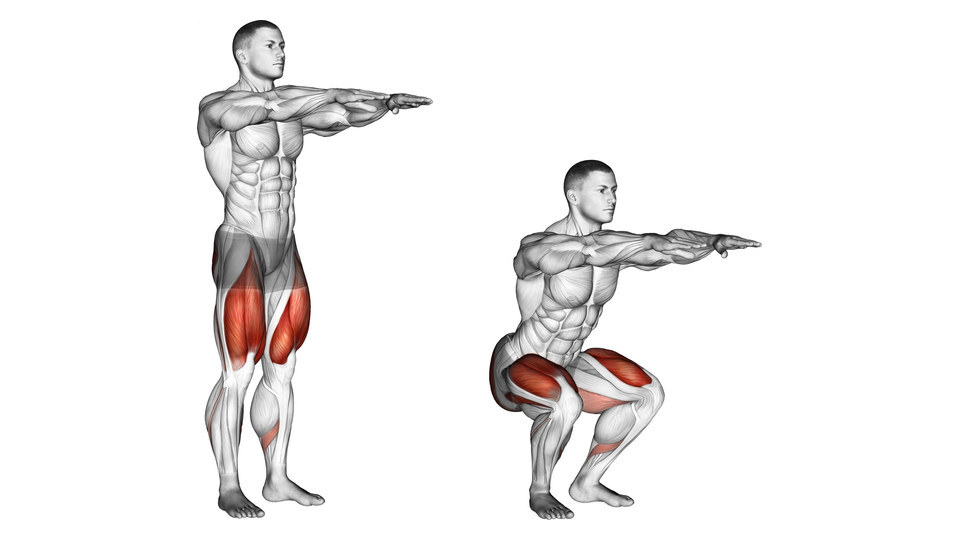
Schematic surface view. Some muscles are partly visible or not shown.
The quadriceps are the muscles at the front of your thighs that straighten your knees. They are the focus of this supported squat; the list does not mean the rest of your body is inactive.
Variations
- Paused Spanish squat — Pause briefly at your chosen bottom position before standing, keeping the same band support and foot contact.
- Bodyweight squatSquat without the band behind your knees. Balance over your feet rather than keeping the supported backward lean.
Related tools
Frequently asked questions
Where does the band go for a Spanish squat?
The band runs from a secure anchor in front of you to the backs of both knees, against the upper calves. Face the anchor and step backward to create tension. A small loop around the thighs or a band under the feet is a different setup.
What band should you use?
Use a long, heavy loop band that can support your backward lean without damage, slipping or being stretched beyond its stated limit. Check the manufacturer's instructions and test it with a shallow rep. Band colours and resistance labels vary, so choose by the support you can control.
How far back should you stand?
Step back enough that the band is taut while you stand and remains supportive as you sit back. Start with a shallow squat and adjust your position before the set if it goes slack or you cannot keep both feet flat.
Should you do repetitions or hold the squat?
This guide teaches controlled repetitions. For a sustained hold, settle at a manageable depth with the same upright torso and band support, then stand before stepping toward the anchor. Repetitions and holds are different ways to use the setup; record which one you perform.
How deep should a Spanish squat be?
Work toward thighs roughly level with the floor if you can keep the band secure, your torso upright and both feet flat. A higher bottom position is fine while learning the setup. Choose a depth you can control instead of forcing a particular angle.
What muscles do Spanish squats work?
The quadriceps at the front of the thighs are the focus. These muscles straighten the knees as you stand. This is not a claim that one part of the quadriceps is isolated or that the band makes other muscles inactive.
Sources
- Bordoni B, Varacallo MA. Anatomy, Bony Pelvis and Lower Limb: Thigh Quadriceps Muscle. StatPearls; updated May 8, 2023. https://www.ncbi.nlm.nih.gov/sites/books/NBK513334/
- Lee JH, Kim S, Heo J, Park DH, Chang E. Differences in the muscle activities of the quadriceps femoris and hamstrings while performing various squat exercises. BMC Sports Science, Medicine and Rehabilitation. 2022;14:12. https://doi.org/10.1186/s13102-022-00404-6