
Spider curl
Also called spider curls, prone incline curl, dumbbell spider curl.
What is a spider curl?
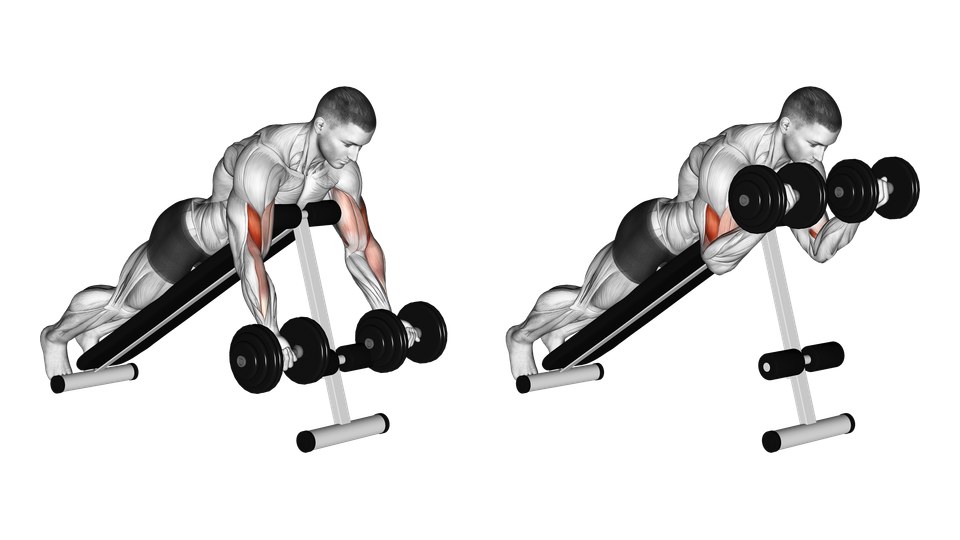
The spider curl is a dumbbell curl performed chest-down on an incline bench with the arms hanging toward the floor. It mainly trains the biceps brachii, while the brachialis, brachioradialis and forearm flexors assist.
How do you perform a spider curl?
Set up
- Set a bench to a moderate incline and lie chest-down with a dumbbell in each hand.
- Let both arms hang straight beneath your shoulders with the palms facing forward.
Execution
- Curl the dumbbells toward your shoulders without lifting your upper arms forward.
- Pause before the forearms press into the upper arms or the shoulders roll forward.
- Lower under control until the elbows are nearly straight again.
Common mistakes
Lifting the elbows toward the head
Moving the upper arms shortens the curl and lets the shoulders help finish the rep.
Peeling the chest off the bench
Losing chest support turns the movement into a swinging incline curl.
Dropping the dumbbells into the bottom
A controlled return keeps each repetition consistent and avoids a sudden pull at the elbows.
Where it fits in a session
Usually placed after compound pulling or with other arm isolation work.
Choose a load that lets both upper arms remain vertical and the final lowering phase stay smooth.
Muscles worked
Primary
Secondary
Schematic surface view. Some muscles are partly visible or not shown.
Supporting the chest keeps the upper arms in front of the torso, while the biceps and other elbow flexors move the dumbbells.
Variations
- Incline dumbbell curl — Faces upward on the bench so the arms begin behind the torso.
Frequently asked questions
What muscles do spider curls work?
They mainly train the biceps brachii. The brachialis, brachioradialis and forearm flexors also help bend the elbow and hold the dumbbells.
What bench angle should you use for spider curls?
Use a moderate incline that supports your chest while allowing both arms to hang freely without the dumbbells hitting the floor.
Should your elbows move during spider curls?
The elbows bend, but the upper arms should remain nearly vertical rather than swinging toward the head.
Are spider curls the same as incline curls?
No. Spider curls face down with the arms in front of the torso; incline curls face up with the arms hanging slightly behind it.
Sources
- Anatomy, Shoulder and Upper Limb, Biceps Muscle. StatPearls. https://www.ncbi.nlm.nih.gov/books/NBK519538/
- Plantz MA, Bordoni B. Anatomy, Shoulder and Upper Limb, Brachialis Muscle. StatPearls. https://www.ncbi.nlm.nih.gov/books/NBK551630/