Stiff-leg deadlift
Also called stiff-legged deadlift, barbell stiff-leg deadlift, straight-leg deadlift.
What is a stiff-leg deadlift?
A stiff-leg deadlift is a barbell hip hinge performed with much less knee bend than a conventional deadlift. This guide uses the floor-start version: lift from a settled bar, stand up through the hips, then return the plates to the floor and reset. Keep a small bend in the knees rather than locking them. The hamstrings and glutes do the hip work while the back stays braced.
How do you perform a stiff-leg deadlift?
Set up
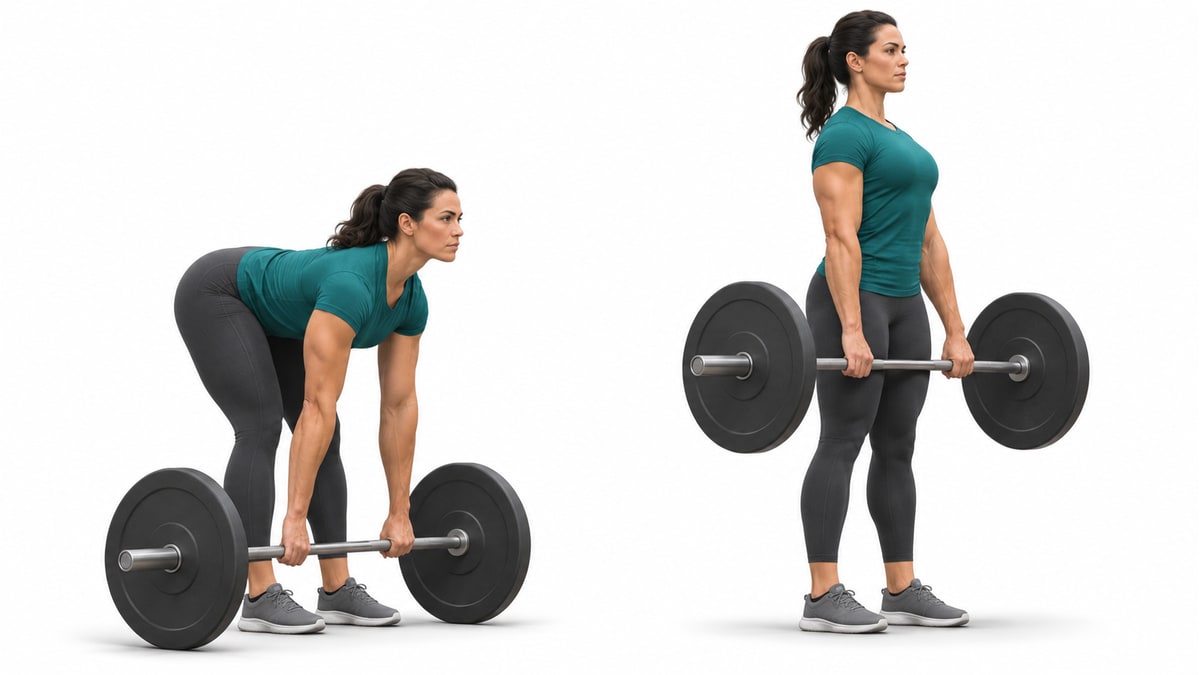
- Place an evenly loaded, light barbell on level ground. Stand about hip-width apart with the bar over the middle of your feet.
- Send your hips back, soften your knees and take an overhand grip just outside your legs. Keep your feet flat and your arms long.
- Brace your trunk and hold your back in its natural shape. If you cannot reach the bar without rounding, stop and raise both ends on stable blocks before lifting.
Execution
- Press through your feet and bring your hips forward to lift. Keep the bar near your legs, arms straight, and shoulders and hips rising together with only a small knee bend.
- Finish standing upright with the bar against your thighs. Stop there rather than leaning backward.
- Move your hips back to lower the bar, keeping the same soft knee position and steady back. Guide the plates down to their starting surface under control.
- Let the plates settle completely, then rebuild your brace before the next rep. After the final rep, leave the bar supported before releasing your grip.
Common mistakes
Making floor contact the goal at any cost
A low starting bar can ask for more range than you can control with a steady back. Raise the bar on stable blocks instead of rounding farther or forcing the knees backward to reach it.
Dropping into a squat before every pull
A large knee bend changes the setup into a different kind of deadlift. Reduce the load or raise the starting height if the small-knee-bend position is not manageable.
Rebounding straight into the next repetition
A bounce skips the settled start this version is meant to practice. Let the load stop, keep your hands on the bar and prepare each pull.
Where it fits in a session
Use it as a separate hinge exercise in the session you have planned.
Begin with a load that lets you repeat the same starting height, back position and floor reset. Do not carry over a conventional-deadlift weight automatically. Record the block height if you use one so later sessions compare the same movement.
Muscles worked
Primary
Secondary
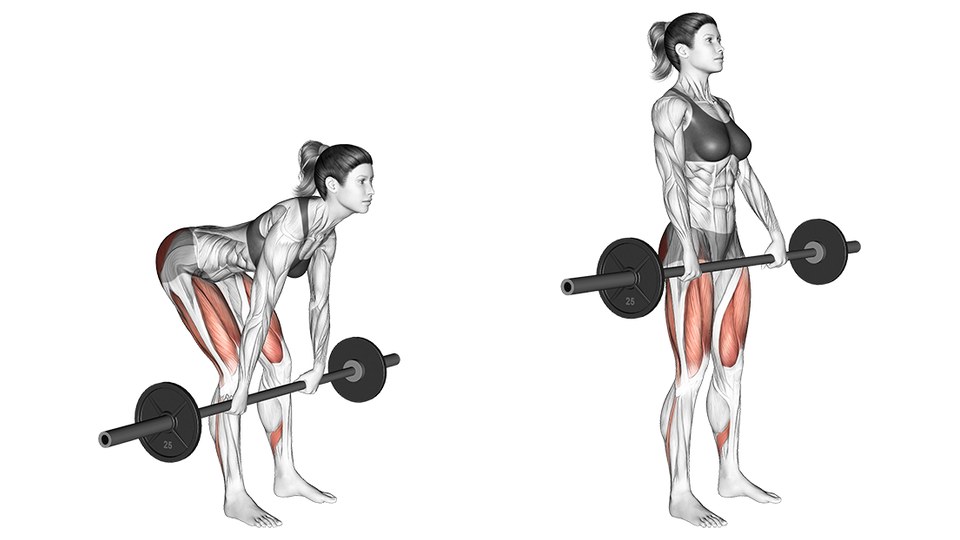
Schematic surface view. Some muscles are partly visible or not shown.
The hamstrings that cross the hip and the gluteus maximus help straighten the hip. The spinal erectors work to hold the trunk steady, and the adductor magnus also contributes to hip extension. This list does not rank muscle growth or show activation percentages.
Variations
- Romanian deadliftStarts upright and reverses the lowering phase at a controlled depth, without a floor reset between reps.
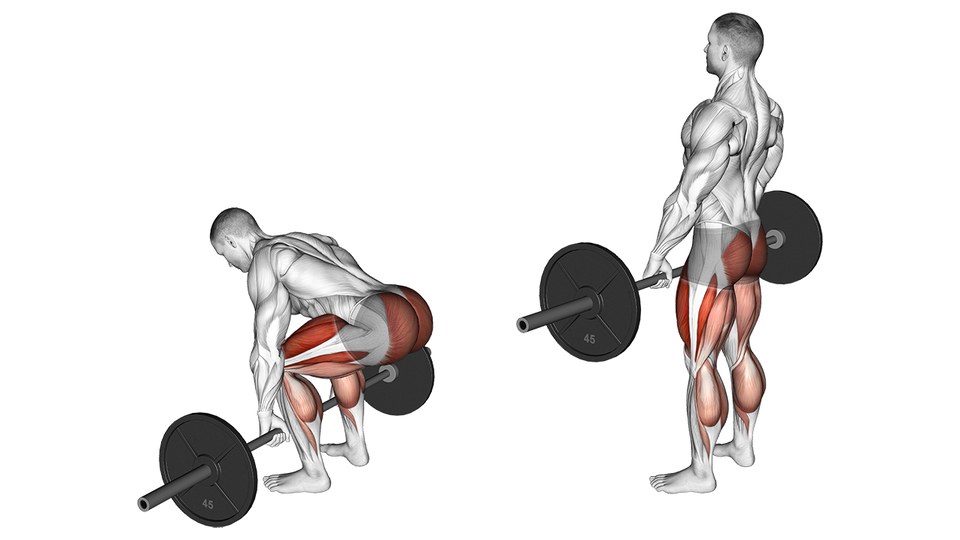
- Conventional deadliftUses more knee bend in the floor setup, with the hips lower than in the version shown by these instructions.
Related tools
Frequently asked questions
Is a stiff-leg deadlift the same as a Romanian deadlift?
Names are used inconsistently. Here, stiff-leg deadlift means a pull from a bar that rests on the floor between repetitions. The Romanian deadlift guide starts upright and turns around before the bar reaches the floor. Keep those versions separate when comparing your training.
Should my knees be completely straight?
No. Keep a small, comfortable bend rather than pushing the knees into a locked position. The point is a hip-driven lift with little change at the knees, not a test of how straight you can make your legs.
What if I cannot reach the floor with a steady back?
Raise both ends of the bar on stable blocks to a height where you can set up without rounding. Lower back to those supports and reset there on each rep. A higher start is a useful way to practice this pattern; you do not need to stand on a platform or force a deeper reach.
Which muscles does the stiff-leg deadlift train?
The main hip extensors are the gluteus maximus and the hamstrings that cross the hip: semitendinosus, semimembranosus and the long head of biceps femoris. The spinal erectors hold the back steady, and adductor magnus assists at the hip. The short head of biceps femoris does not cross the hip, so it is not included in that hip-extensor group.
Should the bar rest on the floor after every rep?
Yes, for the version taught here. Keep hold of the bar, let its plates stop moving and set your brace again. If you are intentionally doing continuous top-down hinges, use the Romanian deadlift guide instead of adding a floor touch just to match this name.
Sources
- Hu Y, Raja A. Anatomy, Bony Pelvis and Lower Limb, Hamstring Muscle. StatPearls. Updated January 31, 2026. https://www.ncbi.nlm.nih.gov/sites/books/NBK546688/
- Betts JG, et al. Anatomy and Physiology 2e, 11.6: Appendicular Muscles of the Pelvic Girdle and Lower Limbs. OpenStax. 2022. https://openstax.org/books/anatomy-and-physiology-2e/pages/11-6-appendicular-muscles-of-the-pelvic-girdle-and-lower-limbs
- Betts JG, et al. Anatomy and Physiology 2e, 11.3: Axial Muscles of the Head, Neck, and Back. OpenStax. 2022. https://openstax.org/books/anatomy-and-physiology-2e/pages/11-3-axial-muscles-of-the-head-neck-and-back