Sumo deadlift
Also called sumo barbell deadlift, wide-stance deadlift, sumo deads.
What is a sumo deadlift?
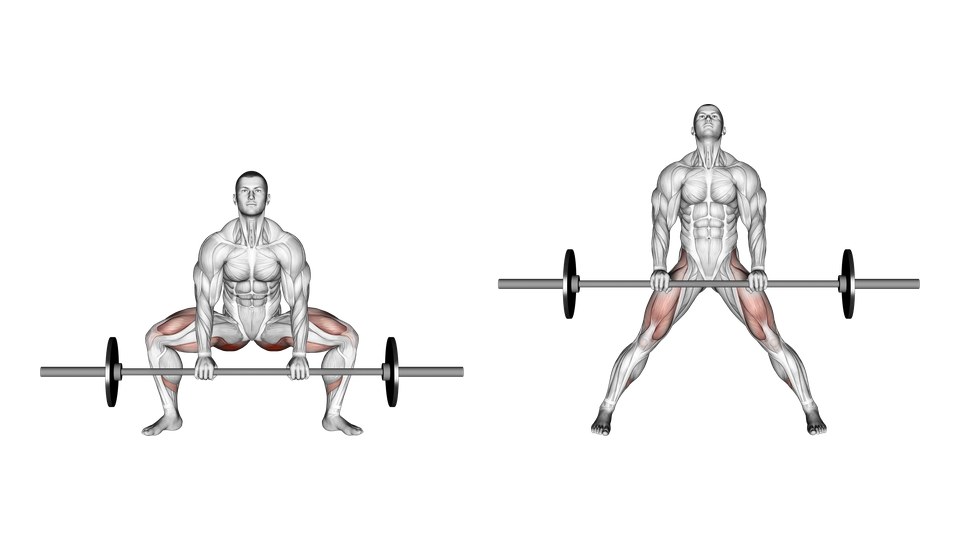
The sumo deadlift is a barbell deadlift performed with a wide, turned-out stance and the hands inside the legs. The hips and knees extend together to lift the bar from the floor, training the glutes, hamstrings, quadriceps and adductors while the trunk and grip hold the load.
How do you perform a sumo deadlift?
Set up
- Stand with the bar over midfoot, take a wide stance you can hold comfortably and turn your toes and knees in the same direction.
- Bend your hips and knees, grip the bar with straight arms inside your legs, then brace and pull the bar tight without lifting it yet.
Execution
- Push the floor away and straighten your knees and hips together, keeping the bar close and each knee following its toes.
- Stand tall without leaning back or bending your elbows.
- Lower the bar by sending the hips back and bending the knees as it passes them, then let it settle on the floor before the next rep.
Common mistakes
Forcing an excessively wide stance
Wider is not automatically better. Use the widest stance that still lets your knees track with your feet and your hands reach the bar comfortably.
Letting the knees collapse inward
The feet and knees stop pointing together and the start becomes unstable. Narrow the stance or reduce the load until alignment holds.
Jerking the bar from slack
A sudden pull changes the starting position before the plates leave the floor. Brace and make the bar taut first.
Where it fits in a session
Use it as the main floor pull in a session or as a wide-stance alternative to the conventional deadlift.
Keep the stance width and toe angle consistent when comparing technique and logged load.
Muscles worked
Primary
Secondary
Schematic surface view. Some muscles are partly visible or not shown.
The hips and knees extend together while the trunk and grip transmit force to the bar. The list does not claim one universal ranking between the hip and thigh muscles.
Variations
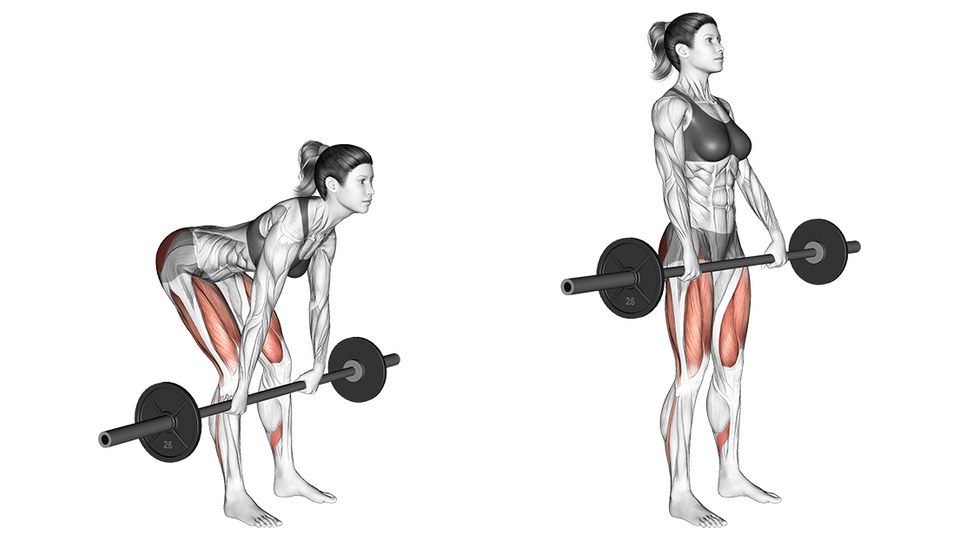
- Romanian deadliftStarts from standing and emphasizes a controlled hinge rather than each repetition beginning on the floor.
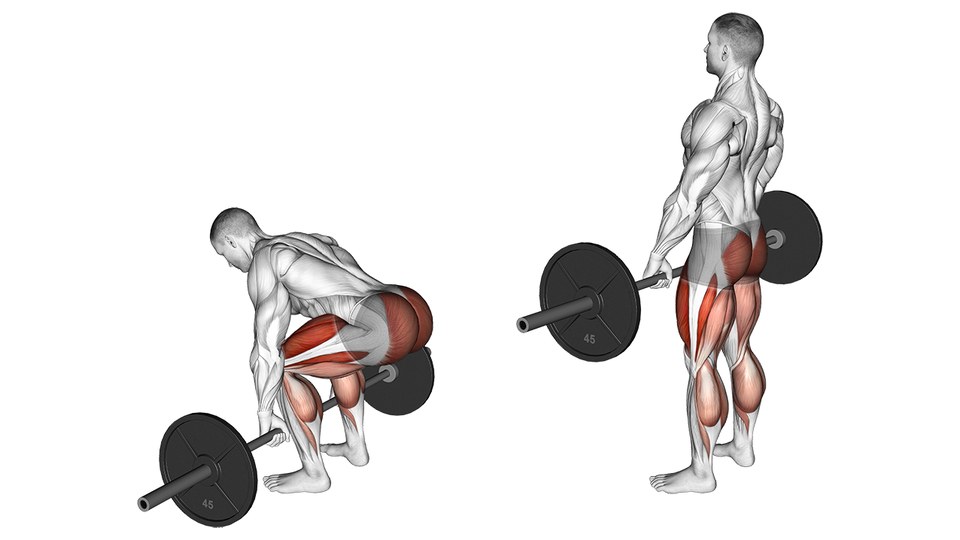
- Sumo deadlift high pull — Adds an upright pull after hip extension and is a different exercise from the deadlift taught here, where the arms stay straight.
Related tools
Frequently asked questions
What muscles does the sumo deadlift work?
It trains the glutes, hamstrings, quadriceps and adductors while the spinal erectors and grip muscles hold the trunk and bar.
How wide should your sumo stance be?
Use a wide stance that lets your knees follow your toes and your hands reach the bar inside the legs without forcing the hips. The best width varies with the lifter.
Should the knees point out?
They should track in the same direction as the toes through the pull rather than collapsing inward.
What is the difference between sumo and conventional deadlifts?
Sumo uses a wider, turned-out stance with the hands inside the legs. Conventional deadlifts use a narrower stance with the hands outside.
Sources
- Henson B, Kadiyala B, Edens MA. Anatomy, Back, Muscles. StatPearls. https://www.ncbi.nlm.nih.gov/books/NBK537074/
- Elzanie A, Borger J. Anatomy, Bony Pelvis and Lower Limb, Gluteus Maximus Muscle. StatPearls. https://www.ncbi.nlm.nih.gov/books/NBK538193/
- Hu Y, Raja A. Anatomy, Bony Pelvis and Lower Limb, Hamstring Muscle. StatPearls. https://www.ncbi.nlm.nih.gov/books/NBK546688/
- Jeno SH, Launico MV, Schindler GS. Anatomy, Bony Pelvis and Lower Limb: Thigh Adductor Magnus Muscle. StatPearls. https://www.ncbi.nlm.nih.gov/books/NBK534842/
- Bordoni B, Varacallo MA. Anatomy, Bony Pelvis and Lower Limb: Thigh Quadriceps Muscle. StatPearls. https://www.ncbi.nlm.nih.gov/books/NBK513334/