Sumo squat
Also called dumbbell sumo squat, wide-stance squat, sumo dumbbell squat.
What is a sumo squat?
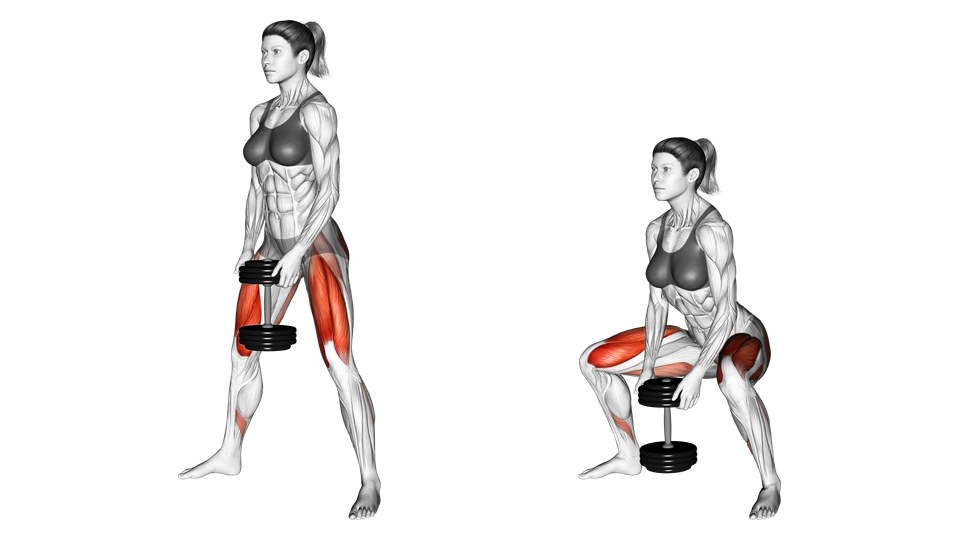
The dumbbell sumo squat is a wide-stance squat performed while holding one dumbbell between the legs. It trains the quadriceps and glutes, with the inner-thigh and hamstring muscles assisting.
How do you perform a sumo squat?
Set up
- Stand wider than shoulder width with your toes turned out to a comfortable angle.
- Hold one dumbbell vertically with both hands so it hangs between your legs, then brace your torso.
Execution
- Sit down between your hips while the knees move in the same direction as the toes.
- Lower until your available hip and ankle range ends without the heels lifting or the back rounding.
- Push the floor away and extend the knees and hips to stand tall.
Common mistakes
Forcing an extremely wide stance
A stance beyond your comfortable hip range can make the feet roll and the knees lose their line.
Letting the knees collapse inward
Keep each knee moving in the same direction as its toes throughout the descent and ascent.
Turning the rep into a hip hinge
The hips and knees should bend together rather than sending the hips far back while the knees barely move.
Where it fits in a session
Usually used as a leg-session accessory or as the main squat when only a dumbbell is available.
Choose a stance you can repeat with flat feet and knees tracking over the toes before increasing the dumbbell load.
Muscles worked
Primary
Secondary
Schematic surface view. Some muscles are partly visible or not shown.
The wide stance still uses knee and hip extension: the quadriceps and gluteus maximus lead, while the adductor magnus and hamstrings assist at the hip.
Variations
- Barbell sumo squat — Places a bar across the upper back instead of holding the load between the legs.
Frequently asked questions
What muscles do sumo squats work?
They train the quadriceps and gluteus maximus, while the adductor magnus and hamstrings assist with hip extension.
How wide should your sumo-squat stance be?
Start a little wider than shoulder width and adjust until you can squat with flat feet and knees following the toes. Wider is not automatically better.
Should the toes point straight ahead?
No. Turn them out to a comfortable angle and keep the knees moving in that same direction.
Is a sumo squat the same as a goblet squat?
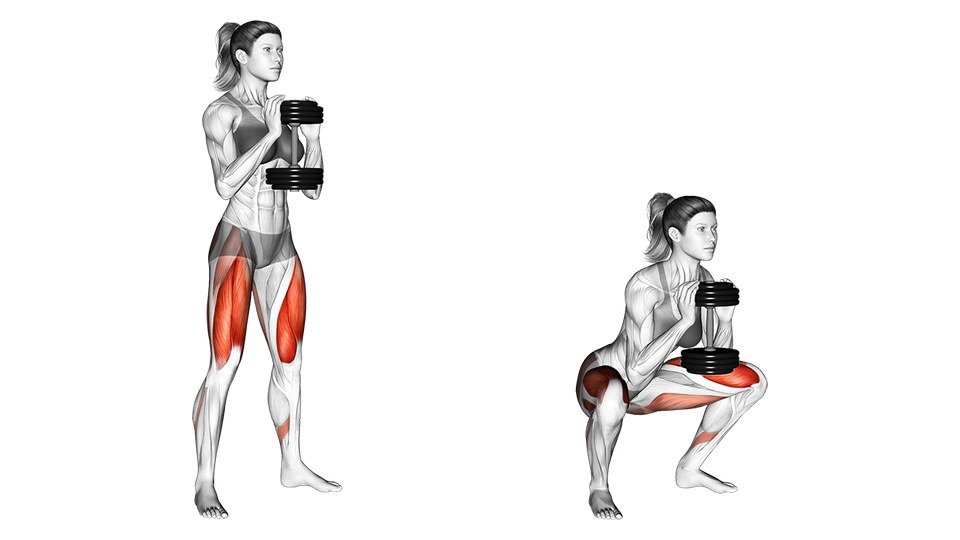
Both can use one dumbbell, but a sumo squat uses a wider turned-out stance and holds the weight between the legs; a goblet squat holds it at the chest.
Sources
- Bordoni B, Varacallo MA. Anatomy, Bony Pelvis and Lower Limb: Thigh Quadriceps Muscle. StatPearls. https://www.ncbi.nlm.nih.gov/books/NBK513334/
- Elzanie A, Borger J. Anatomy, Bony Pelvis and Lower Limb, Gluteus Maximus Muscle. StatPearls. https://www.ncbi.nlm.nih.gov/books/NBK538193/