
Superman
Also called superman exercise, prone superman.
What is the Superman exercise?
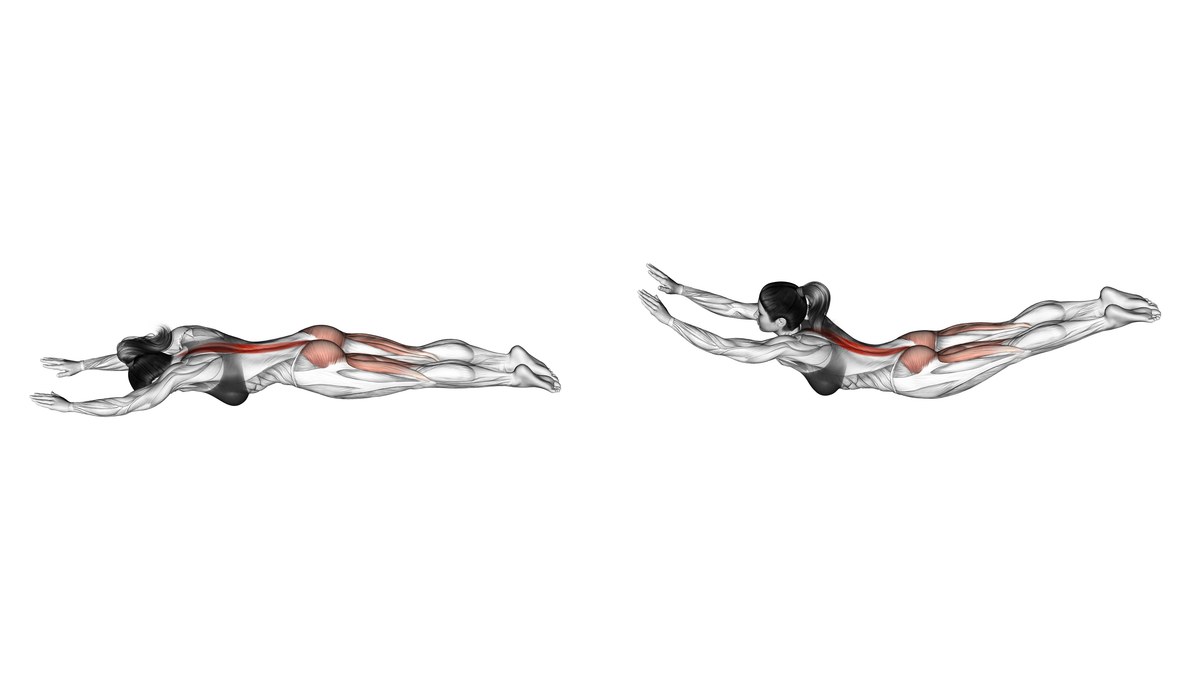
The Superman is a floor exercise performed lying face down with your arms overhead. You lift your arms, chest and legs a little from the floor, then lower them together. It involves the back extensors, glutes and hamstrings without using a back-extension bench.
How do you perform the Superman exercise?
Set up
- Lie face down on a mat with your legs extended and arms reaching ahead of your head. Leave enough room to move without touching nearby equipment.
- Look down and keep your neck following the line of your upper back. Rest your pelvis and abdomen on the floor.
Execution
- Lift both arms, your upper chest and both legs a small distance from the floor without jerking.
- Pause briefly with your gaze down and your pelvis still supported. Use a smaller lift if you cannot breathe comfortably.
- Lower your limbs and chest together, settle on the floor, then repeat.
Common mistakes
Looking up to lift the chest
Keep your gaze toward the mat so your neck follows the movement of your upper back.
Throwing the limbs upward
Start and finish each lift slowly. Reduce the height if you need a swing to leave the floor.
Where it fits in a session
Use it as floor-based back work when that movement fits your session.
Choose a small, repeatable lift rather than a maximal arch. If the movement causes back discomfort, stop and choose an alternative or get advice on an appropriate version.
Muscles worked
Primary
Secondary
Schematic surface view. Some muscles are partly visible or not shown.
The back extensors lift the trunk while the glutes and hamstrings help lift the legs.
Variations
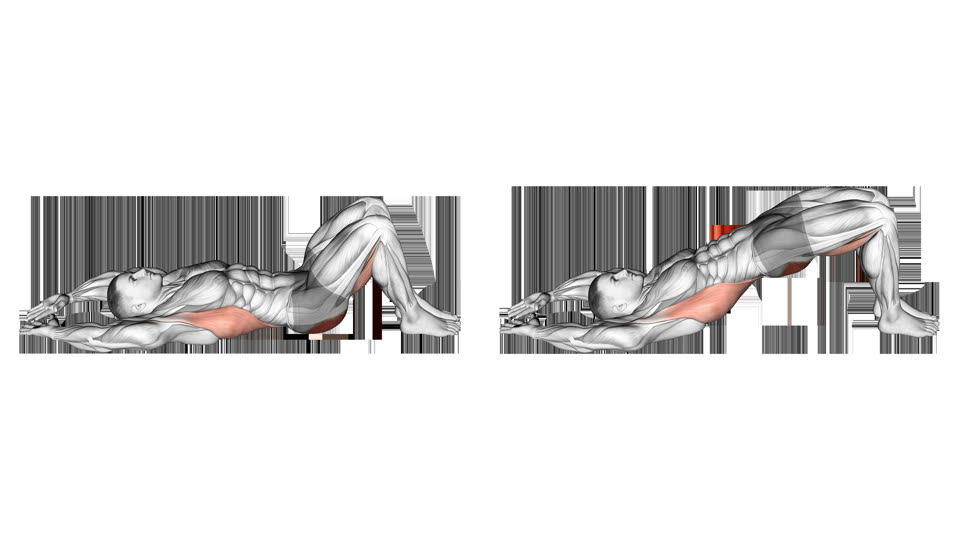
- Arms-at-sides prone extension — Keep the arms alongside the torso instead of reaching overhead.
Frequently asked questions
How high should I lift?
Lift only a little while keeping the movement smooth and your pelvis on the floor. There is no height target to reach.
Is Superman the same as a back extension?
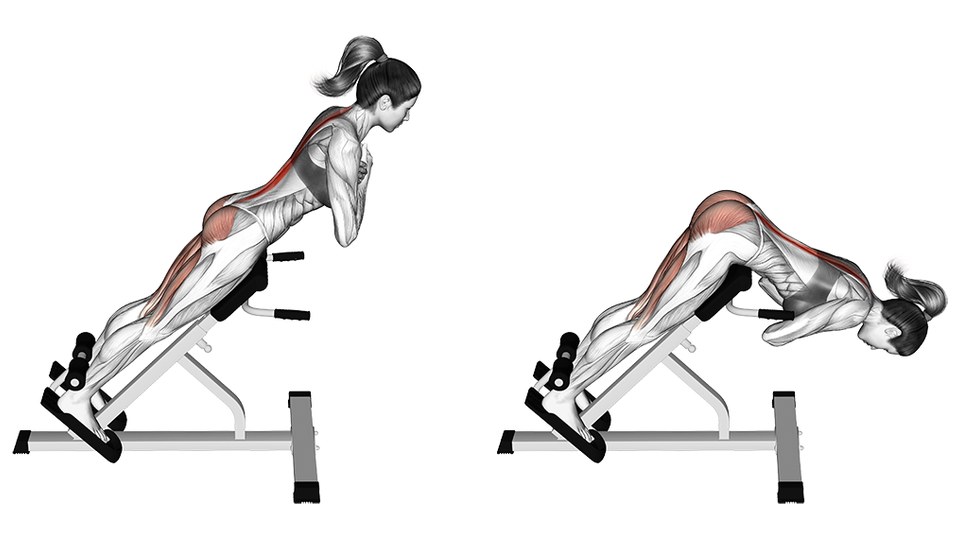
They are related exercises with different support. This guide lies on the floor and lifts both arms and legs; the back-extension guide uses a bench with the feet secured.
Does this guide treat back pain?
No. It explains an exercise, not a rehabilitation programme. If a clinician has prescribed it, use their instructions and limits for your situation.
Sources
- J. Gordon Betts and colleagues, OpenStax. Anatomy and Physiology 2e, section 11.4: Axial muscles of the abdominal wall and thorax. 2022. https://openstax.org/books/anatomy-and-physiology-2e/pages/11-4-axial-muscles-of-the-abdominal-wall-and-thorax
- OpenStax. Anatomy and Physiology 2e, section 11.6: Appendicular muscles of the pelvic girdle and lower limbs. 2022. https://openstax.org/books/anatomy-and-physiology-2e/pages/11-6-appendicular-muscles-of-the-pelvic-girdle-and-lower-limbs
- J. Gordon Betts and colleagues, OpenStax. Anatomy and Physiology 2e, section 11.3: Axial muscles of the head, neck and back. 2022. https://openstax.org/books/anatomy-and-physiology-2e/pages/11-3-axial-muscles-of-the-head-neck-and-back