Suspension row
Also called TRX row, suspension trainer row.
What is a suspension row?
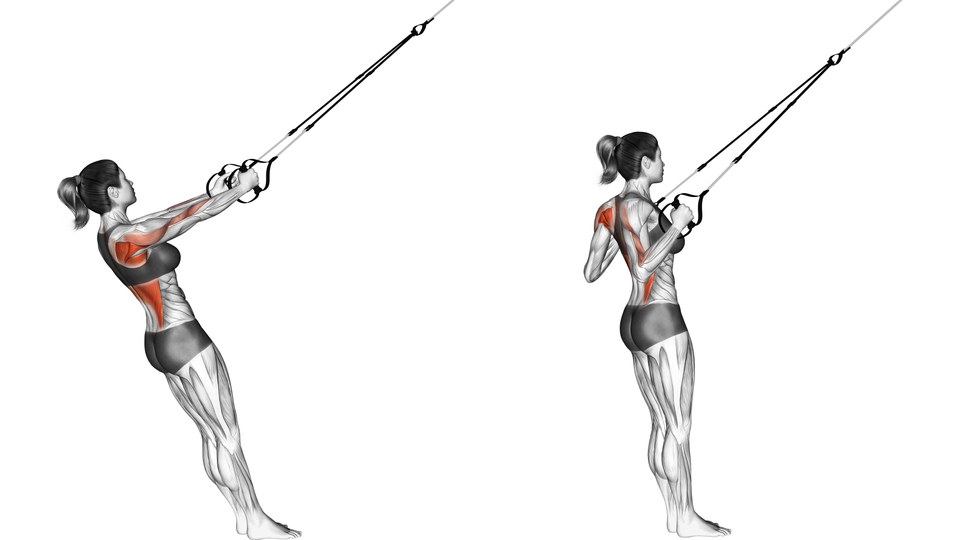
A suspension row is a bodyweight pull using the handles of a suspension trainer. Face the anchor, lean back with your feet on the floor, and pull your torso toward the handles. This guide uses a two-arm row with the elbows close to your sides.
How do you perform a suspension row?
Set up
- Install the trainer on a secure anchor using its manufacturer’s instructions, check the straps and handles, and clear the floor around you. Set both straps to equal length.
- Face the anchor and hold the handles with your palms facing each other. Plant your feet, lean back until your arms are straight, and keep your head, trunk and legs in line. Start at a fairly upright angle.
Execution
- Bend your elbows and bring them back beside your ribs, moving your chest toward the handles without thrusting your hips forward.
- Finish the pull while your torso stays straight and your shoulders remain away from your ears. Let your shoulder blades move with the row.
- Straighten your arms slowly to return to the same leaning position. After the last repetition, step back toward an upright stance before letting go.
Common mistakes
Turning the row into a hip thrust
Use a more upright starting angle and pull with a steady body line. Stop the set when you can no longer hold that position.
Moving your feet during the set
Pick your foot position before starting. If you deliberately change the angle, record that change rather than comparing it as the same setup.
Where it fits in a session
Include this movement where it fits the strength session you have planned.
Record your strap length and foot position alongside repetitions so that changes in setup do not look like changes in strength.
Muscles worked
Primary
Secondary
Schematic surface view. Some muscles are partly visible or not shown.
These are the main muscles represented in the guide, not an exhaustive list or a measured activation ranking.
Variations
Frequently asked questions
Is this the same as a ring row?
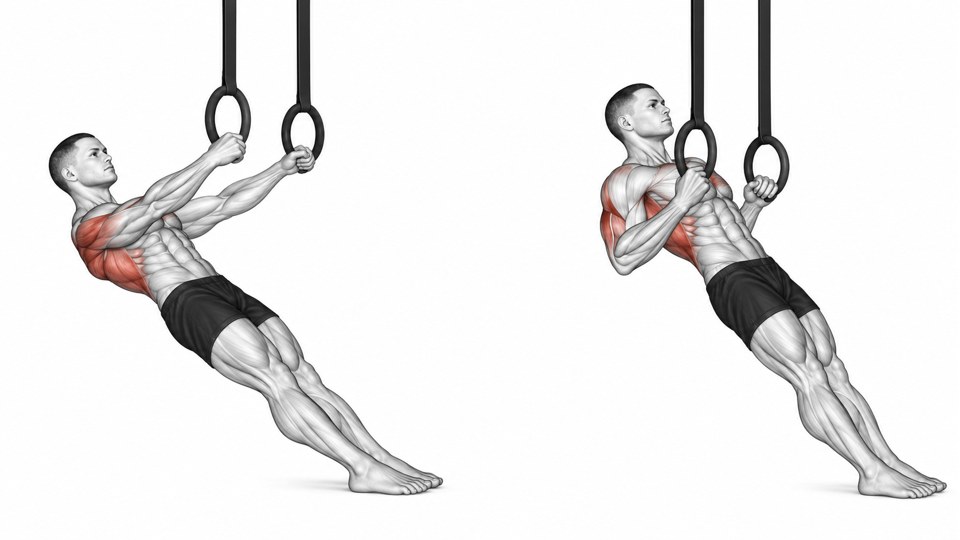
Both are bodyweight rows with movable handholds. This guide uses suspension-trainer handles; the ring-row guide uses gymnastic rings. Keep the equipment and setup consistent when comparing your sessions.
How do I adjust the difficulty?
With the strap length fixed, begin more upright for an easier row. Move your feet closer to the point beneath the anchor to lean back farther. Choose the angle before the set and keep your feet planted.
Sources
- Betts et al. Anatomy and Physiology 2e. OpenStax, 2022. https://openstax.org/books/anatomy-and-physiology-2e/pages/11-5-muscles-of-the-pectoral-girdle-and-upper-limbs